




Georgian Yew Caddy
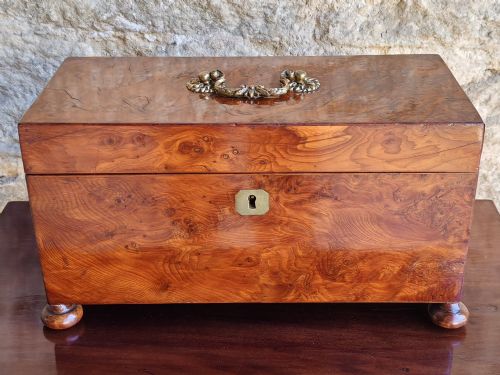
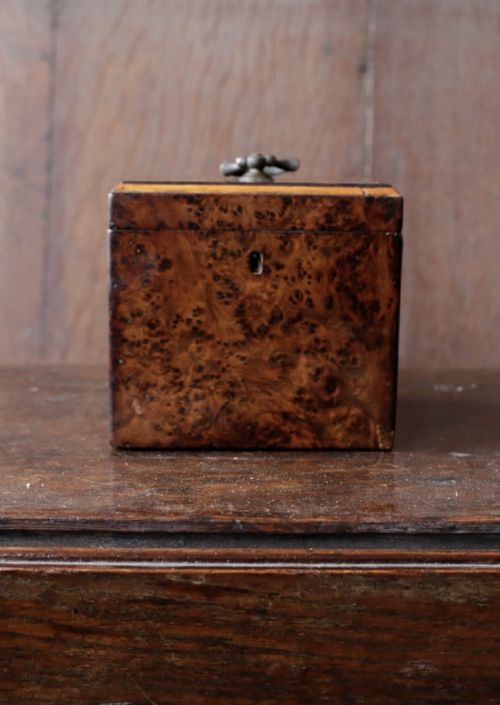
These georgian yew caddy pieces are distinctive wooden containers built to store precious leaf, prized for their rich grain and historic character.
Georgian Yew Caddy
When you search for a georgian yew caddy, you encounter domestic containers designed to keep dry tea secure under lock in earlier parlours. These items take varied geometric forms including cubes, hexagons, barrels and semi-circular boxes.
The pieces on this page span the eighteenth and nineteenth centuries, taking in the Georgian, Regency and later Victorian eras up to eighteen sixty. Alongside standard caddies, the selection includes larger freestanding teapoys and unusual decorative boxes.
How they were made
Cabinetmakers utilised solid timber and decorative burr veneers over a wood foundation, displaying the natural figuring of the yew tree. Workshops added contrasting inlay work and fitted interior compartments for separating different leaf varieties.
Constructors mounted brass hardware such as hinges, escutcheons and carrying handles to the exterior of the containers. Interiors often retained remnants of foil lining or bone details alongside working locks.
Georgian Yew Caddy Retail Price Guide 2026
Typical asking prices for georgian yew caddy among the pieces listed under this phrase on Sellingantiques today, from the lower quarter to the upper quarter. They describe what is for sale here now, not the wider market.
Many of these miniature wooden chests still retain tiny interior lids designed to keep the expensive tea leaves fresh centuries ago.
What varies in quality
Superior examples showcase exceptional burr yew figuring across every surface, paired with intricate marquetry and precise geometric proportions. Simpler pieces rely on plain straight-grained timber with minimal decorative embellishment.
The integrity of the original wood surfaces and the survival of interior fittings distinguish better specimens from heavily restored containers. Items retaining complete internal components carry greater interest for collectors.
The Georgian Yew Caddy Glossary
- Teapoy
- A pedestal table fitted with a tea container or box on top, sometimes containing multiple internal caddies for different blends. These pieces sat beside parlour seating.
- Marquetry
- The art of applying decorative pieces of wood veneer to a structure to form intricate patterns and pictures. Makers utilised this technique on geometric box lids.
- Escutcheon
- A flat plate of brass surrounding a keyhole that protects the surrounding wood from wear and damage. This hardware appears frequently on period tea chests.
Georgian Yew Caddy: Frequently Asked Questions
What is a georgian yew caddy?
A georgian yew caddy is a small wooden container made during the eighteenth or early nineteenth century to store dry tea leaves safely under lock.
Tea was an expensive commodity in historical households, requiring secure storage in specialised wooden boxes to preserve its quality and flavour.
How were these boxes used?
Households kept these containers in the parlour or dining room, where the mistress of the house unlocked them to dispense tea leaves before brewing.
Servants typically prepared the brew, but the tea leaves remained under the direct control of the homeowner to prevent theft.
How do I date a yew tea caddy?
Dating relies on observing the overall shape, construction methods, hardware styles and timber preparation visible across the piece.
Earlier examples from the eighteenth century often display simpler cubic or hexagonal proportions, while Regency items introduce barrel forms and bolder marquetry.
What is the difference between a caddy and a teapoy?
A tea caddy is a portable box designed to sit on a table or sideboard, whereas a teapoy is a freestanding piece of furniture incorporating a storage compartment on a central pillar or legs.
Teapoys emerged during the Regency period to serve the same function while standing independently in the room.