

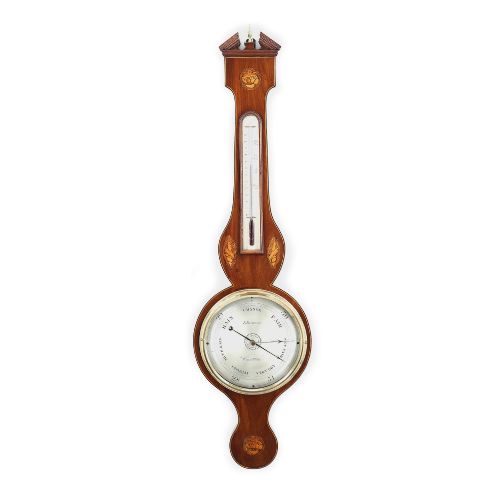





Georgian Wooden Barometer
A georgian wooden barometer brings a working instrument and a distinct focal point to any room.
Georgian Wooden Barometer
When you search for a georgian wooden barometer, you are looking at practical meteorological instruments housed in timber cases that often span several periods from Georgian times onwards. These pieces range from banjo and wheel formats to stick barometers, reflecting the domestic utility and scientific interest of their era.
On this page, the version you are most likely to meet is the mahogany wheel barometer, frequently inlaid with marquetry or boxwood stringing. These instruments combine the function of weather tracking with the decorative presence of rich timber frames and silvered metal dials.
The material palette is anchored in mahogany, paired with glass, brass, and silvered metal for the dials and indicators. Examples span stylistic iterations from the Georgian and Regency periods through to later Victorian and revival pieces.
How they were made
Makers constructed these barometer cases primarily from solid and veneered mahogany, often selecting figured grains like birdseye maple for visual depth. Marquetry inlay, boxwood stringing, and bone details embellished the wooden bodies.
Precision was required for the internal mercury tubes, which sat alongside thermometers and were protected behind glass faces. Dials were typically engraved on silvered metal plates, while bezels and indicators utilised brass components.
Georgian Wooden Barometer Retail Price Guide 2026
Typical asking prices for georgian wooden barometer among the pieces listed under this phrase on Sellingantiques today, from the lower quarter to the upper quarter. They describe what is for sale here now, not the wider market.
Materials recorded on this site include boxwood, bone, birdseye maple, and marquetry inlay alongside standard mahogany and glass.
What varies in quality
The distinction between standard and superior examples often lies in the fineness of the cabinetwork and the complexity of the wood selection. Pieces featuring intricate marquetry inlay, bird's-eye maple veneers, and delicate boxwood stringing demonstrate greater craftsmanship than plain timber versions.
Makers' signatures engraved on the silvered metal dials elevate the standing of an instrument. Signed works by documented makers from provincial towns indicate a higher tier of production compared to anonymous workshop output.
B Besozzi of Weymouth·Molton of Norwich·Jenkins Of Old Swindon·L Casatelli of Liverpool·Vecchio & Co of Shaftsbury·A Rivolta·Alexander Adie·J Groce York·F Salteri & Co Nottingham·Malacrida of Dublin
The Georgian Wooden Barometer Glossary
- Wheel barometer
- An instrument housed in a banjo-shaped wooden case where a float in the tube turns a pointer via a pulley and wheel. This format became the dominant domestic style during the late eighteenth and nineteenth centuries.
- Stick barometer
- A tall, narrow wall instrument containing a vertical mercury column that measures atmospheric pressure directly without a dial mechanism. These tend to have cleaner lines than their wheel counterparts.
- Silvered metal
- A brass or copper dial plate treated to achieve a bright, reflective silver finish. Graduations and maker details are typically engraved into this surface.
- Marquetry inlay
- Pieces of contrasting timber fitted into a veneer ground to create decorative patterns and motifs. This technique frequently adorns the damp-resistant mahogany bodies of better barometers.
- Boxwood stringing
- Thin lines of pale boxwood inlaid into darker mahogany surfaces to outline edges and panels. It provides a sharp linear contrast on instrument cases.
Georgian Wooden Barometer: Frequently Asked Questions
How do I read a wheel barometer?
The pointer moves clockwise or anticlockwise across the silvered metal dial to indicate changes in atmospheric pressure. Weather descriptors such as fair, change, and rain are typically engraved around the face to guide interpretation.
Secondary indicators like a manual set hand allow you to track whether the pressure is rising or falling since your last observation.
Where should I hang a wooden barometer?
Mount your barometer on an interior wall away from direct sunlight, radiators, and exterior doors to protect the timber case and mercury tube. Stable room temperatures ensure the wood does not warp and the mechanism functions accurately.
Ensure the hanging point is secure, as these mahogany and glass instruments carry significant weight.
How do I identify the period of a barometer?
Examine the timber, dial design, and overall silhouette for clues to the era of manufacture. Georgian and Regency pieces often feature simpler mahogany proportions or crisp boxwood stringing, while Victorian iterations can incorporate heavier carvings or distinct dial typography.
Signed dials bearing a maker and location offer the most direct route to dating an instrument.
Are mercury barometers safe to keep at home?
The mercury remains safely sealed inside a thick glass tube under normal domestic conditions. Standard handling and hanging pose no risk to the household.
Avoid tilting the instrument excessively or attempting to dismantle the glass tube yourself.