

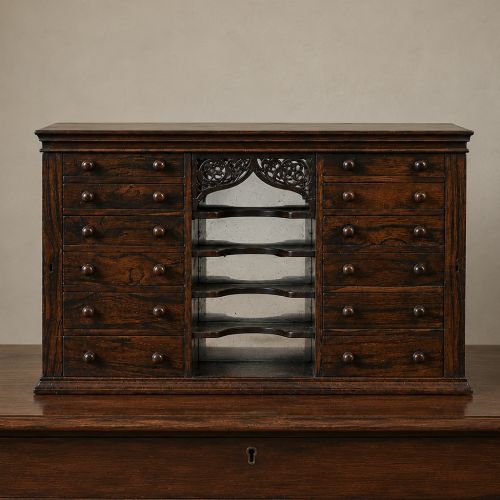
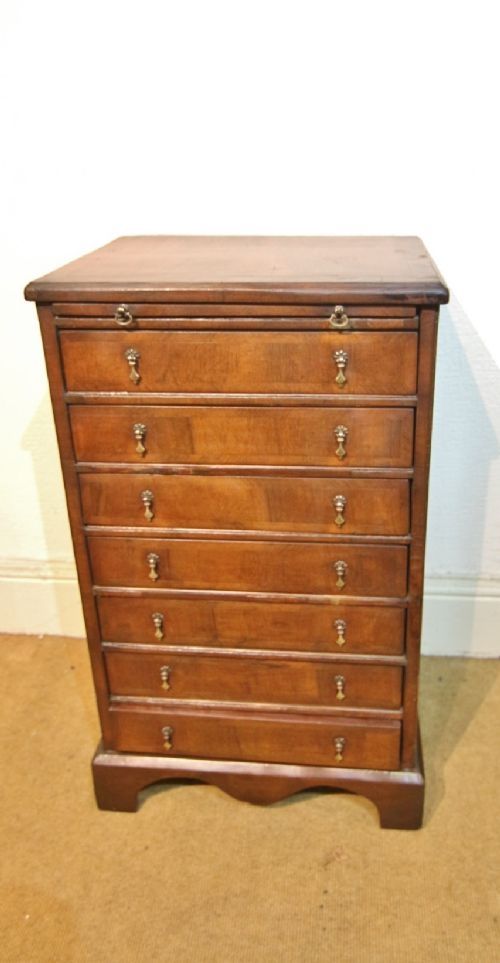


Georgian Wellington Chest
A Georgian Wellington chest is a tall, narrow set of drawers secured by a locking side pilaster, offering discreet storage for papers and small treasures.
Georgian Wellington Chest
A Georgian Wellington chest is characterised by its slender proportions, designed to fit narrow wall spaces while providing a vertical stack of drawers. The pieces seen here span the nineteenth century, including Regency examples and later revivals from the early twentieth century.
Most items on this page take the form of a chest of drawers or a specialised collectors cabinet, sometimes accompanied by mirror glass or associated library bookcase bases. These pieces originate across the nineteenth century and into the nineteen-twenties, incorporating both Georgian and Regency design idioms.
How they were made
Construction relies heavily on dense timbers such as mahogany, walnut, and rosewood, chosen for their stability and rich grain patterns. Secondary woods like pine appear within internal framing and drawer box construction.
Cabinetmakers utilised brass for locking mechanisms, hinges, and drawer hardware, while ceramic elements sometimes feature on fittings. Surface finishes include polished wood grains and, in certain country house examples, original scumble paint.
The distinguishing locking mechanism involves a hinged vertical pilaster that swings or lifts to release the drawer stack when unlocked with a key. Joinery follows traditional cabinetmaking standards appropriate for tall, narrow case furniture.
Georgian Wellington Chest Retail Price Guide 2026
Typical asking prices for georgian wellington chest among the pieces listed under this phrase on Sellingantiques today, from the lower quarter to the upper quarter. They describe what is for sale here now, not the wider market.
Listings feature items spanning the nineteenth century up to nineteen-twenty, utilising mahogany, walnut, rosewood, and pine.
What varies in quality
Quality rests significantly on the selection of timber veneers and solid stock, where highly figured rosewood or walnut elevates a piece above standard mahogany builds. The crispness of proportion in these narrow carcasses dictates the visual balance.
The integrity of the locking side pilaster and its associated hinge mechanism marks a clear division in execution. Original brass hardware and untouched surface treatments, such as country house scumble paint or polished polish, preserve the historical character better than later interventions.
The Georgian Wellington Chest Glossary
- Wellington Chest
- A tall, narrow chest of drawers featuring a locking side pilaster that secures the entire stack. This form became popular during the nineteenth century for efficient storage.
- Pilaster
- A vertical architectural member projecting from a wall or cabinet side, which in this furniture style acts as the locking bar. It swings or fastens to block the drawer edges.
- Scumble Paint
- A decorative paint technique involving translucent layers dragged or brushed over a base coat to simulate wood grain or texture. It appears on country house furniture.
- Collectors Cabinet
- A specialised piece designed to store small specimens, coins, or curiosities in shallow drawers. These often share the tall, narrow format of Wellington chests.
- Regency
- A British architectural and decorative style spanning the early nineteenth century. It emphasises classical restraint and refined proportions.
Georgian Wellington Chest: Frequently Asked Questions
What is a Wellington chest?
A Wellington chest is a tall, narrow set of drawers distinguished by a hinged locking side pilaster. This vertical locking bar secures all the drawers simultaneously with a single key.
Originally designed for efficient storage in limited spaces, these pieces date primarily from the nineteenth century. They combine practical utility with elegant, slender proportions.
How were these chests used?
These chests served primarily for storing private papers, linen, or small personal valuables in bedrooms and dressing rooms. Their narrow footprint allowed them to fit into tight wall spaces between windows or doors.
Some variants were built specifically as collectors cabinets for holding specimens, coins, or small artefacts in shallow, fitted drawers. The locking pilaster ensured the contents remained secure.
How do I place one in a room?
A Wellington chest works well in hallways, studies, or bedrooms where floor space is restricted. Because they are tall and narrow, they draw the eye upward without dominating the room's footprint.
Pair them with traditional or eclectic interiors where their dark timber tones can contrast against lighter walls. Ensure there is enough clearance beside the chest for the locking pilaster to swing open.
How do I distinguish periods?
Early nineteenth-century examples, including Regency pieces, typically display finer timber veneers, such as rosewood or figured mahogany, and restrained classical lines. Pieces from the early twentieth century often reflect revival styles with heavier framing or alternative secondary woods.
Examining the construction methods inside the drawer boxes and the age of the brass locking mechanisms helps clarify whether a piece is original nineteenth-century or a later interpretation.