




Georgian Satinwood Tea Chest
A georgian satinwood tea chest brings bright, figured timber and refined neoclassical decoration straight to a drawing room table.
Georgian Satinwood Tea Chest
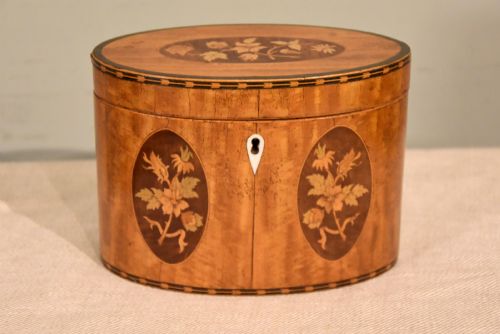
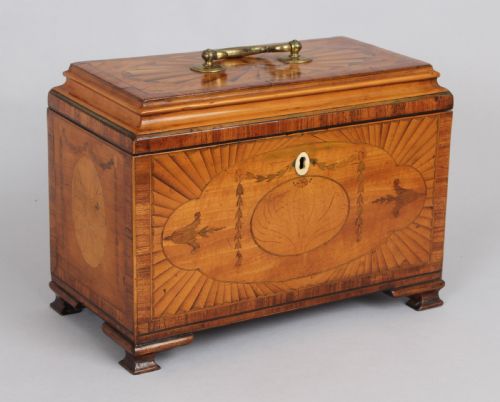
A georgian satinwood tea chest appears as an oval, octagonal, or sarcophagus-form box designed to store valuable loose tea leaves securely under lock and key. Buyers searching for a georgian satinwood tea chest encounter pieces spanning the late eighteenth century into the regency period, often housing internal compartments or glass mixing bowls.
The prevailing form on this page is the oval or octagonal tea caddy shaped from satinwood, frequently enriched with contrasting stringing, butterfly inlays, shell motifs, or marquetry. These decorative boxes reflect the refined taste of the georgian era, combining exotic timbers with meticulous cabinetmaking.
Originating predominantly from the georgian and regency periods, these boxes utilise contrasting veneers like harewood, mahogany, ebony, and rosewood to frame the lustrous golden satinwood panels. Each piece demonstrates the period's obsession with portable luxury and formal hospitality.
Judging quality and craftsmanship
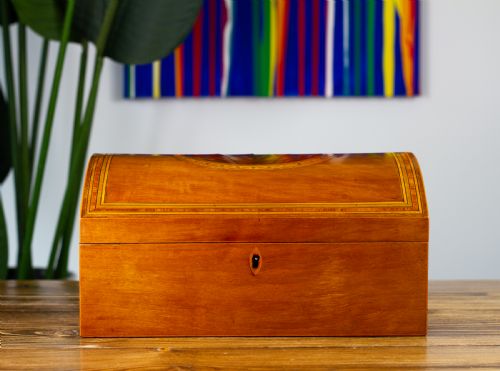
Quality rests in the vibrancy of the satinwood figure and the precision of the contrasting inlay work, where superior examples exhibit tight, symmetrical grain patterns and crisp, gap-free botanical or animal motifs. Inferior boxes rely on plain timber and simple, uninspired banding.
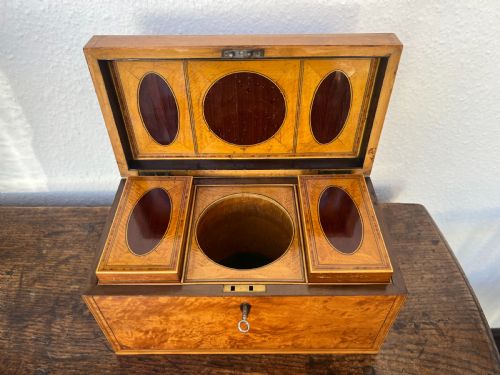
The sophistication of the silhouette defines the upper tier, distinguishing straightforward rectangular or oval boxes from complex sarcophagus forms with elaborate mouldings and intact original interior fittings like glass mixing bowls and mixing sticks.
Original glass mixing sticks survive inside these boxes, having miraculously avoided being broken or lost over two centuries of tea parties.
The Georgian Satinwood Tea Chest Glossary
- Satinwood
- A hard, yellow-tinted timber with a chatoyant grain that produces a characteristic shimmering effect when polished. It was heavily favoured by georgian cabinetmakers for high-status veneer work.
- Teapoy
- A small stand or large table-style chest designed to hold tea caddies and serving equipment. The term also applies to substantial tea caddies of the period.
- Parquetry
- A geometric mosaic of wood veneers arranged in repeating patterns such as cubes or chequers. It creates striking visual depth on flat and curved box surfaces.
- Escutcheon
- A protective metal plate surrounding the keyhole of a chest or box. In these pieces, it is typically cast or engraved from brass.
- Marquetry
- The art of applying fitted pieces of veneer to a structure to form decorative pictures or ornamental designs. It distinguishes finer georgian boxes from simpler banded versions.
Georgian Satinwood Tea Chest: Frequently Asked Questions
What is a teapoy?
A teapoy is a larger form of tea storage vessel or a small pedestal table designed to hold tea caddies.
These pieces provided a stable station for preparing tea in formal reception rooms.
Why do some caddies have glass bowls?
The central glass bowl served as a mixing vessel where different grades of loose tea leaves were blended before brewing.
Original bowls with matching mixing sticks remain significant indicators of an intact interior.
How do I care for satinwood?
Satinwood requires stable indoor humidity away from direct sunlight to prevent the delicate veneers from lifting or fading.
Regular dusting with a dry, soft cloth preserves the natural lustre of the golden timber.
How are georgian dates told?
Periods are identified through structural silhouettes, hardware styles, and the specific combinations of contrasting inlay veneers like harewood and ebony.
Earlier eighteenth-century pieces often favour delicate oval shapes, while regency examples adopt heavier sarcophagus forms.