

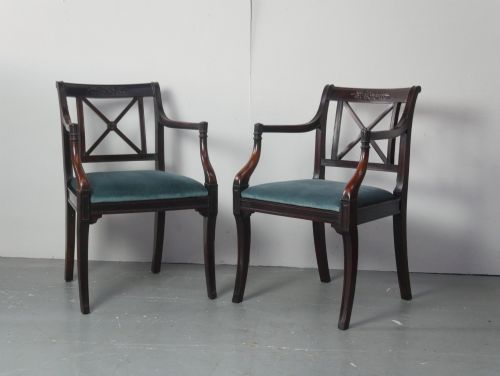
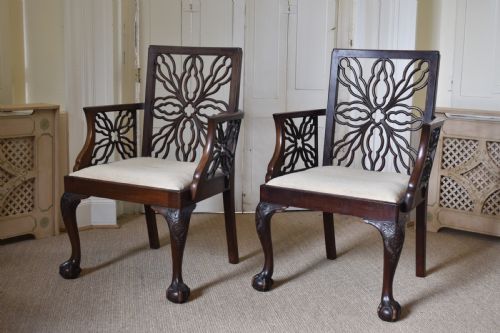
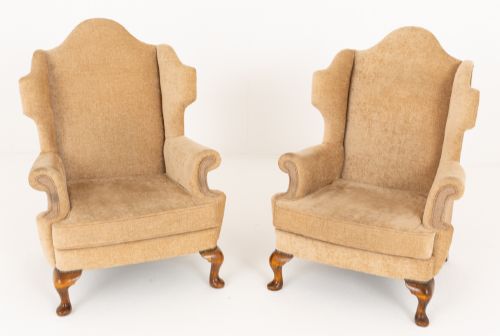
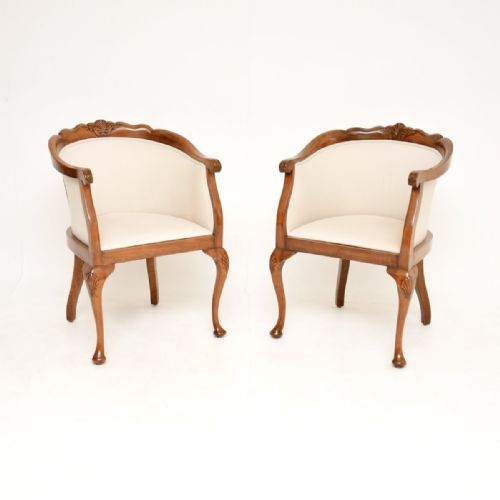

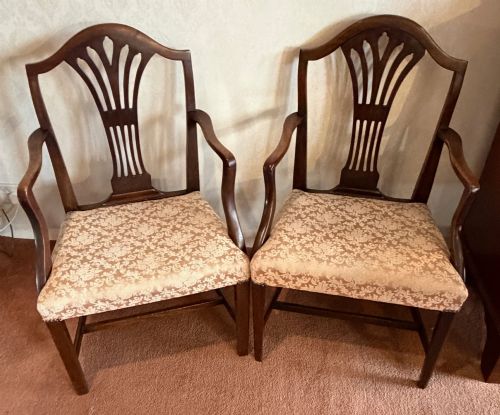


Georgian Revival Armchair Pair
A georgian revival armchair pair brings eighteenth-century elegance into a modern room with matched symmetry and classic proportions.
Georgian Revival Armchair Pair
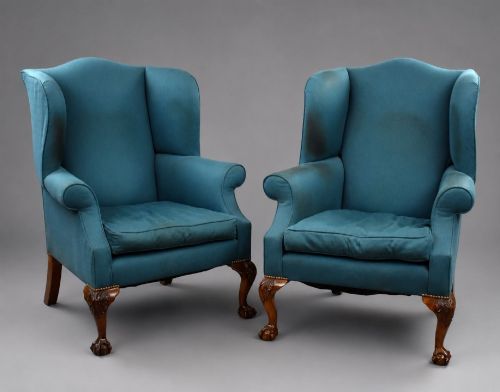
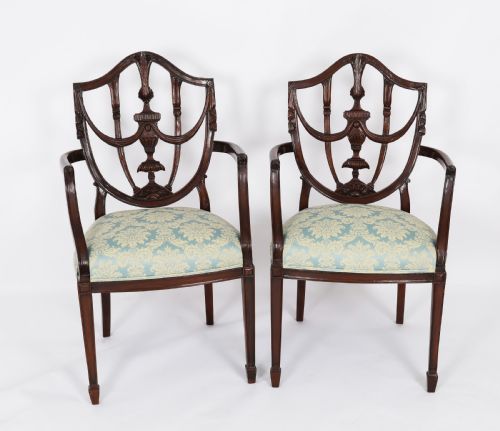
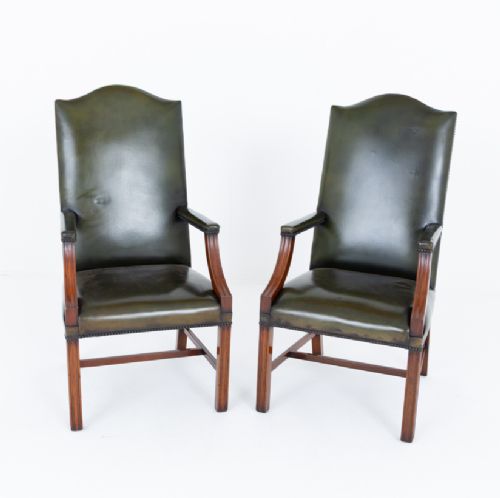
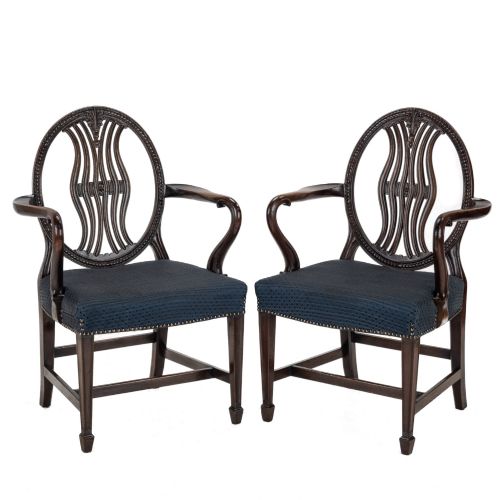
The selections span open armchairs, carver chairs, library gainsborough chairs, and wing backs executed in mahogany, walnut, and satinwood. These seating options serve as both functional furniture and historical decorative statements within sitting rooms and dining spaces.
Materials and construction
Construction relies heavily on solid timber frames, principally mahogany and walnut, selected for structural integrity and rich grain patterns. Inlaid satinwood and contrasting brass details appear across specific revival interpretations.
Upholstery techniques utilise traditional fabrics, leathers, and velvets secured to padded seats, backs, and arm rests. Woodworking methods incorporate classical carving traditions to replicate shield backs, pierced splats, and cabriole legs.
Georgian Revival Armchair Pair Retail Price Guide 2026
Typical asking prices for georgian revival armchair pair among the pieces listed under this phrase on Sellingantiques today, from the lower quarter to the upper quarter. They describe what is for sale here now, not the wider market.
Styles represented across the inventory include Chippendale, Hepplewhite, Sheraton, and Regency revival interpretations.
Factors of quality
Quality separates ordinary reproduction pieces from superior examples through the crispness of hand-carved wood details and the selection of timber figures. Superior pairs demonstrate tighter joinery and finer cabinetmaking standards.
The choice of covering materials, from hand-tooled leather to quality woven velvet, influences the overall presentation of the seating. Proportions that faithfully echo original eighteenth-century lines command greater regard.
The Georgian Revival Armchair Pair Glossary
- Carver chair
- An armchair designed primarily as a host's or hostess's seat at the head of a dining table. These pieces feature open arms to accommodate wider clothing.
- Gainsborough chair
- A wide, low-seated armchair with upholstered back, padded arms, and open wooden supports. This form originated in the mid-eighteenth century for library use.
- Shield back
- A chair back shaped in the outline of a heraldic shield, popularised by Hepplewhite designs. The central splat often incorporates carved wheat ears or drapery.
- Elbow chair
- An alternative term for an open armchair, referencing the supportive arm rests flanking the seat. These chairs typically accompany dining table settings.
- Splat
- The vertical wooden strip down the centre of a chair back connecting the crest rail to the seat. Chippendale and Hepplewhite designs use pierced and carved splats.
Georgian Revival Armchair Pair: Frequently Asked Questions
Where do I place a georgian revival armchair pair?
These matched seating pieces suit flanking positions beside a fireplace, framing a console table, or serving as host chairs at ends of a dining table.
Their balanced symmetry brings a formal anchor to sitting rooms and libraries alike.
How do I identify a revival piece from an original?
Revival pieces typically display timber seasoning, tool marks, and construction techniques characteristic of nineteenth or twentieth-century workshop production rather than the eighteenth century.
Secondary woods and hardware fastenings further clarify the true period of manufacture.
Are these chairs comfortable for daily use?
Many models feature generous proportions, padded upholstered seats, and supportive arm rests designed for extended sitting.
Library and gainsborough variants offer particularly deep seating suited to reading rooms.
What wood types are most common?
Mahogany forms the primary timber across the majority of surviving examples, often paired with walnut or satinwood accents.
Selected models incorporate brass detailing and intricate marquetry inlay.