




Georgian Leather Insert Table
A georgian leather insert table brings tactile warmth and period utility to a room through fitted hide writing surfaces.
Georgian Leather Insert Table
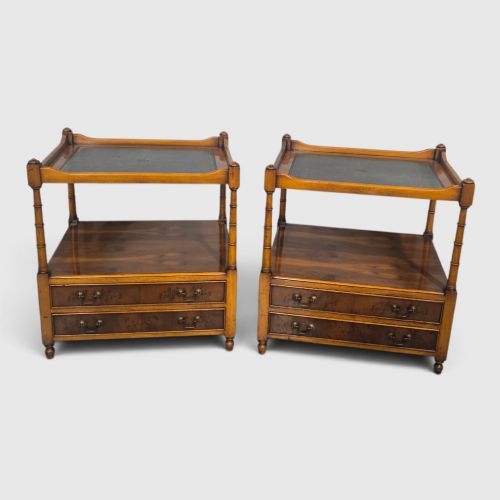
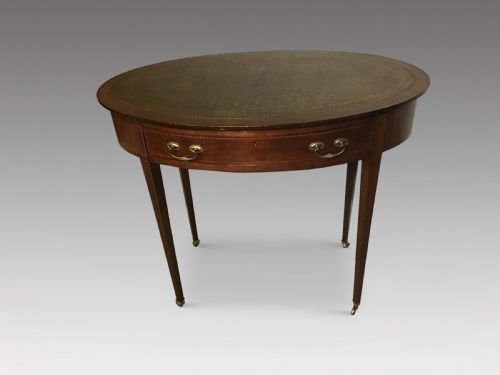
A georgian leather insert table encompasses writing desks, library tables, drum tables, and side tables designed with inset writing surfaces of hide or leather. These functional items serve primarily as work surfaces, centre tables, or lamp stands within a study or reception room.
The pieces on this page span several periods and revivals, including original Regency and Georgian eras alongside Edwardian, William IV, and later twentieth-century interpretations. Formats range from compact occasional side tables and wine tables to large freestanding pedestal desks and rotating drum tables.
Mahogany forms the predominant structural timber across these listings, accompanied by rosewood, yew, satinwood, and kingwood. Buyers most frequently encounter mahogany examples styled in the Sheraton manner or constructed during the Regency period.
How they were made
Makers constructed the primary frames and carcases using dense timbers such as mahogany and rosewood, often incorporating decorative veneers like satinwood and kingwood on specialised surfaces. These woods were selected for their stability and grain pattern, providing a robust structure to support daily writing and use.
Writing surfaces were inset with panels of leather, frequently tooled or gilt around the perimeter, providing a dedicated and tactile medium for ink and paper. Brass fittings, castors, and handles completed the mobile and functional aspects of desks and library tables.
Listings feature mahogany, rosewood, yew, satinwood, and kingwood across periods spanning Georgian, Regency, William IV, and the Edwardian era.
What varies in quality
The distinction between standard pieces and the finest examples rests on the choice of cabinet woods and the sophistication of decorative inlays and carving. Superior items display meticulous timber selection, such as figured mahogany or contrasting satinwood and kingwood banding, paired with crisp hand-carving.
Structural integrity and the retention of original elements, including brass hardware and secondary timbers, dictate the standing of a piece. Finer workshops delivered refined joinery and balanced proportions that elevate utilitarian desks and side tables into works of high craftsmanship.
Willmington and Cope
The Georgian Leather Insert Table Glossary
- Drum table
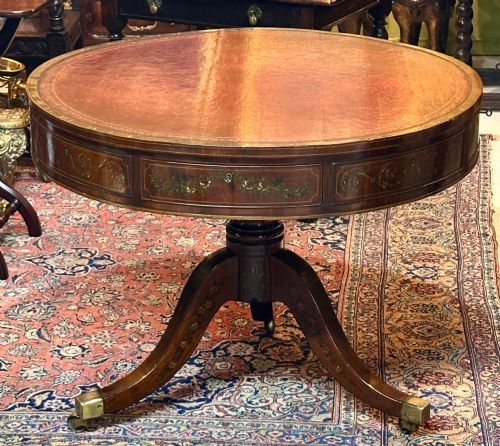
- A circular library table with a deep frieze containing drawers, typically supported on a central pillar and tripod base.
- Library table
- A large freestanding table designed for the centre of a room, used for holding books and writing, often featuring drawers on the frieze.
- Pedestal desk
- A heavy desk comprising a top surface resting on two pedestals of drawers, frequently featuring a leather writing insert.
- Frieze
- The horizontal band running directly beneath the top surface of a table, often housing drawers.
- Inlay
- A technique where pieces of contrasting wood, such as satinwood or kingwood, are inserted into the primary timber to form decorative patterns.
Georgian Leather Insert Table: Frequently Asked Questions
What is a drum table?
A drum table is a circular table with a deep frieze containing drawers, usually supported by a central pillar and tripod feet. These pieces were designed for libraries and studies to hold books and writing materials.
Many examples feature a leather insert on the top surface, providing a smooth writing area while maintaining a compact footprint in a room.
How do I use a writing table today?
A writing table serves effectively as a compact desk in a home office, bedroom, or living space. The inset leather provides a functional surface for writing or placing a laptop.
Their finished backs also allow them to float freestanding in the middle of a room rather than being pushed against a wall.
How do I tell Regency from Edwardian pieces?
Regency pieces date from the early nineteenth century and typically display architectural lines, rosewood or mahogany timbers, and classical brass mounts. They reflect the Regency and late Georgian design vocabulary.
Edwardian pieces, built around the early twentieth century, often show lighter satinwood and kingwood inlays, echoing earlier Sheraton styles with a different quality of internal construction and timber seasoning.
Are these tables suitable for daily use?
These tables were built for functional tasks such as writing and reading, making them well-suited for everyday domestic use. Solid timber construction and durable leather inserts ensure they withstand practical application.
Placing them away from direct heat sources and sunlight helps preserve the finish and the leather insert over time.