


Georgian Furniture Canterbury
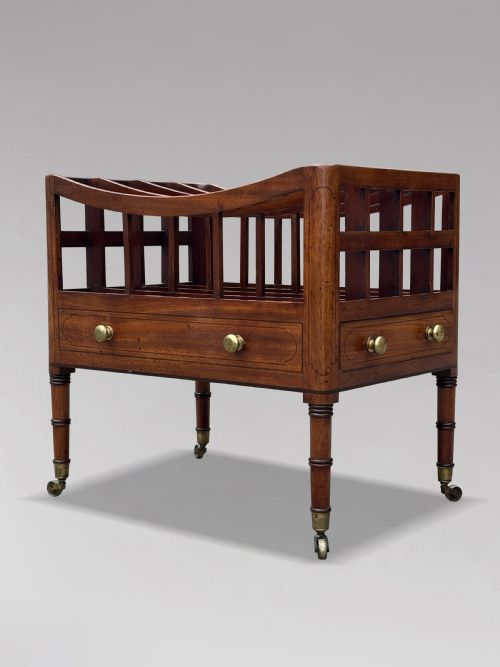
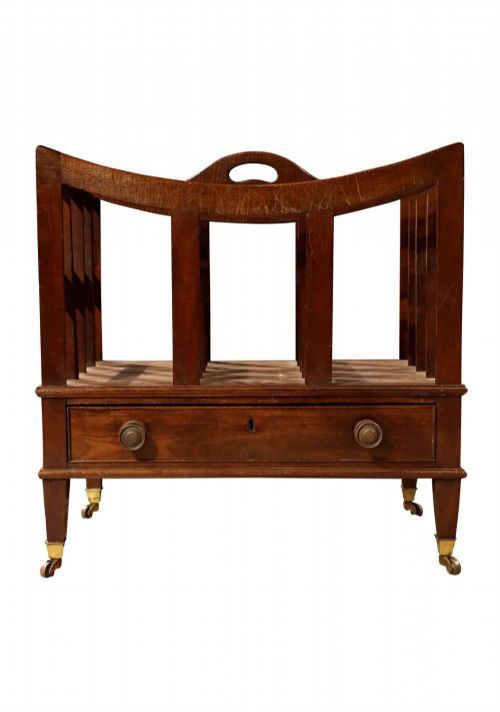
Georgian furniture canterbury pieces are freestanding compartmentalised stands designed to hold folios, sheets of music, and periodicals with enduring practicality and elegance.
Georgian Furniture Canterbury
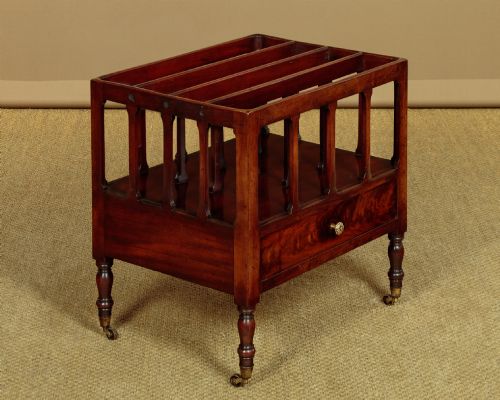
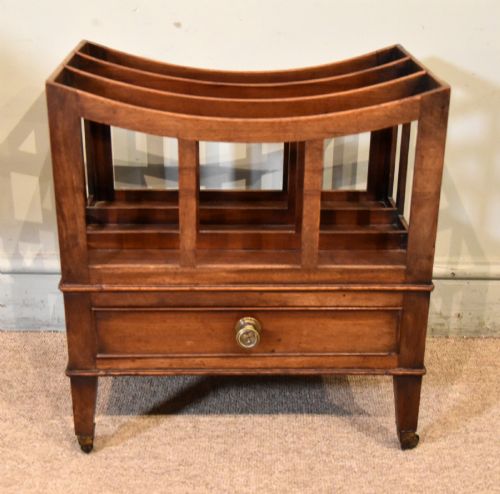
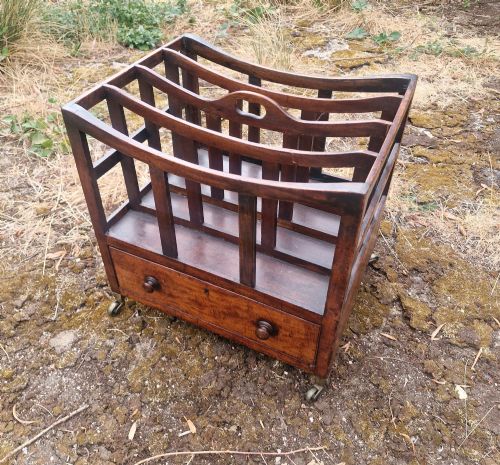
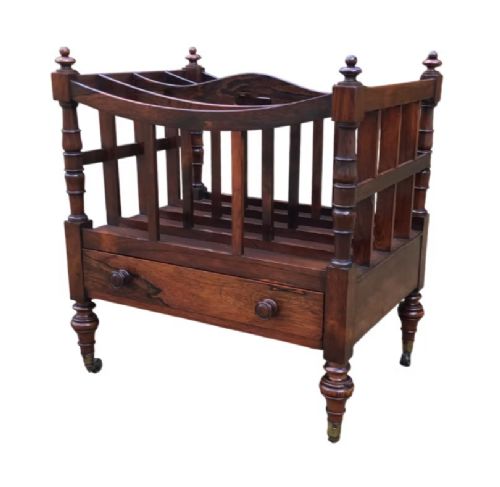
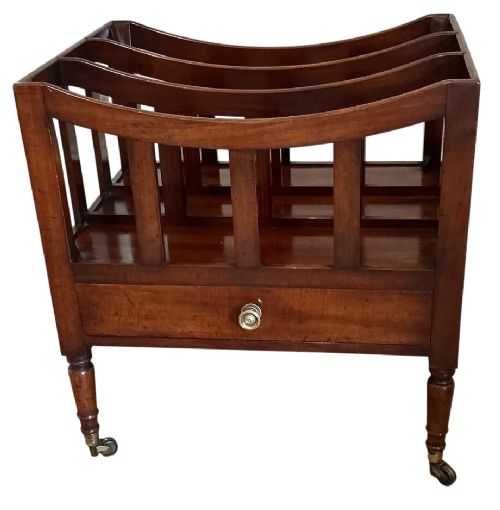
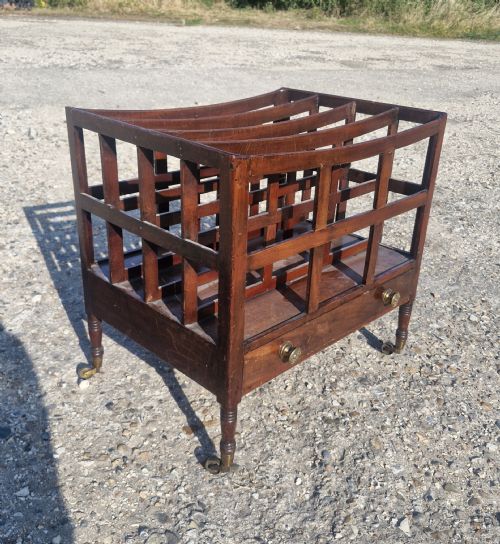
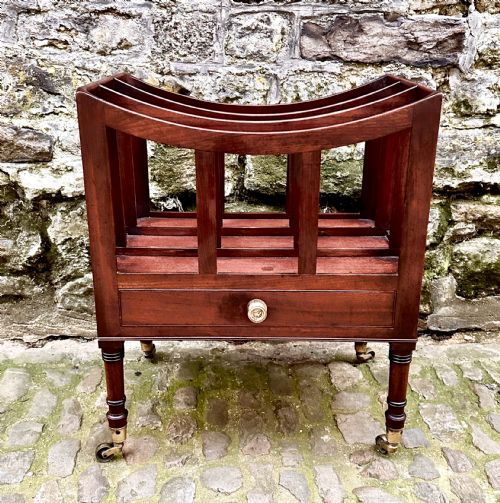
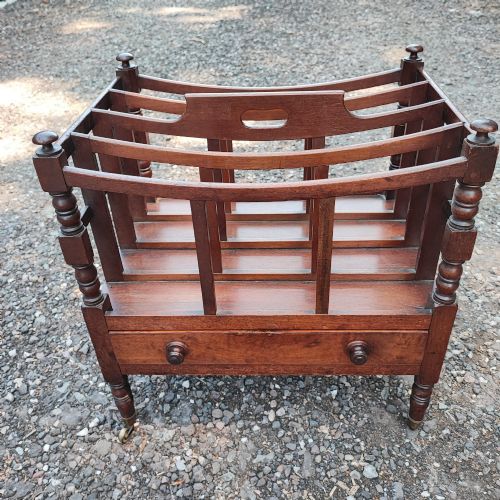
Georgian furniture canterbury examples on this page primarily take the form of low, open-framed stands featuring vertical partitions for sorting papers or books. Buyers looking at these listings will find pieces originating across the Georgian, Regency, and subsequent nineteenth-century periods, capturing a practical household form designed to sit neatly beside a chair or table.
The selections span distinct configurations, ranging from simple slatted four-division racks to boat-shaped designs and variations incorporating a single base drawer. Standard iterations often rest on turned legs fitted with castors, allowing the stand to move easily across a room as required by the household.
Materials and construction
Cabinet makers constructed these pieces predominantly using solid mahogany, Cuban mahogany, and richly grained rosewood, often enhanced by decorative touches such as ebony banding and fine inlay. Flame mahogany veneer appears frequently on surfaces to create movement and depth across the panels and drawer fronts.
Structural integrity relied on stable joinery to support the vertical dividers and low slatted sides, while decorative elements like carved Prince of Wales feathers or turned wooden supports demonstrate the attention given to detail by period workshops.
Listings feature mahogany, rosewood, and Cuban mahogany alongside decorative elements like brass, inlay, and flame mahogany veneer.
Distinctions in craftsmanship
The upper tier of these pieces reveals itself through the choice of timber, such as heavily figured Cuban mahogany or deeply warm rosewood, paired with precise inlay and careful proportioning. Lesser examples rely on plain pine or standard mahogany without the refined turnings or decorative banding found on superior specimens.
Construction nuance dictates the overall standard, distinguishing simple utilitarian racks from sophisticated pieces that incorporate well-fitted base drawers, finely carved ornamentation, and original brass castors that move smoothly on their axles.
The Georgian Furniture Canterbury Glossary
- Canterbury
- A low freestanding rack with vertical partitions, originally designed for holding music sheets and folios. The name derives from the Archbishop of Canterbury, who is said to have commissioned the first such piece.
- Regency
- A style period spanning roughly the early nineteenth century, noted for classical restraint and inspiration drawn from ancient Greece and Rome. Pieces from this era often feature clean lines alongside dark woods like rosewood and mahogany.
- Veneer
- A thin layer of choice wood applied to a sounder base timber to provide a decorative exterior surface. Flame mahogany veneer is particularly valued for its patterned, flickering grain appearance.
- Castor
- A small swivelling wheel attached to the base of a leg to permit easy rolling movement. Original brass castors add both utility and period authenticity to these low stands.
- Inlay
- A technique where contrasting materials are inserted into recessed cavities on a wooden surface to form decorative patterns. Ebony banding represents a common application found on classical stands.
Georgian Furniture Canterbury: Frequently Asked Questions
What is a canterbury used for?
These stands were originally created to hold sheets of music, folios, and books near a piano or seating area. Today they serve equally well for organising contemporary magazines, newspapers, and letters in a living space.
The partitioned sections keep unbound papers upright and sorted, combining a neat appearance with immediate access to daily reading materials.
How do I date a canterbury?
Dating relies on observing the prevailing timber choices, leg designs, and overall stylistic vocabulary of the piece. Regency models often show boat-shaped frames and rosewood surfaces, whereas earlier George III items lean towards straight mahogany posts and subtle inlay.
Hardware details such as original brass castors and the method of drawer construction also provide clear clues to the decade of manufacture.
Where should I place a canterbury?
Their low profile and compact footprint allow these stands to sit comfortably beside a sofa, armchair, or desk without blocking pathways or views. They function well as freestanding accents in a sitting room, study, or hallway.
Because the pieces are finished on all sides for open placement, they do not need to be pushed directly against a wall.
What woods were used?
Makers relied heavily on rich hardwoods, with mahogany and rosewood forming the vast majority of surviving examples. Cuban mahogany and flame mahogany veneer offered striking grain patterns favoured by high-end workshops.
Details in contrasting timbers, such as ebony banding or lighter stringing, were frequently added to highlight the edges of shelves and tabletops.