



Georgian Firearms
Georgian firearms span pocket pieces to heavy cavalry carbines, bringing mechanical ingenuity and military history into your hands.
Georgian Firearms
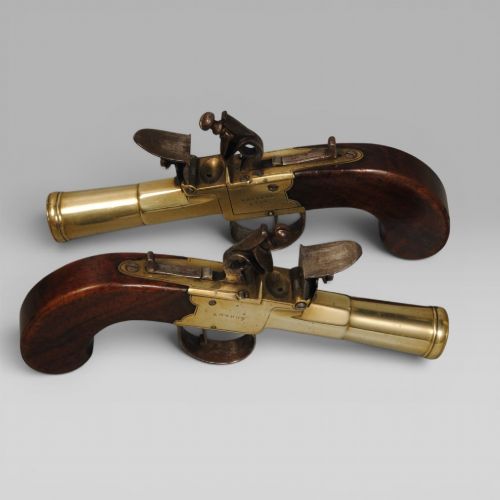
Georgian firearms encompass the pocket pistols, duelling arms, muskets and blunderbusses produced during the eighteenth and early nineteenth centuries. These pieces reflect the intricate mechanical developments of their time, shifting from early flintlock mechanisms to later percussion ignition systems.
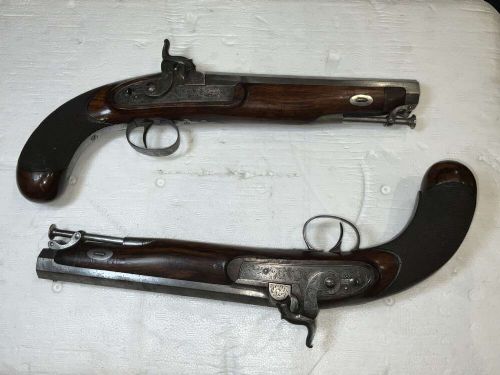
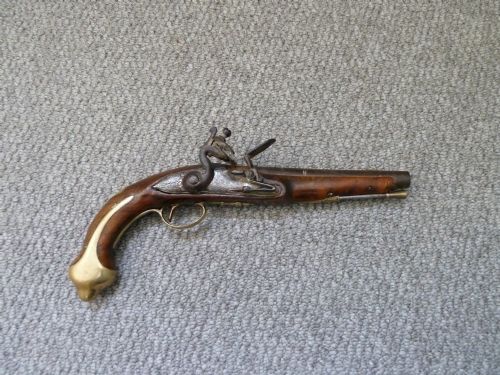
Collectors frequently encounter pocket pistols, heavy holster weapons and military service arms bearing the proof marks of London and Birmingham makers. The selection ranges from plain government-issued Tower dragoon pistols to ornate silver-mounted duelling sets.
Originating largely from British workshops alongside continental and Scottish makers, these objects served both practical defensive needs and military operations. Their survival bridges the gap between domestic self-protection and the grand campaigns of the Napoleonic era.
Materials and construction
Gunsmiths shaped stocks from dense hardwoods such as walnut and mahogany, occasionally embellishing grips with silver wire inlay and cast grotesque butt caps. Barrels and locks relied on forged steel, iron and brass, with some pieces incorporating spring-loaded bayonets.
Action mechanisms required precise hand-fitting of steel springs, flintcocks and trigger assemblies to ensure reliable spark generation. Barrels were turned, bored and sometimes decorated with gilt inlay or proof stamps before final assembly.
Georgian Firearms Retail Price Guide 2026
Typical asking prices for georgian firearms among the pieces listed under this phrase on Sellingantiques today, from the lower quarter to the upper quarter. They describe what is for sale here now, not the wider market.
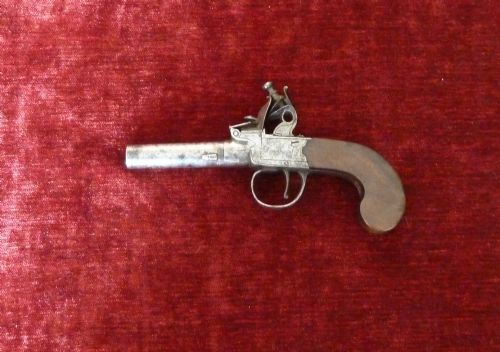
Some pocket pistols hid spring-loaded bayonets, ready to surprise an unwary highwayman after the single shot was spent.
Assessing quality
The distinction between standard military issue and bespoke civilian arms lies in the refinement of the metalwork and the grade of the timber stock. High-grade duelling and pocket pistols display crisp engraving on the lock plates, well-figured walnut, and precise integration of silver mounts.
Signatures of recognised makers and crisp proof marks elevate an item, showing the maker's pride and adherence to strict guild standards. Conversely, heavy utilitarian wear and replacement components alter the original integrity of a service arm.
John Campbell of Doune·T. Potts·Twigg·Joseph Egg·Sargant and Son·James Barber·Thomas Henshaw·Timothy Hughes·R. Willoughby·Meyer and Mortimer·J. Robinson·Barber of Newark·Dutton
The Georgian Firearms Glossary
- Flintlock
- An ignition mechanism utilising a flint held in a cock to strike a steel frizzen, creating sparks to ignite the priming powder.
- Percussion cap
- A later ignition system using a small detonating cap placed on a nipple, struck directly by the hammer to fire the charge.
- Turn-off barrel
- A barrel designed to unscrew completely from the breech, allowing gunpowder and ball to be loaded from the front of the chamber.
- Blunderbuss
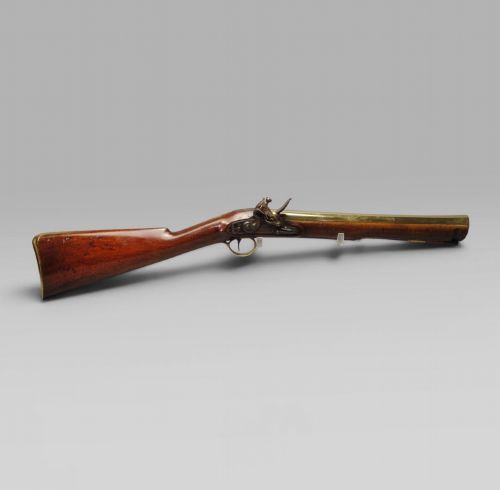
- A muzzle-loading firearm with a flared barrel designed to scatter lead shot effectively at short ranges.
- Boxlock
- A pistol design where the breech and action frame are forged as a single unit, placing the frizzen and pan directly on top.
Georgian Firearms: Frequently Asked Questions
What is a flintlock pistol?
A flintlock pistol uses a piece of flint clamped in a rotating cock to strike a steel plate, generating sparks into a priming pan.
This ignition system governed personal firearms throughout the eighteenth century before the invention of percussion caps.
How do I identify a Georgian firearm?
Examine the lock plate for maker signatures, crown stamps and government proof marks characteristic of London and Birmingham workshops.
Stylistic cues such as silver wire inlays, walnut stocks and cannon-shaped barrels also point directly to the eighteenth century.
What is a turn-off barrel?
A turn-off barrel unscrews entirely from the frame, allowing the user to load the ball directly into the rear of the muzzle.
This design appears frequently on pocket pistols from the period to ensure a tight shot seal without a ramrod.
Were these pistols used in duels?
Specific matched pairs were manufactured specifically for gentlemen settling disputes under strict rules of engagement.
These duelling arms prioritize balance, adjustable triggers and smooth-bore accuracy over concealed portability.