





Georgian Corner Whatnot
A georgian corner whatnot is a tiered shelving unit designed to fit neatly into a room angle, offering both display and storage space.
Georgian Corner Whatnot
When searching for a georgian corner whatnot, you are looking at multi-tiered shelving units designed specifically to utilise awkward room angles. These pieces originate from the Georgian and Regency periods, spanning the late eighteenth and early nineteenth centuries.
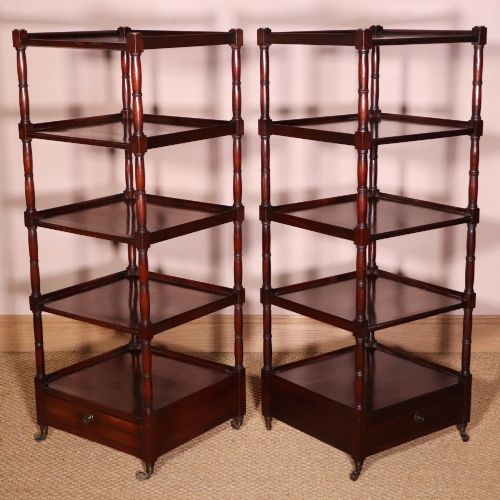
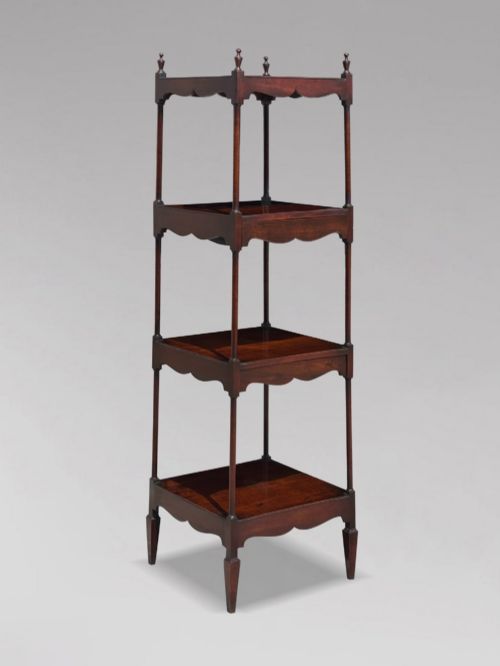
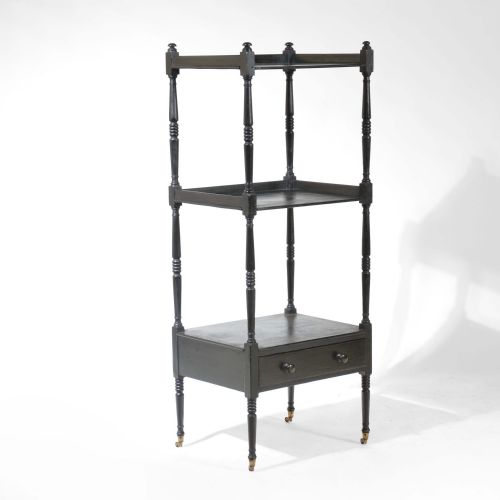
The versions most commonly met on this page are constructed from mahogany, though examples in oak, birdseye maple, and ebonised wood also appear. They take various forms, including bow-fronted designs and tiered stands intended to hold books, ceramics, or decorative objects.
Makers of the era built these items to serve practical purposes in domestic interiors, frequently combining open shelves with lower cupboards. Their compact scale makes them particularly useful for modern rooms where floor space is at a premium.
Materials and construction methods
Cabinet makers relied heavily on solid mahogany and oak to build the structural framework of these tier stands and etageres. Timber selection governed the durability of the corner posts and the delicate turned supports dividing each shelf.
Finishes varied according to the specific style, utilising ebonised wood for dark contrast or highlighting the natural grain in birdseye maple panels. Brass details occasionally appeared on castors or hinges, adding functional accents to the timber construction.
Georgian Corner Whatnot Retail Price Guide 2026
Typical asking prices for georgian corner whatnot among the pieces listed under this phrase on Sellingantiques today, from the lower quarter to the upper quarter. They describe what is for sale here now, not the wider market.
Some nineteenth-century makers evidently believed corners deserved just as much decorative ambition as the middle of the room.
Distinctions in quality
The finer examples of a georgian corner whatnot display superior timber selection, with closely matched grain patterns across the various tiers. Superior craftsmanship shows in the precise joinery of the A-frame or bow-fronted structures and the crisp turning of the support columns.
Proportion and scale distinguish the more desirable items from standard utility pieces. Compact dimensions and sophisticated detailing, such as integrated cupboards or refined edge moulding, elevate the standing of an individual piece.
Gillows
The Georgian Corner Whatnot Glossary
- Etagere
- A French term for a tiered display stand, often used interchangeably with the word whatnot in period listings. These pieces provide horizontal surfaces arranged vertically.
- Dumb waiter
- A tiered serving stand fitted with rotating or stationary shelves, sometimes combined with a whatnot form. It was traditionally used in dining rooms for holding dishes or silverware.
- Bow-fronted
- A curved cabinet or shelving front that swells outward in the centre. This shape softens the angular geometry of standard corner furniture.
Georgian Corner Whatnot: Frequently Asked Questions
What is a georgian corner whatnot used for?
These tiered units served primarily for displaying small decorative objects, books, or china in period drawing rooms and parlours. Their corner placement allowed households to make use of unutilised wall junctions.
Today, they function well in contemporary spaces for holding plants, lamps, or collections while occupying minimal floor area.
How do I date a corner whatnot?
Dating relies on observing timber types, structural forms, and stylistic markers associated with the eighteenth and nineteenth centuries. Pieces from the Georgian and Regency eras often display characteristic turning on the upright supports and specific wood selections like mahogany or oak.
Comparing the construction methods of the joints and shelves against known period examples helps clarify the likely decade of manufacture.
What is the difference between a whatnot and an etagere?
In historical and modern trade terminology, the two terms frequently describe the same form of multi-tiered shelving unit. Etagere leans toward the French origin for a display stand, whereas whatnot represents the traditional English descriptor.
Both types focus on vertical storage and display space across stacked wooden platforms.
Are these pieces sturdy enough for daily use?
Most surviving examples were built with solid hardwoods like mahogany and oak, designed to hold substantial weight on each tier. Their corner construction naturally lends structural stability when placed firmly against two adjoining walls.
Careful placement away from heavy traffic areas ensures these antique items remain secure and functional in a modern home.