

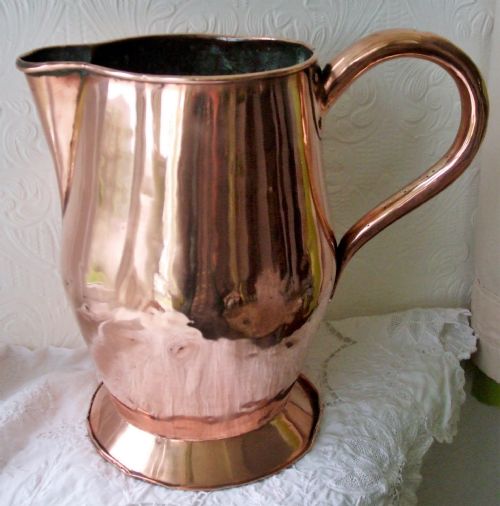


Georgian Copper Water Jug
These georgian copper water jug pieces offer robust utility and warmth, bringing enduring metalwork into daily use.
Georgian Copper Water Jug
A georgian copper water jug stands as a primary household vessel from the eighteenth and nineteenth centuries, designed for carrying and pouring water. The pieces appearing here span the Georgian period, including items dated to eighteen hundred and the wider nineteenth century.
Forms on this page range from modest two pint and three pint sizes up to large twelve pint examples, two gallon vessels, and a colossal lidded copper pitcher. Tavern use also appears through a Burton benefit club tavern jug alongside domestic forms.
Most examples originate from English workshops, adhering to the stylistic conventions of George III design. Buyers meet standard domestic jugs alongside specialised tavern and club vessels.
Materials and construction
These vessels utilise heavy gauge copper sheet, shaped and joined to handle liquids safely. Brass components appear alongside the copper, typically forming handles, rims, or fixings.
Internal surfaces receive a protective lining of tin to prevent copper from reacting with water. Exterior metalwork relies on hand-beaten seams and soldered joints characteristic of period metalworking.
Georgian Copper Water Jug Retail Price Guide 2026
Typical asking prices for georgian copper water jug among the pieces listed under this phrase on Sellingantiques today, from the lower quarter to the upper quarter. They describe what is for sale here now, not the wider market.
One heavy tavern jug carries the specific identity of the Burton Benefit Club into the modern era.
Distinctions in quality
Quality rests in the weight of the metal and the integrity of the original construction rather than surface gleam alone. Thicker copper sheet and substantial brass attachments elevate a piece above standard utility ware.
Maker attribution marks distinction, as seen in signed examples associated with London makers like Loftus of Oxford Street. Capacity and scale also divide standard domestic vessels from colossal lidded pitchers and club tavern jugs.
Loftus of Oxford Street London
The Georgian Copper Water Jug Glossary
- George III
- The period of the British monarchy spanning from seventeen sixty to eighteen twenty. This era defines the classical proportions seen in many domestic copper vessels.
- Tin lining
- A protective interior coating applied to metal water containers. This layer prevents direct contact between water and copper.
- Pitcher
- A large pouring vessel featuring a spout and handle. These items often possess greater capacity than standard household jugs.
- Tavern jug
- A robust vessel intended for commercial drinking houses rather than private homes. These pieces often bear inscriptions or club association marks.
Georgian Copper Water Jug: Frequently Asked Questions
What were georgian copper water jugs used for?
These vessels served to transport and store water for domestic households, washbasins, and commercial taverns.
Larger variants held supplies for communal use or club gatherings before indoor plumbing became standard.
How do I date a georgian copper water jug?
Dating relies on construction methods, handle attachments, and stylistic markers associated with the eighteenth and nineteenth centuries.
Specific pieces may also carry maker stamps or inscriptions that narrow their period of origin.
Are these copper jugs safe for daily use?
Most antique water jugs retain a historical tin lining intended to separate the water from the copper body.
Modern buyers generally treat them as decorative display items or dry storage rather than using them for drinking water.
Why do some jugs have brass parts?
Brass provided a stronger, more rigid material for handles, rims, and fixings that required extra durability.
Metalworkers combined copper and brass to balance malleability in the body with strength in the fittings.