





Georgian Bird Painting
A georgian bird painting captures the vibrant plumage of natural history and portraiture on porcelain, canvas, and glass.
Georgian Bird Painting
A georgian bird painting encompasses various artistic representations of avian subjects created during the eighteenth and early nineteenth centuries. These works appear on porcelain tea services, reverse glass panels, watercolours, and oil canvases spanning the Georgian and Regency periods.
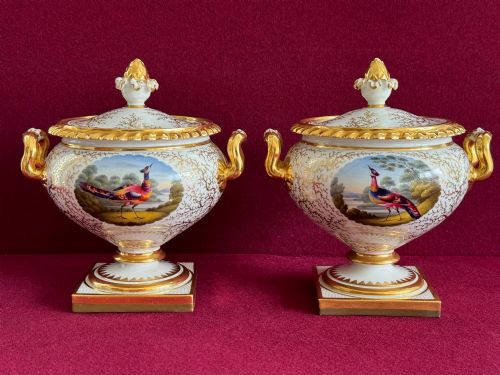
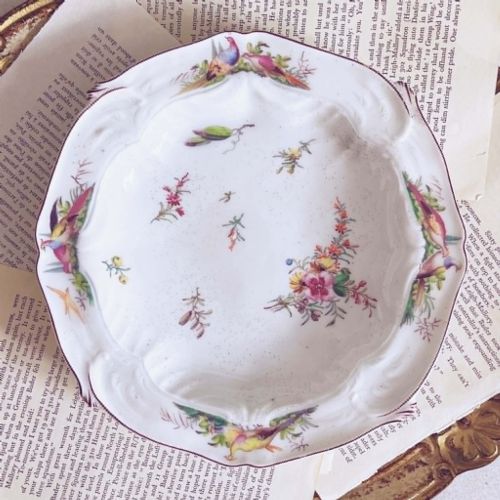
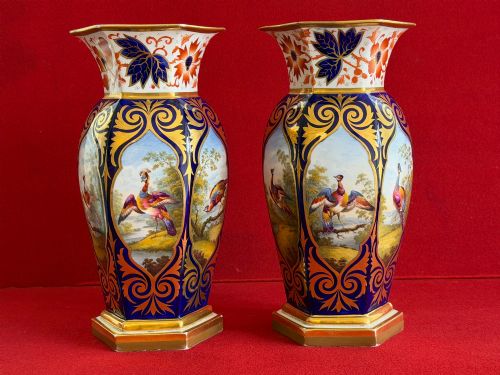
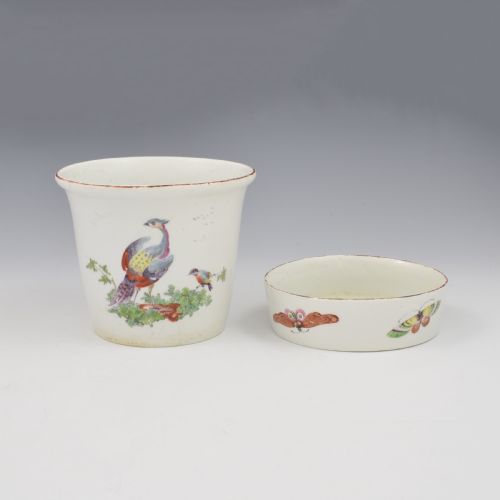
Buyers encounter both naturalistic studies and decorative ceramics adorned with handpainted polychrome birds. The selection includes framed watercolours alongside porcelain tureens and cups bearing detailed ornithological motifs.
Originating largely from British and European workshops, these pieces bridge fine art and decorative utility. The subjects range from exotic macaws and parrots to native game birds rendered within domestic or natural landscapes.
Materials and construction methods
Artists and makers utilised traditional media such as watercolour on paper, oil on canvas, and enamel on copper for smaller patch boxes. Ceramics were formed from porcelain, pearlware, and faience, then handpainted with polychrome mineral pigments.
Frames and mirrors incorporated maple wood and gilt wood, frequently protected beneath glass panels. Reverse glass painting required meticulous application of pigments directly onto the rear surface to achieve luminous clarity when viewed from the front.
Georgian Bird Painting Retail Price Guide 2026
Typical asking prices for georgian bird painting among the pieces listed under this phrase on Sellingantiques today, from the lower quarter to the upper quarter. They describe what is for sale here now, not the wider market.
Exotic birds share domestic space with local game and naval engagements, proving Georgian artists painted whatever caught their eye.
Judging the execution and preservation
Quality rests in the precision of the brushwork and the fidelity of the avian subject's anatomy. Handpainted porcelain and watercolours display greater artistic command when the feather details and colour gradients show subtle layering rather than flat application.
Condition and originality dictate the standing of each piece, particularly regarding the survival of original maple frames and undamaged enamel surfaces. Intact glazes on porcelain and clear preservation under reverse glass maintain the visual impact of the work.
Flight Barr And Barr·Barr Flight And Barr·Chamberlain Worcester·Michael Dahl·William Andrews Nesfield·George Lance·Edward Bird·Stephen Elmer
The Georgian Bird Painting Glossary
- Polychrome
- Decoration executed in multiple colours. This technique defines the bright plumage found on period ceramics and painted panels.
- Reverse glass
- An artwork technique where the image is painted directly on the back of a glass sheet. This method protects the pigment and produces a distinct glossy finish.
- Pearlware
- A fine-grained earthenware developed in the late eighteenth century. It often serves as the body for painted domestic vessels.
- Faience
- Tin-glazed earthenware produced in Europe. It provides an opaque white surface suitable for colourful bird motifs.
- Gilt wood
- Wood coated with a thin layer of gold leaf. It commonly frames historical mirrors and artwork.
Georgian Bird Painting: Frequently Asked Questions
What is a georgian bird painting?
A georgian bird painting is a period artwork or decorated ceramic depicting avian subjects from the eighteenth or early nineteenth centuries.
These pieces combine artistic observation with decorative utility across various media.
How were these paintings displayed?
Works on paper and canvas were typically hung on walls within original maple or gilt wood frames. Ceramic versions served as functional tableware or decorative garnitures in period rooms.
Reverse glass panels were similarly hung to catch the light in domestic interiors.
How do I identify the period?
Dating relies on stylistic markers, framing materials, and specific factory marks found on porcelain bodies. The transition from eighteenth-century Rococo curves to Regency neoclassical symmetry helps narrow the timeframe.
Assessing the pigment types and backing materials also clarifies the production era.
Are these works handpainted?
The examples in this selection feature handpainted execution across both ceramics and fine art. Artists applied polychrome enamels and watercolours by hand to capture realistic plumage.
Even decorative vessels received individual brushwork rather than printed transfers.