
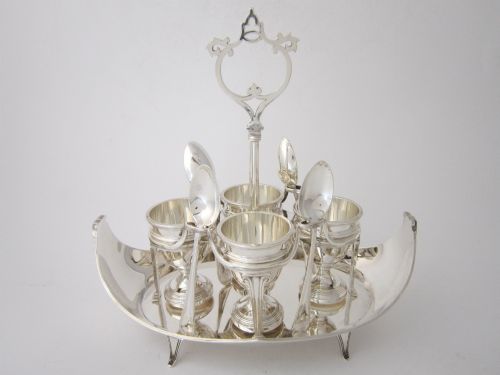


George V Silver Cruet
These george v silver cruet sets bring practical elegance to the dining table, combining polished sterling frames with fitted glass bottles for mustard, pepper and salt.
George V Silver Cruet
A george v silver cruet set comprises matching condiment containers held within a dedicated frame or stand, designed for domestic dining tables. When searching for a george v silver cruet, buyers encounter both fitted stands holding glass bottles and cased sets containing open salts, pepper shakers and mustard pots.
The pieces on this page span the early twentieth century, alongside earlier Georgian iterations and later George VI designs. Most examples found here originate from the 1910s and 1930s, reflecting the output of prominent silversmiths from those decades.
Distinctions in Quality
Quality in these condiment sets rests upon the weight of the solid silver used in the frame and spoons, alongside the integrity and clarity of the glass bottles. Sets that retain their original matching glass liners and associated silver spoons command greater appreciation.
The reputation of the maker also shapes the standing of a piece, with distinguished firms producing heavier, more finely finished frames. Complete cased sets in sound condition demonstrate superior preservation compared to assembled or partial groups.
The site archives record silver condiment pieces spanning the eighteenth century through to the middle of the twentieth century.
William Neale·Viners Sheffield·Mappin And Webb·Walker And Hall·Hester Bateman·John Schofield·Elkington
The George V Silver Cruet Glossary
- Sterling silver
- An alloy consisting of 92.5 percent silver by mass, with other metals added for durability. This material forms the primary structure of the frames and lids.
- Silver gilt
- Silver that has been coated with a thin layer of gold on its interior or exterior surfaces. This technique protected the metal from corrosive condiments such as vinegar and mustard.
- Caster
- A small jar or shaker with a perforated lid used for sprinkling sugar or dry spices over food. These vessels form an integral part of many larger table stands.
- Cruet stand
- The chassis or frame designed to hold multiple condiment bottles securely in place. These stands frequently feature a central carrying handle.
- Hallmark
- An official stamp applied by an assay office to indicate the purity of the metal, the maker and the year of manufacture. These marks provide the primary means for dating British silver.
George V Silver Cruet: Frequently Asked Questions
What pieces are included in a standard cruet set?
A standard set typically includes receptacles for salt, pepper and mustard, often accompanied by matching spoons. Larger formats may incorporate oil and vinegar bottles or frames designed specifically for boiled eggs.
These components sit together within a shared silver or ebonised stand, allowing hosts to transfer multiple condiments around the dining table in one movement.
How do I distinguish George V cruets from Georgian examples?
George V pieces generally reflect early twentieth-century design movements such as Art Deco, or clean neoclassical revivals typical of the 1910s and 1930s. Hallmarks stamped into the silver provide the exact year and assay office to confirm the era.
Georgian cruets, by contrast, date from the eighteenth or early nineteenth centuries and display heavier cast frames, distinct maker marks such as those by Hester Bateman, and simpler hand-raised silhouettes.
How were silver cruets used on the dining table?
Dining companions used the individual open salts, shakers and mustard pots to season food during meals. The central stand kept the condiments organised and prevented spills on the tablecloth.
Servants or diners lifted the entire stand by its central handle to pass seasonings across the table as courses progressed.
How do I care for sterling silver condiment sets?
Regular dusting with a soft cloth maintains the polished finish of the silver frame. When cleaning is necessary, use a dedicated silver polish applied gently to avoid wearing away hallmarks.
Glass bottles and liners should be washed separately in warm soapy water, ensuring they are dried completely before returning them to the silver frame.
Are replacement glass bottles difficult to find?
Finding exact period replacements for broken glass bottles can prove challenging due to variations in mouth size and frame dimensions. Many frames were custom-fitted with hand-cut glass specific to that maker.
Collectors prefer sets that retain their original matched glass components, as mismatched bottles detract from the uniformity of the ensemble.