


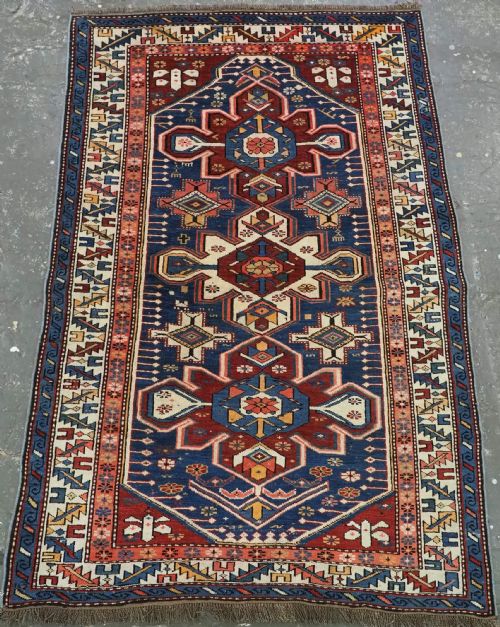


Geometrical Tribal Carpet
A geometrical tribal carpet delivers bold, angular motifs and rich regional character straight to your floor.
Geometrical Tribal Carpet
When you search for a geometrical tribal carpet, you are looking at hand-knotted floor coverings produced by village and nomadic weavers across the Caucasus, Anatolia, Persia, and Central Asia. These textiles rely on rectilinear layouts, medallions, and structured repeat patterns rather than flowing curvilinear designs.
The versions you are most likely to meet on this page span the late eighteenth century through to the early twentieth century, taking the form of area rugs, runners, prayer rugs with distinct mihrab arches, and larger carpets. They originate from specific weaving traditions including Turkmen, Caucasian, Ottoman, and Persian workshops.
Each piece reflects the visual vocabulary of its specific origin, utilising traditional formats such as the triple lobbed medallion or rams horn motifs. The resulting floor coverings combine utility with centuries of local design heritage.
Materials and construction
These floor coverings are constructed primarily from wool and hand-spun wool knotted onto cotton or wool foundations. The choice of staple fibre determines the tactile weight and resilience of the pile.
Weavers relied upon natural dyes to colour the wool, producing deep tones that age gracefully over time. Hand-knotting techniques ensure each piece possesses a dense structure capable of withstanding generations of use.
Geometrical Tribal Carpet Retail Price Guide 2026
Typical asking prices for geometrical tribal carpet among the pieces listed under this phrase on Sellingantiques today, from the lower quarter to the upper quarter. They describe what is for sale here now, not the wider market.
Listings span multiple periods from the eighteenth century to the twentieth century, incorporating wool, cotton, and natural dyes.
Assessing quality in regional rugs
Quality rests upon the precision of the knotting and the integrity of the materials, where hand-spun wool and stable natural dyes demonstrate superior craftsmanship. Tighter knot counts allow for crisper rendering of angular motifs and rectilinear layouts.
The preservation of original borders and structural symmetry separates standard examples from exceptional survivals. Colour saturation and the harmonious balance of natural dye palettes further define the upper tier of these textiles.
The Geometrical Tribal Carpet Glossary
- Mihrab
- The niche in a prayer rug design that points toward Mecca, typically styled with architectural arches or stepped outlines. It forms the focal point of devotional textiles.
- Medallion
- A central decorative motif placed in the field of a rug, often rendered in symmetrical geometrical shapes. These elements anchor the overall composition.
- Kilim
- A flat-woven carpet or rug produced without a pile by tightly interweaving warp and weft threads. This technique yields a lightweight, reversible textile.
- Pile
- The vertical or slanted ends of thread that form the soft surface of a knotted rug. It is created by tying individual knots around the warp strings.
- Warp
- The stationary vertical strings stretched on the loom that hold the structure of the rug. Wefts are passed horizontally through these threads to secure the knots.
Geometrical Tribal Carpet: Frequently Asked Questions
How do I clean an antique rug?
Gentle surface vacuuming without a beater bar removes loose dirt from the pile safely.
Professional specialist cleaning remains necessary for deeper maintenance to protect natural dyes and wool fibres.
Where were these carpets made?
Weavers produced these textiles across regions including the Caucasus, Anatolia, Persia, and Central Asia.
Nomadic tribes and village communities in these areas passed down specific pattern books and dyeing recipes through generations.
Can I place these on heated floors?
Natural materials like wool and cotton tolerate moderate ambient warmth quite well.
Excessive direct heat can dry out natural fibres and foundation threads over prolonged periods.
How do I date a tribal rug?
Structural analysis of the wool, foundation yarns, and dye palette helps establish the likely period of production.
Design motifs and regional weaving traits provide additional context when comparing known historical examples.