


Full Eternity Wedding Band
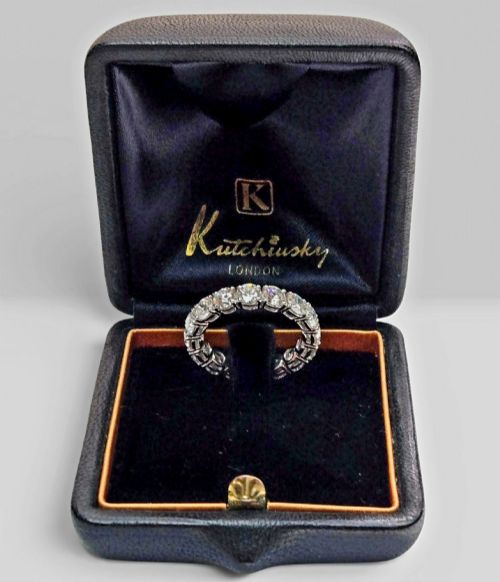
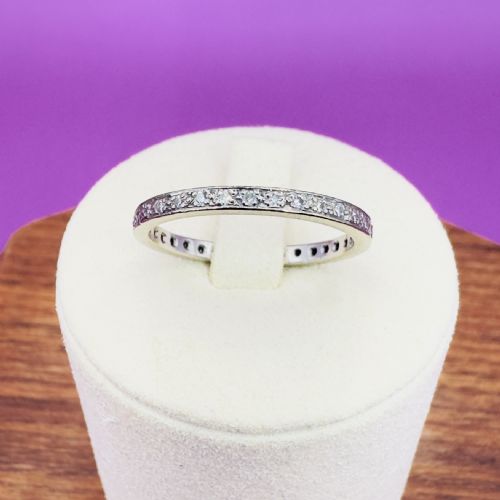
These full eternity wedding band pieces are continuous circles of precious stones set in metal, representing an unbroken line.
Full Eternity Wedding Band
A full eternity wedding band is a continuous circle of gemstones set entirely around the finger, marking an unbroken commitment. When you search for a full eternity wedding band, you are looking at rings designed to be worn either alone or alongside a traditional engagement ring.
The pieces available span the Art Deco, Mid-Century, Modern Classic, and Vintage styles, originating from the decades between 1930 and 1960. You are most likely to meet platinum or white gold mountings set with diamonds, alongside occasional ruby examples from the 1930 and 1940 periods.
How they were made
These rings utilise precious metals including platinum, 18ct white gold, and 18k white gold to form the continuous band. Stones are secured firmly into the metal channel or claw settings that run the entire circumference of the hoop.
The materials combine diamonds and natural rubies with durable white metals, requiring precise gem-cutting to ensure uniform size and continuous sparkle around the entire finger.
A full eternity wedding band has no beginning and no end, making it the ultimate test for anyone prone to losing count of things.
What varies in quality
Quality in a full eternity wedding band lies in the uniformity of the stones and the integrity of the continuous setting. Superior examples display carefully matched gemstone sizes and colours that maintain an uninterrupted visual flow around the entire finger.
The weight of the stones and the choice of metal contribute significantly to the substance of the piece. Platinum mountings paired with larger diamond carat weights represent the upper end of the range seen across these decades.
Kutchinsky
The Full Eternity Wedding Band Glossary
- Full eternity
- A ring set with gemstones continuously around the entire band. This design leaves no plain metal visible on the outer circle.
- Art Deco
- A design style prominent in the 1930s characterised by geometric precision and sleek lines. Pieces from this period often feature crisp platinum settings.
- Platinum
- A dense, durable white precious metal used frequently in mid-century and art deco jewellery. It provides a secure setting for diamonds and rubies.
- Carat
- A unit of weight used for gemstones. Higher carat totals in these listings indicate larger or more numerous stones set into the band.
Full Eternity Wedding Band: Frequently Asked Questions
Can a full eternity ring be resized?
Because the gemstones run continuously around the entire band, altering the circumference of a full eternity wedding band is exceptionally difficult. Jewellers generally avoid resizing them to prevent disturbing the stone settings.
Buyers should confirm their exact ring size before acquiring a piece from the 1930 to 1960 periods, as returning or adjusting them requires specialist work.
How do I wear an eternity band?
These rings are traditionally worn on the ring finger alongside an engagement ring and a plain wedding band. Some prefer them worn alone on either hand to showcase the continuous line of stones.
Matching the metal colour, such as pairing platinum with platinum or 18ct white gold with 18ct white gold, helps protect the adjacent bands from wear.
What is the difference between platinum and white gold?
Platinum is a naturally white, dense metal that maintains its colour without plating over time. It offers robust durability for holding small stones securely in vintage designs.
White gold is an alloy of yellow gold mixed with white metals like palladium or silver, plated with rhodium to give it a bright finish that may require occasional maintenance.
How do I date these rings?
Dating relies on stylistic markers such as the geometric lines typical of 1930s Art Deco pieces or the cleaner, refined profiles of 1950s and 1960s Mid-Century designs. Specific French hallmarks or period-appropriate metal purity stamps also assist in placing the ring in its correct decade.
Examining the setting techniques and stone cuts provides further clues to whether a piece originates from the pre-war era or the post-war decades.