


Full Eternity Band
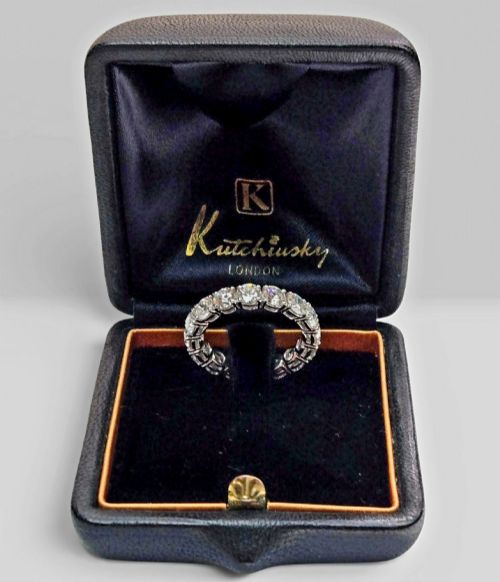
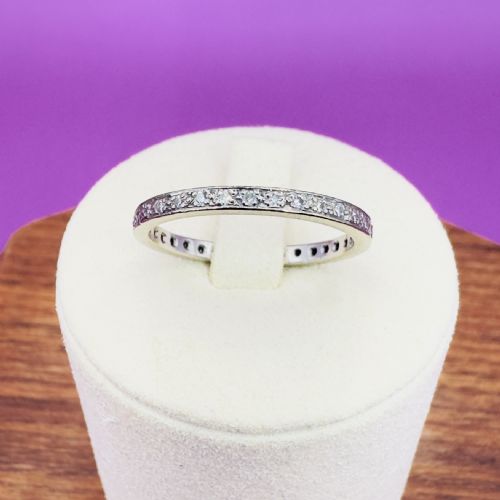
A full eternity band carries an unbroken circle of stones around the finger, representing endless devotion.
Full Eternity Band
A full eternity band is an unbroken circle of gems set right around the hoop, most often seen here in diamond or ruby variations. These rings appear across several eras, with Art Deco designs from the 1930s frequently meeting collectors alongside mid-century pieces.
Assessing quality in eternity rings
The standard of a full eternity band depends heavily on the uniformity and matching of the set stones right around the hoop. Consistency in stone size, colour, and clarity elevates an individual ring significantly.
Metal selection also dictates the character of the piece, with platinum offering substantial weight compared to lighter gold iterations. Maker attribution further distinguishes exceptional pieces from standard workshop output.
Listings feature diamond, ruby, and turquoise set within platinum, 18ct white gold, and 9ct rose gold across 1930, 1950, 1960, 1940, and Edwardian periods.
Kutchinsky
The Full Eternity Band Glossary
- Full eternity band
- A ring featuring a continuous, unbroken circle of gemstones set entirely around the precious metal band. This design signifies eternal love and leaves no plain metal visible on the shank.
- Art Deco
- A design style prominent during the 1920s and 1930s characterised by geometric precision and sleek lines. Pieces from this era often feature clean platinum settings.
- Platinum
- A dense, durable, and naturally white precious metal frequently utilised in high-end antique and vintage jewellery. It securely holds small, closely set stones without adding excessive bulk.
- Old cut
- A diamond cutting style typical of antique and vintage jewellery before the advent of modern brilliant cutting. These stones display smaller tables and broader facets.
- Carat
- A unit of weight used for measuring gemstones, determining the overall scale of the stones mounted in the ring. Higher carat weights indicate larger or more numerous gems.
Full Eternity Band: Frequently Asked Questions
Can a full eternity band be resized?
Resizing a full eternity band is exceptionally difficult because the continuous circle of stones leaves no plain metal section to cut or expand. Altering the circumference typically requires rebuilding part of the ring entirely.
Buyers must ensure the stated size matches their finger precisely before acquiring one of these continuous stone bands.
How do I date an antique eternity ring?
Dating relies on stylistic clues such as geometric Art Deco motifs from the 1930s or the softer rose gold settings typical of the Edwardian period. Maker marks and precious metal hallmarks stamped inside the band also help pinpoint the era.
Examining the stone cuts, such as earlier old cut diamonds, provides further chronological evidence for pieces originating in the early twentieth century.
What is the difference between ruby and diamond eternity rings?
Ruby eternity rings introduce vibrant red colour through natural corundum stones, frequently seen in Art Deco pieces from the 1930s and 1940s. Diamond versions rely on brilliant sparkle and traditional white metal settings.
Both variations maintain the signature unbroken circle of gems characteristic of the category.