





Fruit Serving Spoons
These fruit serving spoons are heritage silver cutlery pieces designed to grace formal dining tables with period elegance.
Fruit Serving Spoons
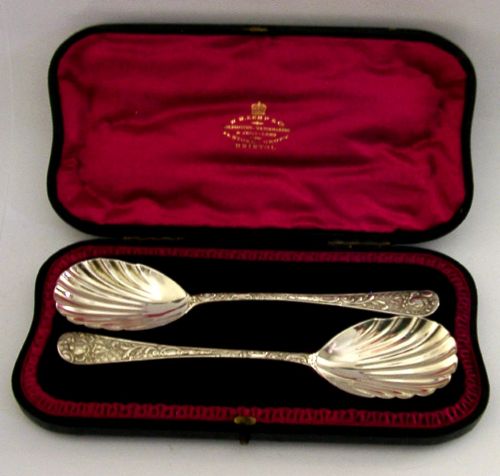
Fruit serving spoons are specialised silver flatware pieces designed for portioning fruit at the dining table, often appearing as matched pairs within fitted presentation boxes. When you search for fruit serving spoons, you will encounter pieces spanning from the eighteenth century through to the early twentieth century, reflecting shifting dining rituals over successive generations.
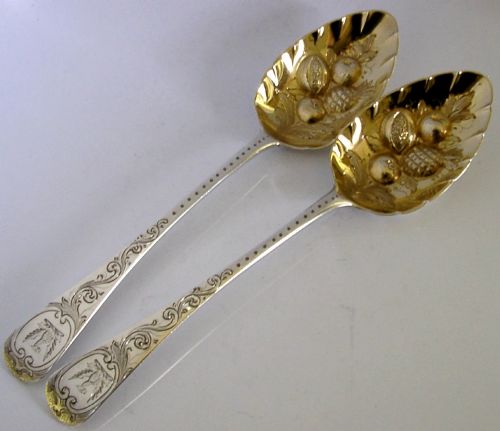
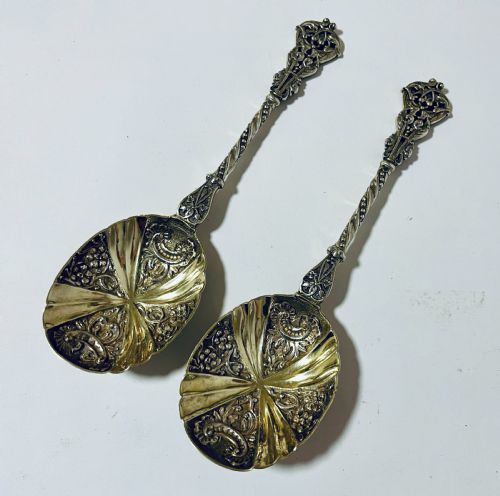
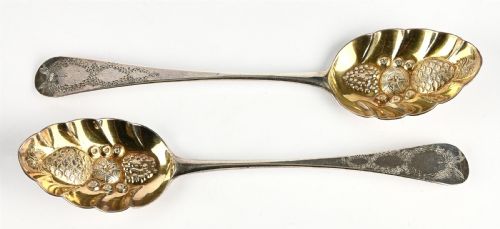
The selections on this page predominantly feature Victorian and Georgian examples, alongside Edwardian and Art Nouveau designs. Many of these silver implements take the form of berry spoons, featuring ornate fruit repoussé and engraving applied to the bowls and handles long after their initial manufacture.
Makers and silversmiths fashioned these items in sterling silver and silver plate, frequently incorporating gold gilt finishes within the bowls to prevent citric acid corrosion. Buyers frequently find complete boxed sets that include matching fruit knives, nutcrackers, or grape scissors alongside the primary spoons.
How they were made
Silversmiths forged these items primarily from sterling silver or silver plate, hammering and shaping the metal into expansive bowls suitable for serving delicate fruit. Many Georgian and Victorian examples received later embellishments, where artisans chased fruit motifs and berry designs into the original plain bowls and applied intricate engraving to the handles.
Makers applied partial gold gilt coatings, known as vermeil, directly onto the silver bowls to protect the metal from the acids present in fresh fruits. Workshops also housed these utensils in velvet, silk, and satin lined presentation boxes, securing the cutlery for formal dining storage.
Fruit Serving Spoons Retail Price Guide 2026
Typical asking prices for fruit serving spoons among the pieces listed under this phrase on Sellingantiques today, from the lower quarter to the upper quarter. They describe what is for sale here now, not the wider market.
Listings feature sterling silver and silver plate items, alongside velvet, silk, satin, and gold gilt finishes spanning multiple centuries.
What varies in quality
The quality of these spoons rests upon the crispness of the chased fruit decoration and the original gauge of the silver. Finer examples retain deep, sharp detailing in the bowl repoussé and substantial weight in the stem, whereas lesser pieces exhibit worn ornamentation and thin metal.
The preservation of the original fitted presentation box significantly influences the desirability of a pair or set, particularly when the internal satin and velvet linings remain intact. Makers who applied gold gilt to the bowls executed this finish with varying thickness, affecting the longevity of the protective coating.
Peter And Anne Bateman·William Chawner II·Hukin And Heath·Whiting Co
The Fruit Serving Spoons Glossary
- Berry spoon
- A tablespoon retrofitted during the Victorian era with chased fruit and berry motifs across the bowl. These spoons were originally plain George III items decorated decades later.
- Repoussé
- A metalworking technique where artisans hammer the design from the reverse side to form raised fruit patterns on the spoon bowl. This method creates high relief ornamentation.
- Silver gilt
- Sterling silver that has been coated with a thin layer of gold, often found inside the bowls of fruit serving spoons. This finish protects the silver from fruit acids.
- Hallmark
- An official stamp struck into precious metal indicating the assay office, silver standard, and year of manufacture. These marks allow collectors to date the base spoon accurately.
- Cutlery
- Implements used for preparing, serving, and eating food at the table. In this context, it includes specialised serving spoons and fruit sets.
Fruit Serving Spoons: Frequently Asked Questions
What are berry spoons?
Berry spoons are serving spoons that feature embossed fruit and foliage designs across the bowl. They originated as plain Georgian spoons before being decorated later.
Silversmiths chased the bowls with berries and leaves during the Victorian period to match changing dining fashions.
How were fruit serving spoons used?
These spoons served fresh fruit at the conclusion of formal meals, often alongside specialised cutlery like grape scissors. Their broad bowls supported delicate soft fruits.
Hostesses utilised them from fitted presentation boxes when entertaining guests in grand dining rooms.
Why do some spoons have gold bowls?
The gold wash, or silver gilt, protected the underlying silver from the corrosive acids found in citrus and soft fruits. It prevented tarnishing and staining during use.
This gilt layer also added a decorative contrast to the bright silver handles.
How do I date these spoons?
You date them by examining the hallmarked stamps pressed into the silver, which reveal the assay office and year. Style clues like Art Nouveau curves or Georgian crests also indicate the era.
Box construction and lining materials provide further context for Victorian and Edwardian sets.