


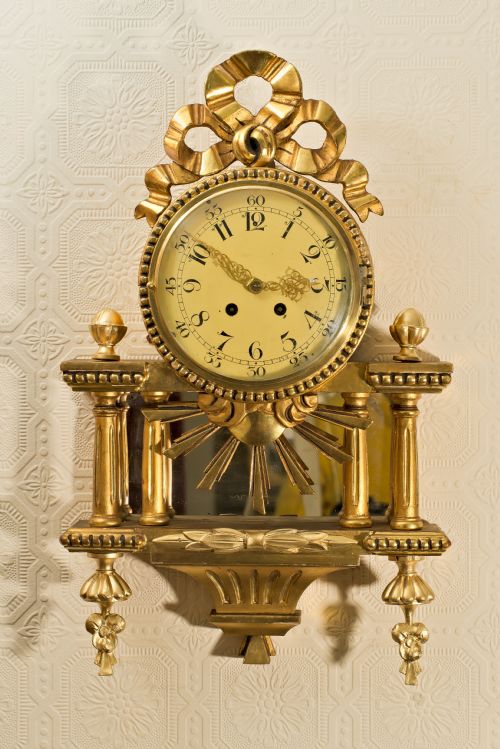


French Wall Timepiece
A french wall timepiece brings architectural form and mechanical precision together on a room's vertical surface, offering both a reliable movement and a striking focal point.
French Wall Timepiece
A french wall timepiece is a clock designed to hang securely on a wall rather than rest upon a mantel or floor, combining functional timekeeping with sculptural presence. These items range from ornate wooden cartel designs to modernist geometric walnut cases, spanning periods from the Georgian era through the early twentieth century.
The versions most frequently met on this page date from the nineteenth century, often exhibiting revival styles such as Louis XVI, Baroque, and Rococo. Alongside these giltwood and ormolu examples appear simpler mahogany and rosewood domestic clocks, as well as distinct regional forms like the Comtoise.
Makers and regional workshops produced diverse formats, from architectural cartel clocks framed in carved wood and gilt bronze to striking Westminster carillon models. Each piece reflects the interior design priorities of its era, turning a practical necessity into a decorative statement.
How they were made
Makers built the structural cases of these timepieces from dense hardwoods such as walnut, mahogany, and rosewood, alongside softer timbers heavily treated with giltwood or ormolu finishes. Carvers shaped the wooden frames by hand, integrating mirror glass, brass bezels, and glazed panels to protect the delicate dials within.
The visible faces typically feature white enamel dials marked with Roman or Arabic numerals, shielded behind curved or flat glass panes. Internal movements incorporated specialised mechanisms like pinwheel escapements, driven by weights or springs to maintain steady motion.
French Wall Timepiece Retail Price Guide 2026
Typical asking prices for french wall timepiece among the pieces listed under this phrase on Sellingantiques today, from the lower quarter to the upper quarter. They describe what is for sale here now, not the wider market.
Some nineteenth-century French makers even suspended time in mystery globe clocks, where the mechanism appears to float without obvious support.
What varies in quality
The standard of carving and gilding sets the visual hierarchy among these timepieces, distinguishing deeply undercut, hand-carved giltwood and cast ormolu from simpler moulded surfaces. Superior examples demonstrate crisp definition in decorative motifs like acanthus leaves, ribbons, and classical urns.
Movement sophistication also divides the range, separating standard time-only pieces from complex mechanisms equipped with carillons, mystery globe displays, or pinwheel escapements. The integration of high-grade materials, such as heavy brass bezels and flawless enamel dials, elevates an ordinary wall clock to an accomplished work of decorative art.
WETTERSTRANDS·Valiant Paris·Perivale of England
The French Wall Timepiece Glossary
- Cartel clock
- A wall clock housed in an ornamental frame made of giltwood, bronze, or brass rather than a traditional wooden box case. These designs became popular during the baroque and rococo periods.
- Ormolu
- Finely ground high-carat gold applied to a bronze base using a mercury amalgamation technique, common in French decorative arts. It provides a rich, enduring metallic lustre.
- Pinwheel escapement
- A mechanical device used in precision clocks to control the release of power from the gear train. It uses small pins instead of traditional teeth to engage with the pallet arms.
- Comtoise
- A traditional weight-driven wall clock originating from the Franche-Comté region of France. They are known for their distinctively shaped brass dials and long pendulum drops.
- Carillon
- A set of bells tuned to play a musical melody on the hour or quarter-hour. In French wall timepieces, this mechanism is often housed within larger walnut or architectural cases.
French Wall Timepiece: Frequently Asked Questions
What is a french wall timepiece?
A french wall timepiece is a decorative clock engineered to be hung directly onto a wall, combining timekeeping with ornate case designs made from materials like giltwood, brass, and walnut.
These pieces reflect distinct historical periods and decorative movements, ranging from nineteenth-century revival styles to early twentieth-century Art Deco forms.
What periods do these clocks cover?
The listings span several centuries and decorative eras, encompassing Georgian, Victorian, and nineteenth-century pieces alongside early twentieth-century items up to the 1940s.
Design styles shift across these timelines from elaborate baroque and rococo revivals to clean-lined Art Deco geometries.
How do I identify the style?
Style identification relies on examining the case materials, decorative motifs, and overall architectural silhouette of the clock frame. Rococo and Louis XVI pieces feature scrolling foliage, ribbons, and gilt finishes, whereas Art Deco models favour streamlined walnut and minimalist dials.