
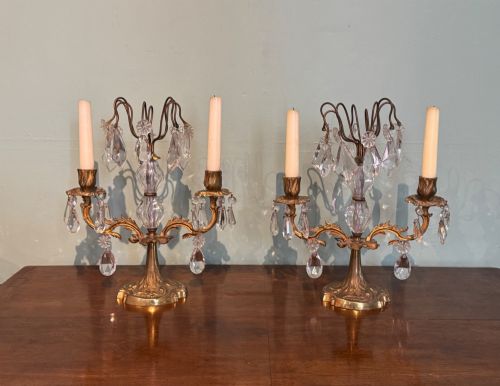


French Two Arm Candelabra
French two arm candelabra bring genuine period illumination to a room, cast in bronze, brass, and gilt metals with classic branch forms.
French Two Arm Candelabra
When you search for french two arm candelabra, you find pairs of twin-branch lighting fixtures spanning the nineteenth and twentieth centuries. These pieces originate from distinct periods including the 1860s, 1880s, and later twentieth-century revivals.
The forms encompass wall lights, wall sconces, table lamps, and freestanding candelabra. You are most likely to meet matched pairs featuring two distinct candle arms branching from a central stem or backplate.
Design vocabulary draws heavily on historical traditions such as French Rococo Revival, Louis XVI, Neoclassical Revival, and French Second Empire. Makers incorporated ornamental details including marble bases, cast cherubs, and cut glass elements.
Materials and Construction
Foundry workers shaped these pieces using cast bronze, ormolu, brass, and gilded brass, often adding carved wood or marble components. Metal surfaces received gilt finishes to catch candlelight, while glass components added reflective brilliance.
Makers combined metal casting with hand-chasing to define surface details on figures, foliage, and scrollwork. Wall lights and sconces utilised sturdy backplates for secure mounting, whereas table candelabra relied on weighted bases for stability.
Listings span the nineteenth and twentieth centuries, featuring gilt bronze, brass, and marble alongside cut crystal and fabric elements.
Judging Quality and Execution
The integration of mixed materials dictates the overall success of the piece, particularly where bronze meets marble or cut crystal hangs from the arms. Heavier gauge metalwork and balanced proportions distinguish the finer workshops from standard production.
Claude Clodion
The French Two Arm Candelabra Glossary
- Ormolu
- Gilded bronze produced through a mercury amalgamation technique, creating a durable golden surface on decorative metalwork. This finish was widely utilised in French lighting manufacture.
- Rococo Revival
- A nineteenth-century design movement favouring asymmetrical scrollwork, naturalistic shell motifs, and exuberant curves. It appears frequently in mid-nineteenth-century French metalwork.
- Louis XVI Style
- A neoclassical aesthetic characterised by geometric symmetry, straight fluted columns, and classical urn or floral motifs. This style returned to popularity during the late nineteenth century.
French Two Arm Candelabra: Frequently Asked Questions
How were these candelabra used?
Originally utilised for domestic illumination in salons and formal rooms, they were placed on tables, mantelpieces, or mounted directly to walls. The two branches held wax candles to cast light across interior spaces.
Mirrors were often positioned behind wall-mounted versions to multiply the flickering candlelight and brighten dark evening rooms.
How do I live with them?
Integrate them into contemporary or traditional interiors by placing pairs on sideboards, mantels, or flanking a fireplace. Wall-mounted versions require secure fixing to support the weight of the metal arms.
Keep them away from direct heat sources and clean the metal surfaces gently with a soft dry cloth to preserve the finish.
How do I tell periods apart?
Look to the decorative vocabulary and material combinations, as mid-nineteenth-century pieces often display robust Rococo Revival casting or cast cherubs. Later nineteenth-century items frequently adopt Louis XVI neoclassical symmetry with marble elements.
Twentieth-century examples often streamline these historic motifs or combine cut glass with simpler brass frames.