



French Style Secretary Desk
A french style secretary desk brings continental elegance and concealed writing space to a room through refined marquetry and metal mounts.
French Style Secretary Desk
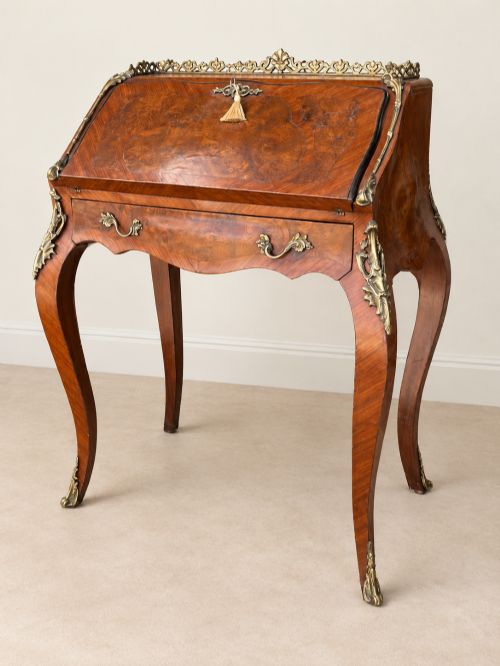
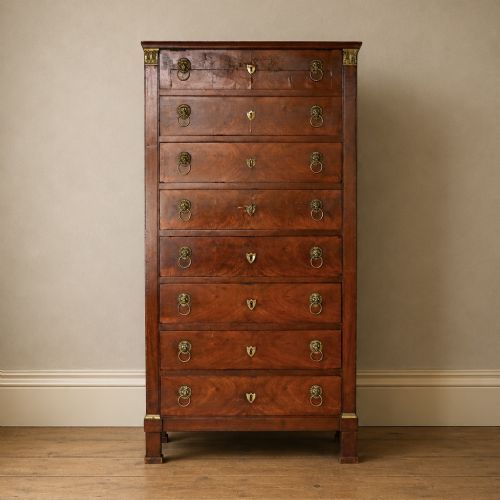
A french style secretary desk encompasses writing cabinets and drop-front bureaux originating across the nineteenth century, including revival styles and Victorian interpretations. Pieces range from upright secretaire à abattant cabinets to diminutive bonheur-du-jour writing desks fitted with upper tiers of shelves and drawers.
Buyers encounter varied formats designed for private correspondence and display, from narrow escritoires to elaborate ladies writing desks. These furniture pieces combine functional storage with decorative presence suited to sitting rooms and studies.
Materials and construction
Cabinetmakers constructed carcass frames from native and exotic timbers including mahogany, walnut, rosewood, kingwood, tulipwood and satinwood. Veneers and marquetry designs create geometric parquetry patterns or floral motifs across the writing surfaces and drop fronts.
Ormolu mounts and cast brass fittings accent the corners, drawer pulls and framing borders of nineteenth-century examples. Glass panels and painted plaques occasionally appear on upper cabinets and writing compartments, paired with fitted interior pigeonholes.
French Style Secretary Desk Retail Price Guide 2026
Typical asking prices for french style secretary desk among the pieces listed under this phrase on Sellingantiques today, from the lower quarter to the upper quarter. They describe what is for sale here now, not the wider market.
Many a Victorian letter writer relied on these hidden compartments to keep grocery lists away from prying eyes.
Assessing quality and execution
The refinement of the marquetry work and the crispness of the cast ormolu mounts dictate the upper tiers of production. Finer examples display carefully selected burr veneers and precisely fitted interior drawers behind the drop-front writing surface.
Structural integrity depends on the stability of secondary timbers and the precision of the joinery within the writing compartments and drawer linings. Maker attribution, when present through stamps or distinct execution, further separates standard production from exceptional cabinetwork.
Edwards and Roberts·Millet
The French Style Secretary Desk Glossary
- Secrétaire à abattant
- An upright tall cabinet featuring a hinged drop-front panel that conceals a fitted writing interior. This vertical form saves floor space while offering substantial compartmentalised storage.
- Bonheur-du-jour
- A light ladies writing desk featuring a small cabinet or set of drawers superstructure upon the main writing surface. Originating in France, these pieces frequently incorporate delicate marquetry and slender cabriole legs.
- Ormolu
- Gilded bronze used for decorative mounts, handles and feet on nineteenth-century cabinets. The metal is cast and chased before receiving a layer of gold amalgam.
- Marquetry
- Inlaid wood veneers assembled to form pictorial or decorative patterns across furniture surfaces. Craftsmen utilise contrasting tones of exotic timbers to achieve tonal depth.
- Parquetry
- Geometric wood inlay forming repetitive patterns such as cubes or chequers. This technique highlights the natural grain variations of kingwood, tulipwood and walnut.
French Style Secretary Desk: Frequently Asked Questions
What is a secretaire à abattant?
A secretaire à abattant is an upright cabinet with a vertical front that folds down to create a writing surface. Inside, small drawers and pigeonholes organise stationery and letters.
When closed, the piece presents a flat, decorative surface that showcases wood veneers and metal mounts without dominating the room layout.
How do I distinguish a bonheur-du-jour?
A bonheur-du-jour is a small writing desk distinguished by an upper tier of shelves, drawers, or a miniature cabinet attached to the back of the work surface. These compact desks were designed for lighter correspondence.
They appear frequently in nineteenth-century walnut, mahogany, and marquetry woods, often raised on slender legs.
Where were these desks used?
These desks served as private writing and correspondence stations within bedrooms, boudoirs, and formal drawing rooms. The lockable drop-fronts kept personal papers secure.
Today, they function as working writing desks or decorative display pieces in residential studies and living spaces.
How do I identify French revival styles?
French revival pieces adopt the curved lines of Louis XV or the neoclassical symmetry of Louis XVI, produced primarily during the nineteenth century. Details include ormolu mounts, floral marquetry, and shaped aprons.
Victorian makers in Britain also adopted these continental motifs, blending local cabinetmaking traditions with French aesthetic influences.