





French Street Painting
A french street painting captures the atmospheric charm of Parisian boulevards and provincial towns through expressive brushwork.
French Street Painting
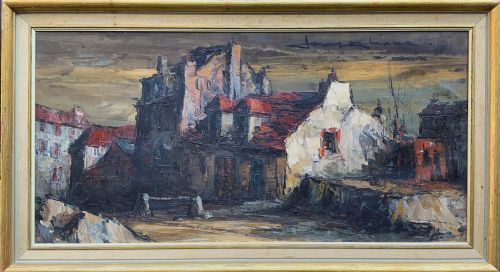
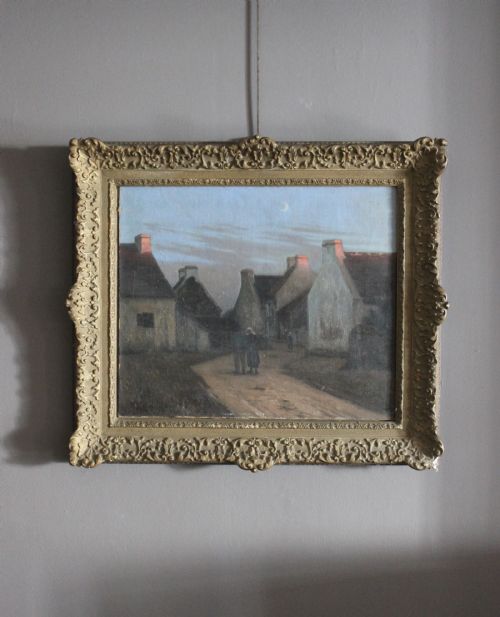
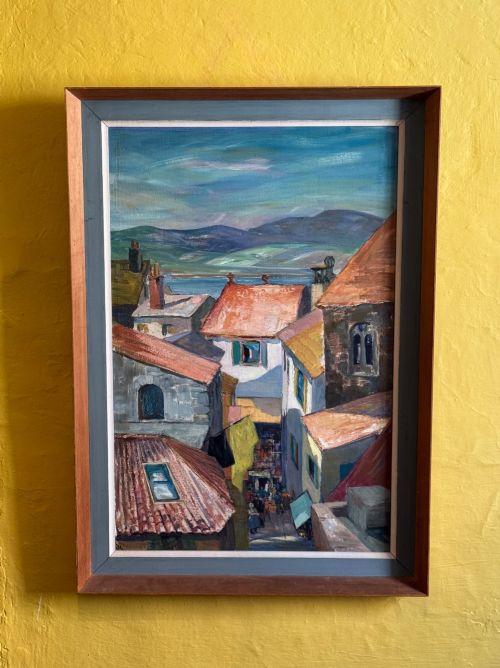
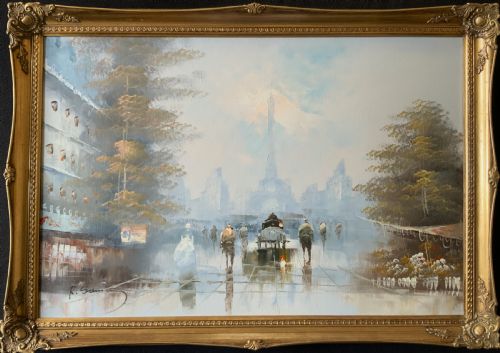
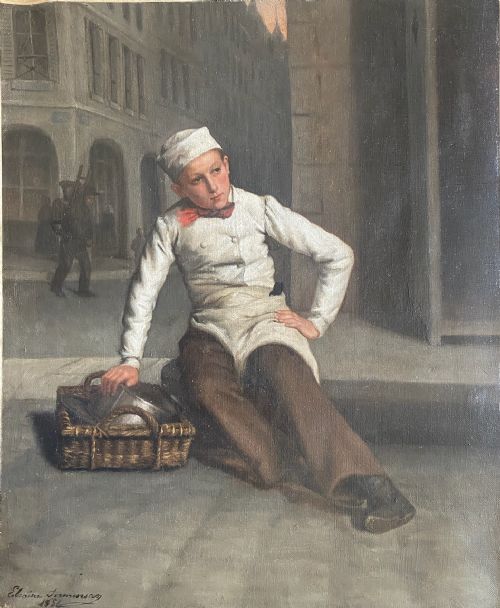
When you examine a french street painting, you are looking at urban landscapes, bustling markets, and quiet squares rendered by artists who observed daily life in France. These works range from grand nineteenth-century salon pieces to mid-century impressions of Paris cityscapes and provincial scenes.
The version you are most likely to meet on this page is an oil painting on canvas, framed in wood or gilt leaf, depicting famous landmarks like the Eiffel Tower or anonymous street corners during various daylight hours.
The selection encompasses periods stretching from the mid-nineteenth century through the mid-twentieth century, capturing stylistic shifts from realism and the belle epoque to post-impressionism and mid-century impressionism.
How they were made
Artists primarily employed oil paint on canvas or board, occasionally utilising watercolour on paper for lighter townscape studies. The application of pigment ranges from smooth, academic nineteenth-century glazing to the vigorous, textured impasto characteristic of mid-century impressionist works.
Surviving canvases are frequently housed in their original wood frames, sometimes embellished with gold leaf or gilt wood that reflects the aesthetic tastes of the painting's period.
French Street Painting Retail Price Guide 2026
Typical asking prices for french street painting among the pieces listed under this phrase on Sellingantiques today, from the lower quarter to the upper quarter. They describe what is for sale here now, not the wider market.
Among the quiet townscapes and grand cathedrals, a nineteenth-century mechanical organ figure and several street vendor figurines make a cheeky appearance.
What varies in quality
The distinction between a standard decorative canvas and a superior work lies in the handling of light, atmosphere, and human movement within the composition. Master painters manage to evoke the specific damp chill of a Parisian winter or the sun-drenched warmth of the Cote d'Azur with economy and precision.
The integration of the frame with the painting further dictates the piece's integrity, as period-matching gilt wood and frames enhance the visual weight of the artwork without overpowering the painted surface.
Albert Ludovici Jnr·Caroline Burnett·Victor Gabriel Gilbert·Cecil Rochfort D'Oyly-John·Merio Ameglio·Léon Joseph Voirin·Eduard Leon Cortes·Joseph W. Milliken·ALBERT GUILLAUME·Henry Schafer·Letitia Marion Hamilton
The French Street Painting Glossary
- Impasto
- Paint applied thickly to a canvas, standing out from the surface so that the marks of the brush or palette knife remain visible. This technique adds tactile depth and catches natural light effectively.
- Salon
- An official art exhibition held periodically in Paris, which established academic standards for fine art painting during the nineteenth century. Exhibiting in these shows marked a painter of established professional standing.
- Gilt wood
- Timber treated with a thin layer of gold leaf or metallic powder to resemble solid gold. It was widely utilised for decorative frames during the nineteenth and twentieth centuries.
- Genre painting
- Artwork depicting scenes from ordinary life, typically involving figures engaged in everyday activities. These pieces provide social history alongside artistic merit.
- Post-Impressionism
- A predominantly French art movement that developed roughly between the late nineteenth century and the early twentieth century. Practitioners extended impressionism while rejecting its limitations, focusing on more symbolic content and heavier brushwork.
French Street Painting: Frequently Asked Questions
How do I date a french street painting?
Dating relies heavily on stylistic cues, costume details of the figures depicted, and the construction methods of the stretcher and frame. Nineteenth-century works tend towards tighter realism, whereas mid-century examples often embrace looser impressionism and brighter palettes.
Signatures, artist biographies, and exhibition labels on the reverse provide further chronological anchors for specific canvases.
What subjects appear in these paintings?
Common subjects include Parisian boulevards, famous monuments like the Eiffel Tower, quiet provincial squares, cathedral facades, and bustling market days. Artists also turned their attention to coastal scenes in the south of France and winter views of Montmartre.
Figures such as street vendors, cab drivers, and resting citizens frequently animate the foregrounds of these townscapes.
How should I hang and light oil paintings?
Oil paintings on canvas require stable indoor humidity and protection from direct, prolonged sunlight to prevent the paint surface from drying out or cracking. Hang them securely on load-bearing walls using appropriate fixings suited to the weight of the wood frame.
Picture lights fitted with cool, low-uv LED bulbs mounted above the frame will illuminate the brushwork without generating damaging heat.
Are watercolours framed differently than oils?
Watercolour paintings on paper require glazing with glass or acrylic to protect the delicate medium from dust and moisture. They are typically mounted behind a card mat and fitted into lighter frames than heavy oil paintings.
Oil paintings on canvas or board are displayed unglazed to allow the textured surface of the paint to be seen directly.