


French Slate Mantle Clock
These heavy black slate and marble pieces bring architectural presence to a room, driven by brass movements and enamel dials.
French Slate Mantle Clock
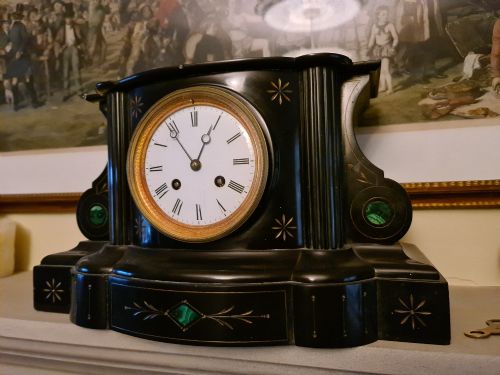
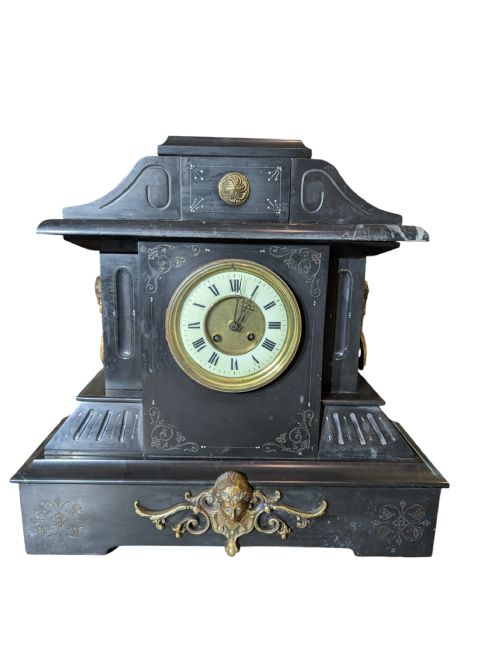
A french slate mantle clock is a substantial nineteenth-century timekeeper, most often encountered in Victorian architectural, classical revival, and empire styles from the decades between eighteen-fifty and eighteen-ninety. You will regularly find these clocks formed from heavy black marble or slate blocks, occasionally inlaid with contrasting coloured marbles and fitted with brass accents.
The objects span simpler domestic mantel clocks to grand garniture sets complete with side pieces, alongside specialised designs featuring perpetual calendars, equation of time complications, or bronze Egyptian revival figures.
How they were made
These clocks rely on dense blocks of black slate and marble, shaped into architectural facades, porticos, and temple-like cases by nineteenth-century stonemasons. The heavy stone chassis house mechanical eight-day brass movements, paired with enamel dials that often display visible escapements or detailed moon phases.
Inlaid stone panels and incised gilt detailing frequently decorate the main slate body, while cast brass bezels, lion mounts, and bronze figural elements complete the assembly.
Some dials feature a tiny painted moon that waxes and wanes behind a window to track the lunar cycle.
What varies in quality
Quality rests in the ambition of the architectural stone housing and the sophistication of the internal movement, moving from straightforward timepieces to complex perpetual calendars and equation of time mechanisms by makers such as Brocot. The crispness of the marble inlay, the weight of the cast bronze mounts, and the presence of matching garniture sets separate standard domestic clocks from exceptional pieces.
Philippes Paris·Baby and Jannings·Achille Brocot·Brocot
The French Slate Mantle Clock Glossary
- Garniture set
- A mantel clock accompanied by matching side ornaments, typically urns or vases in corresponding marble and slate.
- Movement
- The mechanical inner workings of the clock, driven by springs or weights to measure time and strike hours.
- Enamel dial
- A clock face made by fusing powdered glass to a metal substrate, providing a smooth, glossy surface for painted numerals.
- Egyptian Revival
- A nineteenth-century design style drawing on ancient motifs, hieroglyphs, and figural bronzes.
- Perpetual calendar
- A complex clock mechanism that automatically adjusts for months of differing lengths and leap years.
French Slate Mantle Clock: Frequently Asked Questions
How heavy are these clocks?
These pieces are constructed from solid blocks of natural stone, making them exceptionally heavy.
You should ensure your mantelpiece or shelf has adequate structural support before placing one.
Do they strike the hours?
The majority of these models contain eight-day mechanical movements that strike on bells or gongs.
Most can be adjusted or silenced if you prefer a quiet room.
What is a garniture set?
A garniture set pairs the central timepiece with matching decorative side pieces, usually urns or vases.
These were designed to create a balanced display across a mantel.
How do I wind the movement?
Winding requires a matching brass key inserted into specific arbors on the enamel dial.
Turning the key clockwise tensions the internal springs for the week ahead.