



French Rural Painting
These works capture the quiet spaces of French rural painting, bringing pastoral landscapes and village scenes into the home.
French Rural Painting
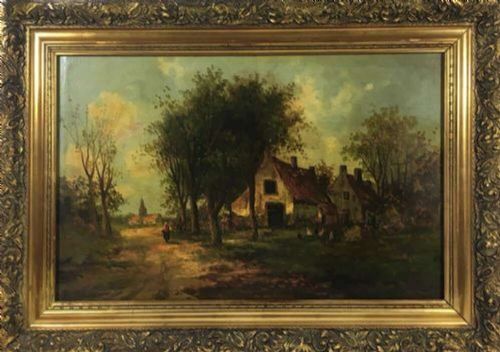
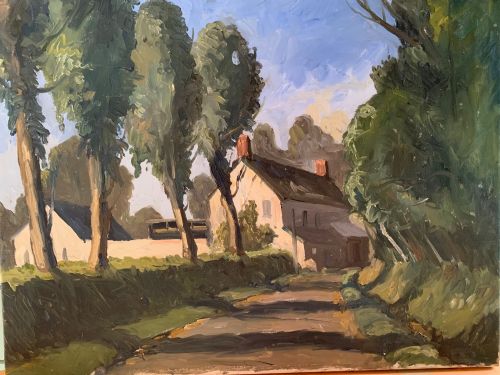
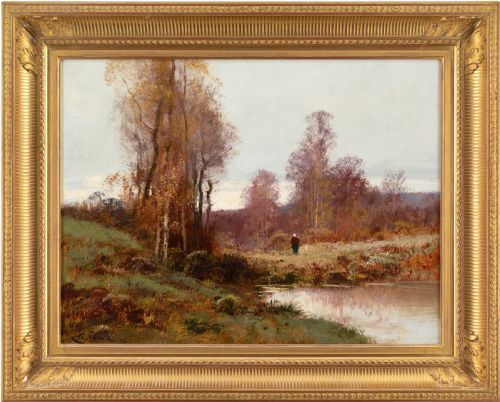
French rural painting encompasses oil paintings, watercolours and fine art focused on the countryside, farmyards and agricultural life. Canvases depict winding paths, river banks, haystacks and cattle grazing in regional landscapes from Provence to Normandy and Brittany.
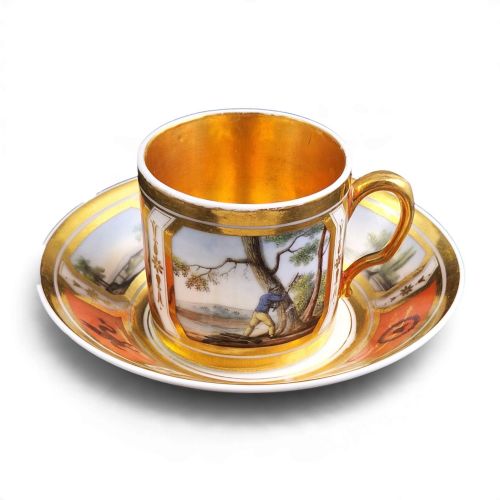
The pieces on this page span from the nineteenth century through the early twentieth century, incorporating periods such as the Barbizon School, Post-Impressionism and French Impressionism. Formats range from framed provincial oil paintings on canvas and wood panel to porcelain cups featuring rural views.
Materials and technique
Artists worked primarily with oil paint on canvas or wood panel, applying pigment to capture natural light and atmospheric conditions in pastoral settings. Some works utilise watercolour on paper, whilst other items take the form of hard-paste porcelain decorated with gold leaf and rural scenes.
Framed compositions rely on traditional stretched canvas techniques alongside wood panels, reflecting the working methods of nineteenth-century French schools and early twentieth-century colourists.
French Rural Painting Retail Price Guide 2026
Typical asking prices for french rural painting among the pieces listed under this phrase on Sellingantiques today, from the lower quarter to the upper quarter. They describe what is for sale here now, not the wider market.
Listings feature works spanning the nineteenth century through the 1950s, utilising canvas, oil paint, wood, porcelain and gold leaf.
Factors of quality
Quality rests upon the handling of light, brushwork and composition, where confident application brings depth to farmyards, rivers and figures in a landscape. Works associated with known regional schools or documented artists display superior command of colour and proportion.
Condition of the canvas, panel or porcelain surface alongside original framing contributes significantly to the integrity of the piece, separating standard decorative works from accomplished fine art examples.
Charles Clair·Raimond Louis Lecourt·Majorie Hoare·Eugene Battaille·Antoine Bouvard·Henri Joseph Harpignies·Maurice Asselin
The French Rural Painting Glossary
- Barbizon School
- A nineteenth-century French movement focused on realism in landscape painting, emphasising direct observation of nature and rural life. Artists drew inspiration from the forest of Fontainebleau and surrounding agricultural regions.
- Post-Impressionism
- An art movement extending Impressionism whilst rejecting its limitations, using vivid colours, distinct brushwork and symbolic subject matter. Works from this period often emphasise bold forms in pastoral settings.
- Hard-paste porcelain
- A ceramic material composed of kaolin and petuntse, fired at high temperatures to create a durable, vitrified body. It provides a smooth white base for hand-painted rural views and decorative motifs.
- Oil on canvas
- Pigment suspended in a drying oil applied to a woven fabric support stretched across a wooden frame. This medium allowed artists to build rich textures and tonal gradations.
French Rural Painting: Frequently Asked Questions
What periods do these paintings cover?
The selection spans the nineteenth and twentieth centuries, incorporating mid-nineteenth-century works from the Barbizon tradition as well as early twentieth-century Post-Impressionist canvases.
Dates extend from the 1860s through the 1940s, reflecting changing approaches to landscape and pastoral subject matter across different decades in France.
Where were these rural scenes painted?
Subjects are drawn from various regions across France, including Provence, Normandy, Brittany and the Loire Valley. Each location offered distinct geography, from southern olive groves and lavender fields to northern farmyards and river banks.
Artists often travelled to specific rural communities to paint agricultural life, farmhouses and local workers outdoors.
How should I hang an oil painting?
Oil paintings on canvas or wood panel should be hung away from direct sunlight and damp environments to protect the pigments and support. Ensure the wall brackets securely support the weight of the framed piece.
Maintaining stable room temperatures prevents the canvas and wooden stretcher frames from expanding or contracting excessively over time.
What subjects appear in these works?
Common subjects include farmyards, working horses, cattle by streams, washerwomen at work, haystacks and winding country paths. Figures are frequently integrated into pastoral landscapes depicting daily rural labour.
Occasional variations include village scenes, river banks and decorative porcelain items featuring painted pastoral motifs.