



French Restoration Side Table
A french restoration side table brings architectural walnut, mahogany, and veined marble into a room with the restrained lines of the early nineteenth century.
French Restoration Side Table
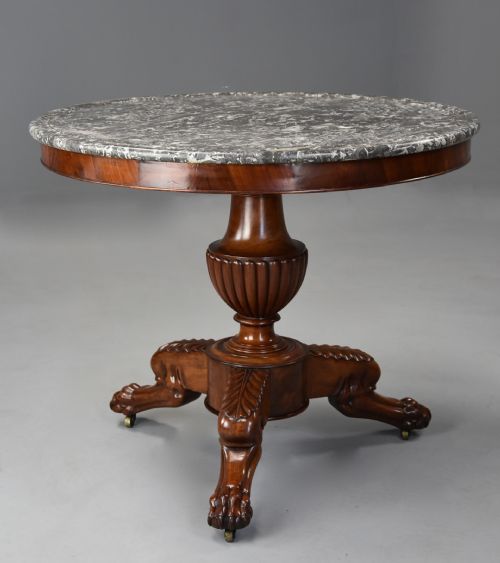
A french restoration side table encompasses console tables, occasional tables, centre tables, and side tables produced during the nineteenth century. These pieces align with the French Neoclassical, French Empire, and Charles X styles, capturing the architectural shift away from heavier Napoleonic designs.
Visitors to this page are most likely to meet circular gueridon tables and rectangular console forms. The structural vocabulary draws directly on nineteenth century French cabinetmaking traditions, utilising distinct timbers and stone tops.
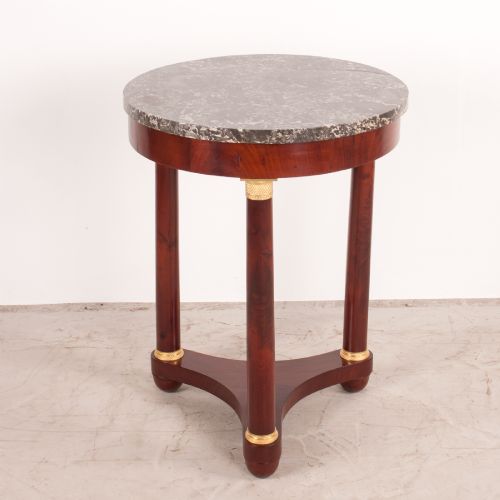
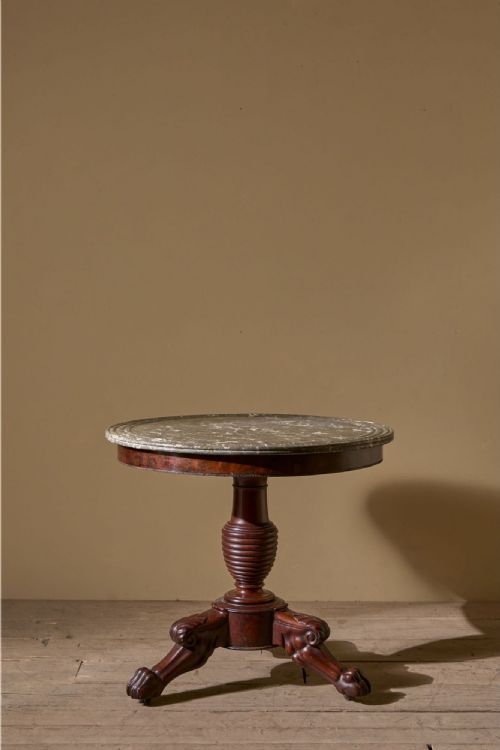
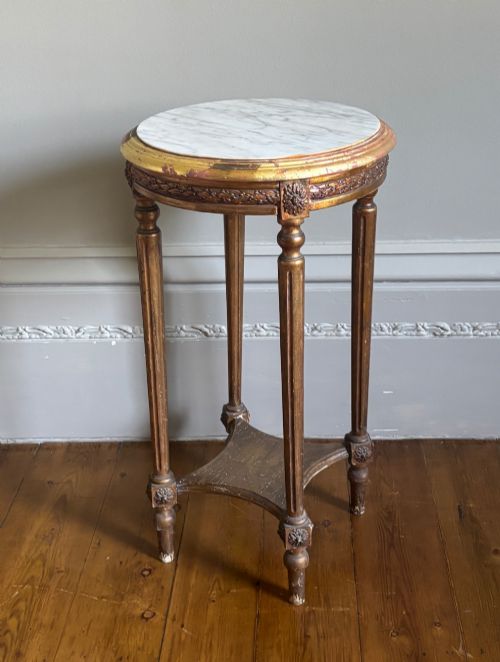
The materials recorded in these pieces include mahogany, walnut, burr elm, satinwood, coromandel, and giltwood. Tops are frequently fashioned from grey marble, fossil stone, or standard veined marble.
Materials and construction
Construction relies upon dense hardwoods such as mahogany, walnut, and exotic timbers including coromandel and burr elm. Cabinetmakers selected these for their rich grain patterns, often pairing timber frames with heavy stone or marble slabs.
Ornamentation incorporates brass and ormolu mounts alongside gold leaf and painted finishes. These decorative elements highlight the transition through the Regency and Charles X periods.
Early nineteenth century French cabinetmakers occasionally utilised fossil stone tops, ensuring every morning coffee rests upon ancient prehistoric remains.
Judging quality and proportion
Quality rests upon the selection of timber veneers and the integration of original stone tops. Tables retaining their original veined marble or grey marble slabs demonstrate greater architectural integrity than those with later replacements.
The refinement of the carving, the precision of brass or ormolu mounts, and the choice of secondary woods distinguish finer workshop production. Subtleties in proportion between the base and the surface define the visual balance of the piece.
The French Restoration Side Table Glossary
- Guéridon
- A small circular table on a central pillar, frequently topped with marble. This form dominates the occasional tables seen in the period.
- Console table
- A wall table supported by brackets or legs, designed to sit flush against a wall. The form often incorporates a marble or fossil stone top.
- Ormolu
- Gilded bronze mounted onto furniture. It provides metallic contrast against dark timbers like mahogany and walnut.
- Charles X
- A decorative style spanning the 1820s characterised by lighter woods and simplified classical proportions. It follows the French Empire period.
- Giltwood
- Timber coated with gold leaf. This finish appears on carved frames within nineteenth century French seating and tables.
French Restoration Side Table: Frequently Asked Questions
What is a gueridon table?
A gueridon is a circular table supported by a central pedestal pillar, commonly fitted with a stone or marble top.
These pieces function as occasional or centre tables within a room, offering a compact surface area.
How do console tables differ from side tables?
Console tables are designed to stand against a wall, frequently supported by front legs or wall brackets.
Side tables are generally freestanding items that can be positioned anywhere within a room scheme.
What woods were used in these tables?
Cabinetmakers utilised mahogany, walnut, satinwood, burr elm, and coromandel for their structural frames and veneers.
These timbers were often paired with contrasting marble tops or gilded mounts.
How do I identify a Charles X table?
Charles X pieces typically feature lighter woods such as satinwood and cleaner structural lines.
This aesthetic developed during the 1820s, moving away from the heavier gilt bronze style of the French Empire.