



French Opaline Lamp
A french opaline lamp brings soft, milky translucence to a room, combining tactile glass with metal mounts.
French Opaline Lamp
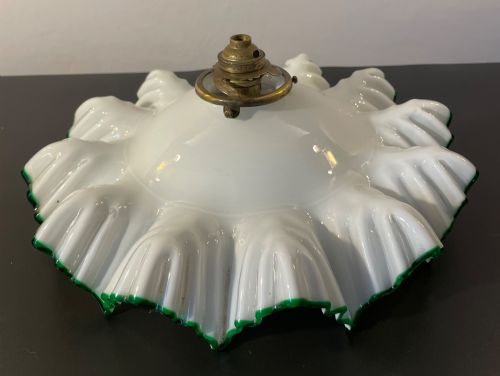
A french opaline lamp encompasses table lamps, pendant lights, and lampshades formed from dense, opaque or semi-translucent glass. These pieces span the Victorian era, the nineteenth century, and the twentieth century into the art deco period.
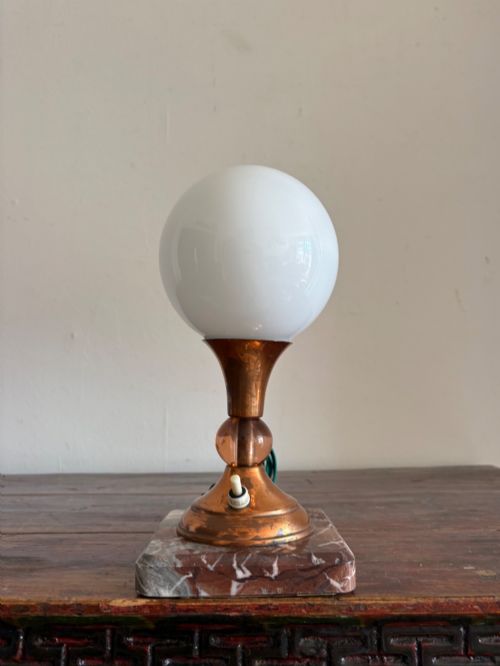
Table lamps frequently pair opaline shades or bodies with bases of brass, copper, marble, granite, bronze, or gilt bronze. Hanging lights and pendants utilise conical, dish, or frilled glass forms suspended from ceilings.
Victorian and nineteenth-century examples often lean towards ornate mounts and rich blue glass, whilst later art deco and mid-century designs favour geometric or streamlined copper and brass pairings.
How They Were Made
The glass elements rely on specialised glass-making techniques that suspend bone ash or other agents within the melt to achieve a milky, opalescent appearance. Blowers shaped the molten material into globes, cones, and decorative shades.
Metal components such as brass, bronze, gilt bronze, and copper were cast, chased, and mounted to support or house the glass. Heavier structural bases incorporate solid blocks of marble or granite to anchor the design.
French Opaline Lamp Retail Price Guide 2026
Typical asking prices for french opaline lamp among the pieces listed under this phrase on Sellingantiques today, from the lower quarter to the upper quarter. They describe what is for sale here now, not the wider market.
Listings feature pieces spanning the Victorian era, 19th century, 1980s, 1910, 1920, and 1930, utilising brass, bronze, copper, and marble.
What Varies in Quality
Quality rests on the depth and evenness of the opaline glass tone, alongside the crispness of the metal casting in the mounts. Finer pieces display harmonious proportions between the glass body and materials like gilt bronze or marble.
The sophistication of the period style, from rococo revival flourishes to art deco restraint, dictates the artistic merit of the framing work.
Perry & Co
The French Opaline Lamp Glossary
- Opaline Glass
- A milky, semi-translucent glass developed in 19th-century France. It diffuses light evenly and appears in various pastel and saturated colours.
- Gilt Bronze
- Bronze treated with a layer of gold. It provides a rich, metallic sheen often seen on period French bases and mounts.
- Art Deco
- A design style prominent in the 1920s and 1930s. It favours geometric shapes, stylised motifs, and modern industrial materials.
- Ormolu
- Finely ground high-carat gold applied to bronze. This decorative surface treatment enhances the warmth and visual weight of metal fittings.
French Opaline Lamp: Frequently Asked Questions
What is a french opaline lamp?
A french opaline lamp is a lighting fixture featuring milk-like opaline glass paired with materials such as brass, bronze, marble, or copper. These pieces range from Victorian table lamps to art deco pendants.
Originating in France across the nineteenth and twentieth centuries, they serve both as functional illumination and decorative centrepieces.
How do I date a lamp?
Dating relies on stylistic clues, mounting materials, and manufacturing techniques. Victorian and 19th-century examples often feature ornate gilt bronze or blue glass, whilst 1920s and 1930s pieces lean towards art deco geometric lines.
Heavier marble and granite bases often accompany the later twentieth-century iterations, matching the transition in interior tastes.
Where were these lamps used?
These lamps functioned as primary lighting in French homes, illuminating reception rooms, hallways, and boudoirs. Table versions sat upon desks and sideboards.
Larger pendant lights and dish lights hung from ceilings to cast diffused, ambient illumination across living spaces.
How do I clean opaline glass?
Clean opaline glass gently with lukewarm water and a mild detergent using a soft cloth. Avoid harsh abrasives that might scratch the delicate surface.
Take care around metal mounts like brass or gilt bronze to prevent moisture damage to the patinated finishes.