


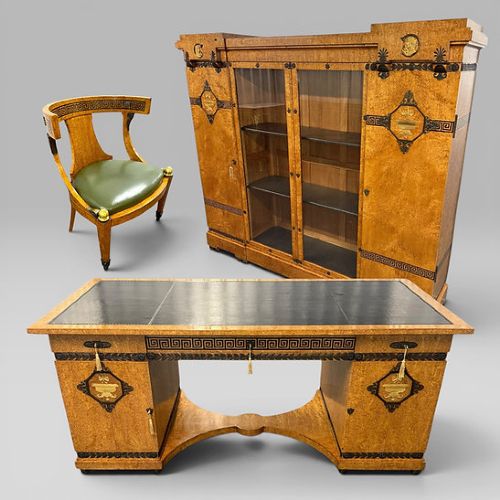



French Neoclassical Desk Set
These pieces bring stately writing desks to life, offering a french neoclassical desk set that combines heavy bronze and cool marble with classical symmetry.
French Neoclassical Desk Set
A french neoclassical desk set gathers the necessary tools of correspondence into a unified, formal arrangement designed for the writing table. You will frequently encounter heavy inkstands and encriers alongside elaborate clock garnitures and matching office sets.
The materials span cold Sienna marble, gleaming ormolu, and cast bronze, often reflecting the rigorous geometry of the Empire and Louis XVI styles. These items date from the eighteenth century through the Victorian era and the nineteenth century, showing formal restraint and classical motifs.
Whether you choose a standalone inkwell or a multi-piece office suite including a desk, cabinet, and chair, each piece anchors the study with architectural gravity. The forms remain rooted in European craftsmanship, utilising patinated bronze figures and gilt mounts to command attention.
How They Were Made
The foundation of these desk accessories rests upon dense stone bases, particularly Sienna marble, cut and polished to support heavy metalwork. Artisans mounted cast bronze and ormolu details directly onto the stone, securing them with threaded fittings and pins.
Gilding and patination define the metallic surfaces, where mercury or electroplate methods applied gold finishes to cast brass and bronze. Enamel elements and hand-chiselled detailing provide the finishing textures on mounts and dial faces.
French Neoclassical Desk Set Retail Price Guide 2026
Typical asking prices for french neoclassical desk set among the pieces listed under this phrase on Sellingantiques today, from the lower quarter to the upper quarter. They describe what is for sale here now, not the wider market.
What Varies in Quality
The distinction in these desk accessories lies in the crispness of the bronze chasing and the density of the marble base. Superior pieces display deep, hand-finished detailing on figurative elements like horses or portrait busts, whereas simpler examples rely on softer, routine casting.
Coherence across multi-piece sets elevates the work, uniting the patination of the bronze with the matching veining of the marble. Complete suites by documented makers retain a stronger architectural integrity than assembled groups of disparate items.
Mercier Frères·Lefebvre of Belgium·Ferdinand Berthoud
The French Neoclassical Desk Set Glossary
- Ormolu
- Gilt bronze produced by applying a mercury-gold amalgam to cast bronze, creating a rich, durable golden surface. This technique was widely employed in high-status French decorative arts.
- Encrier
- A portable writing stand or inkstand containing inkwells, sanders, and pen holders. These desk accessories served as functional centrepieces for correspondence.
- Clock Garniture
- A matching set consisting of a central mantel clock accompanied by side ornaments such as candelabras or vases. They provide symmetry when arranged on a mantelpiece or large desk.
- Sienna Marble
- A yellow or brownish-yellow ornamental limestone quarried in Italy, featuring dark purple or grey veining. It provides a heavy, colourful base for bronze mounts.
French Neoclassical Desk Set: Frequently Asked Questions
What is an encrier?
An encrier is a traditional writing stand designed to hold inkwells and pen nibs on a desktop.
These pieces formed an essential part of historical correspondence before the invention of the fountain pen.
How do I style a desk set?
Place the main inkstand or clock centrepiece directly in the middle of a large writing table.
Keep surrounding items minimal to let the heavy bronze and marble proportions dominate the room.
What periods do these pieces span?
The available items primarily date from the nineteenth century, including Victorian adaptations and earlier eighteenth century examples.
Earlier pieces often reflect strict Empire and Louis XVI design canons.
Are these items functional?
Many inkstands and inkwells retain their original glass or ceramic liners for holding liquid ink.
Collectors generally appreciate the mechanism and craftsmanship rather than utilising them for daily writing.