
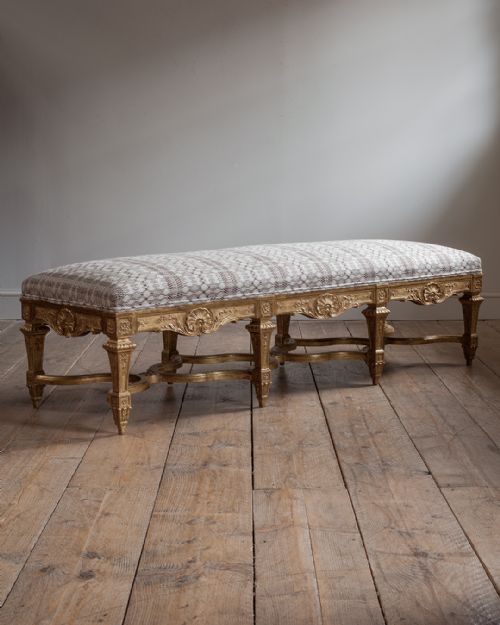
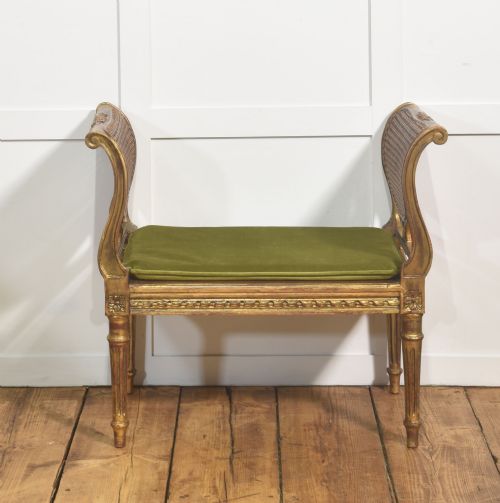


French Gilt Window Seat
A french gilt window seat brings decorative presence to a bedroom or gallery with its gilded frame and upholstered or caned seat.
French Gilt Window Seat
A french gilt window seat is a low seating form designed for placement beneath a window or along a hallway, combining functional seating with ornamental impact. The pieces appearing here span long benches, two seater sofas, duet stools, and X frame stools derived from classical models.
Most examples date from the nineteenth century into the early twentieth century, drawing heavily on Louis XIV, Louis XVI, Empire, and Rococo revival vocabularies. The forms range from compact single stools to elongated canework couches and upholstered boudoir seats.
Makers and workshops across these periods utilised traditional European seating proportions, often pairing gilded woodwork with cane panels, velvet upholstery, or decorative fabric finishes. These seating items served functional roles in boudoirs and drawing rooms while displaying the ornate tastes of their eras.
How they were made
The structural framework relies on timber such as walnut or general wood substrates, shaped into curved rails, fluted legs, and structural supports. Carvers applied gesso and gold leaf to create the characteristic giltwood surface, while parcel gilt variations combined paint with exposed gilding.
Upholstery techniques involved textile coverings, velvet, and fabric padding secured over internal webbing, alongside natural cane interlaced tightly within wooden seat rails. These methods required skilled joinery to support the weight of occupants while maintaining slender, decorative profiles.
Several boudoir seats arrived upholstered in dusky pink and powder blue velvets, proving that past owners loved soft pastel drama.
What varies in quality
The refinement of the carving distinguishes finer examples from simpler production, visible in the crispness of acanthus leaves, floral motifs, and structural moulding. Superior pieces exhibit hand carved detail on solid timber frames rather than heavier, less articulated construction.
The application of the gilt surface determines visual depth, where burnished gold leaf reflects light differently than flat metallic paint. Furthermore, the integrity of the cane work or the execution of the fabric upholstery indicates the level of craftsmanship invested in the piece.
The French Gilt Window Seat Glossary
- Giltwood
- Wood coated with a thin layer of gold leaf over a prepared gesso ground. This material provides the bright metallic finish seen on classical revival furniture.
- Canework
- Woven rattan or cane material forming a breathable seat or back panel. It appears frequently on lighter revival seating from the early twentieth century.
- Empire Style
- A nineteenth century design movement inspired by ancient Roman, Greek, and Egyptian motifs. It favours monumental forms, curule shapes, and formal symmetry.
- Curule stool
- An ancient Roman stool shape featuring intersecting X shaped legs. This form was revived during the nineteenth century for formal halls and drawing rooms.
- Louis XVI Style
- A neoclassical design vocabulary characterised by straight fluted legs, geometric symmetry, and restrained classical ornamentation.
French Gilt Window Seat: Frequently Asked Questions
Where should I place a window seat?
These pieces suit placement beneath low windows, along long corridors, or at the foot of a bed in a principal bedroom.
Their narrow proportions allow them to occupy circulation spaces without blocking pathways while offering convenient occasional seating.
How do I identify the design style?
Look to the leg geometry and carving motifs to determine the stylistic period of the frame. Straight fluted legs point to neoclassical revivals, while curved cabriole supports connect to rococo models.
Empire pieces display heavier classical references such as X frames and architectural moulding.
What is the difference between cane and upholstered seats?
Cane seats utilise woven plant material to create a firm, semi transparent surface that lightens the visual weight of the furniture. Upholstered versions employ fabric, velvet, or textile coverings over internal padding for softer seating.
Both finishes appear across nineteenth and early twentieth century examples.
Are these seats sturdy enough for daily use?
Most surviving examples were built using traditional joinery on hardwood frames designed for actual domestic seating. While decorative, they function well for sitting when placed on level flooring.
Care should be taken with delicate cane panels or antique textile upholstery during regular use.