



French Gemstone Jewellery
French gemstone jewellery brings together vibrant coloured stones and fine European metals from the nineteenth and twentieth centuries.
French Gemstone Jewellery
You are most likely to meet cluster rings, navette rings, and pendant lockets featuring diamonds alongside rubies, emeralds, and sapphires. Yellow gold, white gold, and platinum serve as the primary settings for these stones.
Makers from these diverse decades utilised characteristic regional motifs, ranging from delicate floral sunbursts to geometric platinum work. Each object reflects the prevailing aesthetic of its specific decade of production.
How these pieces were made
The workshops utilised high-carat yellow gold, white gold, and platinum to mount precious and semi-precious stones securely. Craftsmen combined metals like silver and gold in earlier nineteenth-century brooches before platinum gained dominance in twentieth-century settings.
Gems including rubies, emeralds, sapphires, diamonds, pearls, aquamarines, and amethysts were cut and shaped by hand to fit intricate cluster, navette, and bangle designs. Skilled setters integrated smaller accent diamonds around central stones to enhance visual brilliance.
French Gemstone Jewellery Retail Price Guide 2026
Typical asking prices for french gemstone jewellery among the pieces listed under this phrase on Sellingantiques today, from the lower quarter to the upper quarter. They describe what is for sale here now, not the wider market.
Materials span platinum, 18ct yellow gold, 18ct white gold, and 18ct rose gold, alongside silver-topped gold settings.
What varies in quality
The distinction between tiers rests upon the choice of materials and the complexity of the metalwork. Pieces featuring unheated natural gemstones or heavy platinum mountings represent a higher standard than simpler alloy castings.
Proportion and the precision of the stone setting dictate visual success. Superior items display balanced gemstone weights and secure claw or bezel work that holds complex multi-stone layouts firmly in place.
Chaumet
The French Gemstone Jewellery Glossary
- Navette
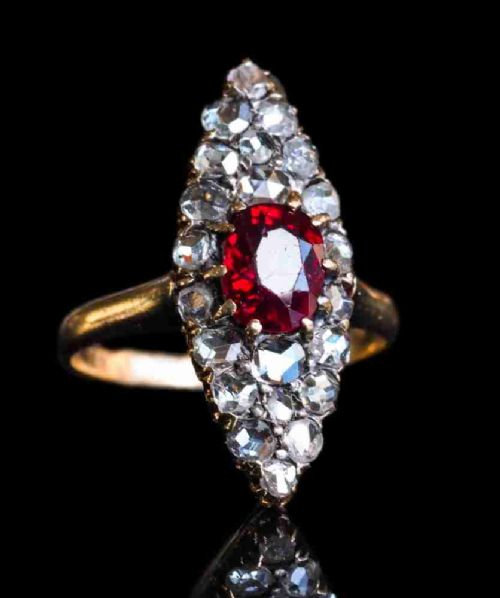
- A boat-shaped ring setting featuring pointed ends that lengthens the appearance of the finger. This silhouette appears frequently in late nineteenth-century designs.
- Belle Epoque
- A stylistic period spanning the late nineteenth century up to the First World War characterised by delicate platinum garlands and lace-like diamond work.
- Art Deco
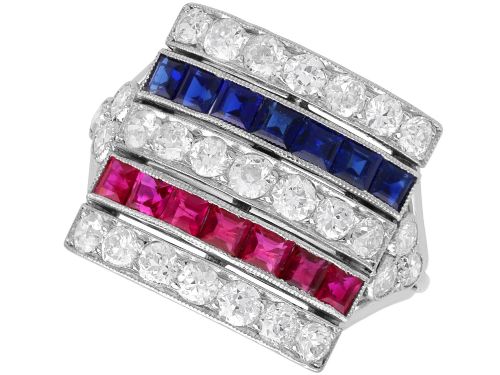
- A twentieth-century design movement favouring strong geometric lines, symmetry, and platinum settings often paired with calibrated rubies, sapphires, and emeralds.
- Cluster ring
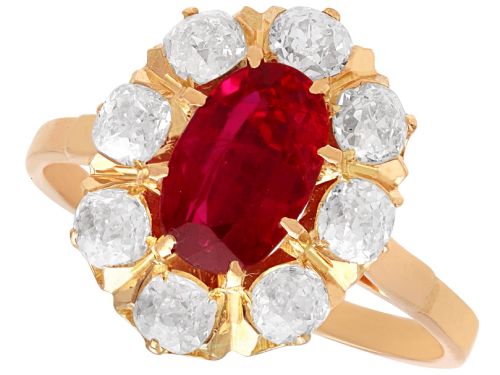
- A ring design where a central gemstone is surrounded by a tight formation of smaller accent stones, typically diamonds.
- Witch's heart
- An asymmetrical pendant form with a twisted tip, traditionally given as a token of romantic love in antique French pieces.
French Gemstone Jewellery: Frequently Asked Questions
What periods do these pieces cover?
The selection spans from the nineteenth century through the Victorian era, Belle Epoque, Art Deco, and into the nineteen-sixties. Each era brings distinct metallurgical techniques and artistic styles.
You will find that nineteenth-century items often use yellow gold and silver-topped gold, whereas twentieth-century creations lean heavily into platinum and white gold settings.
How do I care for antique gemstone jewellery?
Precious stones and delicate metal settings require gentle handling and periodic inspection by a professional jeweller. Avoid harsh chemical cleaners and ultrasonic baths, particularly for pearls and softer stones.
Store each piece individually in a lined box to prevent scratching between harder diamonds and softer gems like amethysts or opals.
Are the gemstones natural?
Many listings specify natural stones such as unheated rubies, natural pearls, and genuine emeralds, aquamarines, or sapphires. Certification details are noted where provided by the individual dealer.
Examination under magnification reveals natural inclusions that distinguish these earth-mined materials from synthetic alternatives.
How do I identify Art Deco pieces?
Art Deco items typically feature platinum construction, stark geometric lines, and symmetrical arrangements of diamonds alongside calibré-cut rubies, emeralds, or sapphires. These pieces emerged strongly during the nineteen-twenties and nineteen-thirties.
The focus shifts away from nineteenth-century organic floral motifs toward streamlined architectural forms and bold colour contrasts.