

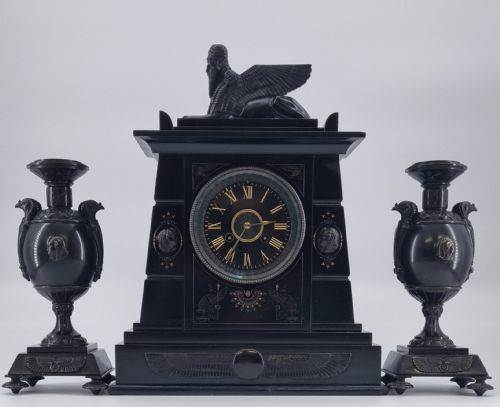


French Clock 1860
A french clock 1860 brings ornate Second Empire grandeur and precise engineering into a room, offering both decorative presence and mechanical mastery.
French Clock 1860
A french clock 1860 typically arrives as a mantel clock, often accompanied by matching garnitures, or as a portable carriage clock designed for travel. These pieces reflect the lavish ornamentation of the mid nineteenth century, spanning Victorian, Napoleon III, and revival aesthetics.
The dominant forms on this page include grand mantel clocks housed in brass, ormolu, and porcelain, alongside refined carriage clocks with intricate engravings. Buyers encounter diverse decorative vocabularies, ranging from Egyptian Revival motifs to classic French Rococo flourishes and Boullework.
Originating predominantly from French workshops during the 1860 period, these horological items serve as focal points for a mantelpiece or desk. They combine functional timekeeping with sculptural bronze, enamel dials, and inset portrait plaques.
How they were made
Maker workshops utilised heavy brass and gilt bronze to cast elaborate structural cases, frequently applying mercury gilding or ormolu finishes to achieve a brilliant metallic sheen. Porcelains and hand-painted enamel dials were integrated into the bronze frameworks to provide contrasting textures and visual depth.
For carriage clocks, makers constructed robust glass-panelled brass housings designed to protect the repeating escapement movements visible within. Boulle pieces required meticulous application of tortoiseshell and brass inlay across curved wooden carcasses, demanding advanced cabinetmaking skills.
Movements were engineered for eight-day striking capabilities, often featuring bell or gong sound components and finely engraved backplates. Artisans chased the metal surfaces by hand, carving crisp foliate patterns, figural putti, and architectural details directly into the bronze.
French Clock 1860 Retail Price Guide 2026
Typical asking prices for french clock 1860 among the pieces listed under this phrase on Sellingantiques today, from the lower quarter to the upper quarter. They describe what is for sale here now, not the wider market.
Listings demonstrate a strong presence of gilt bronze, ormolu, and brass materials, frequently styled in Napoleon III and Victorian revival forms.
What varies in quality
The distinction between standard production and superior work rests on the crispness of the bronze chasing and the depth of the gilding. Master artisans achieved sharp relief in figural casts and architectural mounts, whereas lesser examples exhibit softer details and simpler surface treatments.
Quality also manifests in the complexity of the clock movement and the integrity of the fitted case materials, such as genuine tortoiseshell in Boullework or hand-painted porcelain plaques. Fully engraved carriage clock cases and signed movements by known makers elevate the piece beyond standard decorative timepieces.
Lamy and Lacroix·P.H. Mourey
The French Clock 1860 Glossary
- Ormolu
- A gilded bronze technique used extensively for decorative mounts on nineteenth-century French clock cases. It provides a rich, gold-coloured finish that resists tarnishing.
- Garniture
- A set consisting of a central clock flanked by matching decorative objects, such as urns or candelabra, designed to display together on a mantelpiece. These matching sets unify interior decorative schemes.
- Boulle
- A style of marquetry using brass and tortoiseshell inlaid in elaborate scrollwork patterns, named after the cabinetmaker André-Charles Boulle. This technique adds striking contrast and texture to clock enclosures.
- Carriage clock
- A small, spring-driven clock featuring a glass-panelled brass case and a carrying handle, originally built for travellers. Many examples from this era include striking and repeating mechanisms.
- Escapement
- The mechanical linkage inside a clock that regulates the unwinding of the mainspring by releasing the gear train at measured intervals. It produces the characteristic ticking sound.
French Clock 1860: Frequently Asked Questions
What is a clock garniture set?
A garniture set pairs a central mantel clock with two matching side ornaments, such as decorative urns or candelabra. These pieces were designed to be displayed together as a unified decorative arrangement on a mantelpiece.
Matching materials and stylistic motifs across the set create visual symmetry in a formal interior.
How do carriage clocks work?
Carriage clocks utilise a spring-driven movement housed inside a brass frame with glass panels, allowing the internal escapement to remain visible. They are built to be portable timepieces that maintain accuracy while moving.
Many period examples incorporate repeating mechanisms that sound the hours and quarters upon pressing a button on the top case.
How do I identify Napoleon III style?
Napoleon III design borrows heavily from historic French periods like Louis XIV and Rococo, combining them with opulent Victorian tastes. Look for heavy use of gilt bronze, porcelain plaques, and rich materials like tortoiseshell.
This aesthetic prioritises ornate visual drama, intricate metal chasing, and symmetrical grandeur suited to mid-nineteenth-century salons.