



French Carved Tallboy
A French carved tallboy offers grand vertical storage and rustic continental character, uniting deep walnut, oak, and marble into an imposing bedroom focal point.
French Carved Tallboy
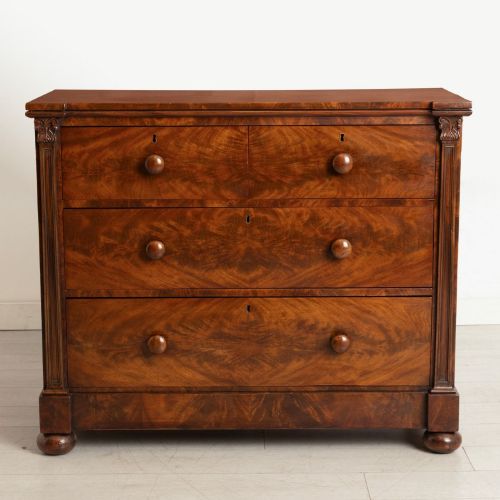
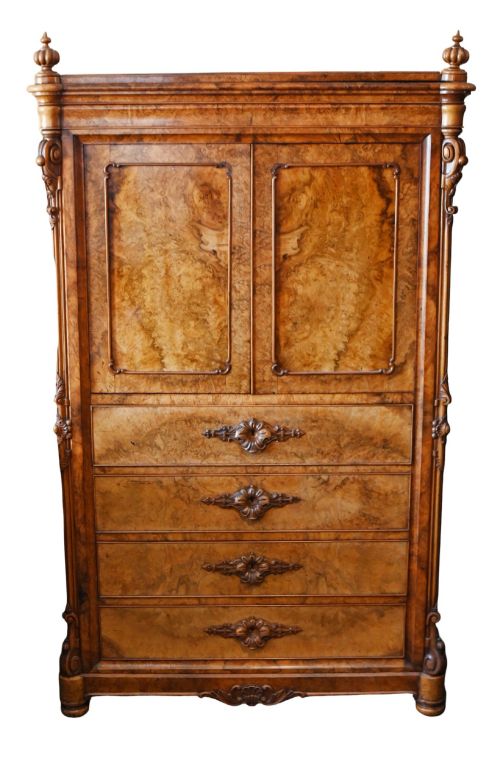
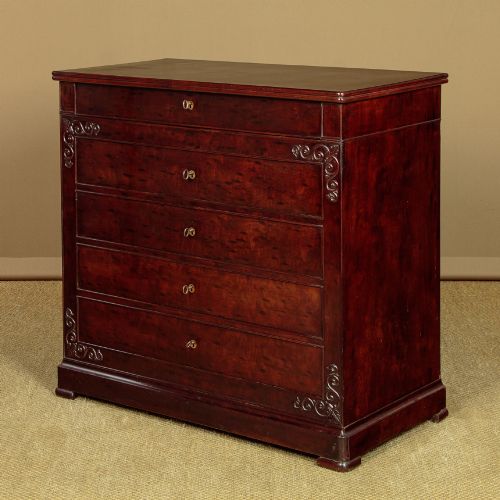
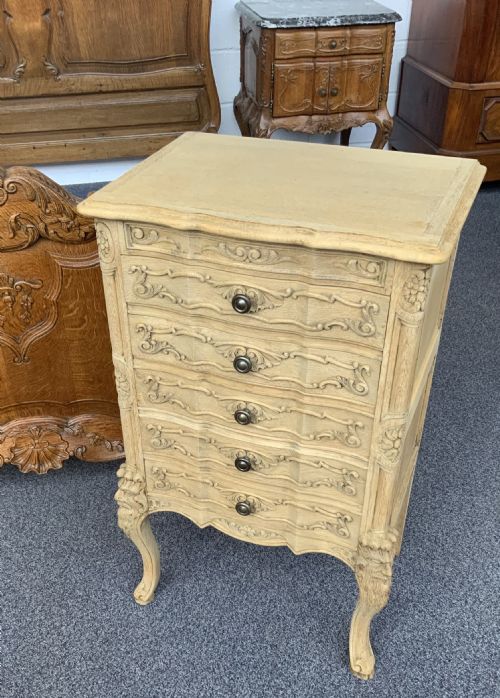
A french carved tallboy stands as a tall chest of drawers or secretary cabinet, delivering significant vertical storage while occupying a modest floor footprint. These pieces bring substantial presence to a bedroom, combining traditional storage with refined surface detail.
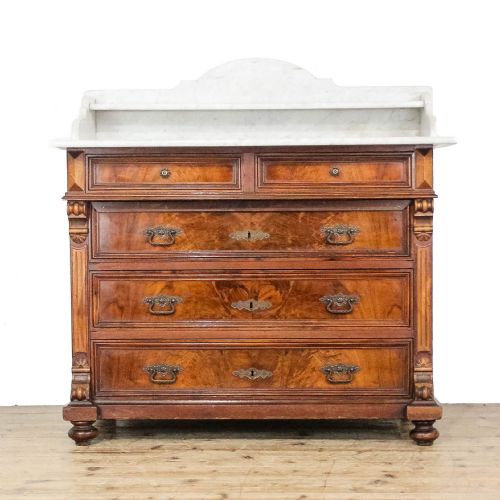
The selections span the eighteenth century, the nineteenth century, and the early twentieth century, taking shape through Victorian influences, French Empire designs, Louis Philippe lines, and French Provincial or Chateau styles. Mahogany, walnut, burr walnut, and oak dominate the construction, often topped with marble or fitted with brass and iron hardware.
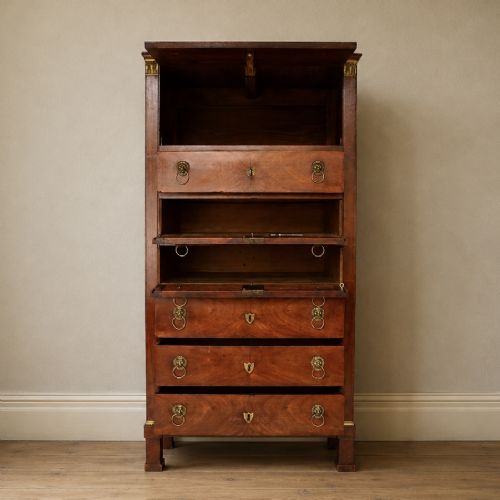
Buyers encounter variations ranging from secretary cabinets with drop-down writing surfaces to marble-topped chests and traditional tall drawer units. Each variation reflects the distinct regional tastes and cabinetmaking traditions of continental Europe and the Victorian era.
Materials and construction methods
Cabinetmakers built these tall storage pieces using dense hardwoods like mahogany, walnut, burr walnut, and oak, applying hand-carved details directly to the timber frames. Burr walnut veneers provided rich, swirling grain patterns across drawer fronts, while solid oak and mahogany formed sturdy structural carcases.
Marble slabs were fitted to the upper surfaces of specific nineteenth-century chests, offering a cool, durable finish that contrasted with the warm tones of the timber below. Metal fittings such as brass and iron supplied structural reinforcement and functional handles.
Secretaries hide tiny wooden pigeonholes behind fold-down desks, built for letters penned when inkpots ruled the room.
Distinctions in craftsmanship and finish
Quality rests in the crispness of the hand carving and the depth of figure in the walnut or mahogany veneers. Finer examples display harmonious grain alignment across multiple drawers and precise joinery that withstands centuries of use.
The integration of fitted marble tops and quality brass or iron hardware distinguishes elevated workshops from standard production. Cabinetmakers who achieved balanced proportions on tall, narrow forms demonstrated superior spatial planning and structural stability.
The French Carved Tallboy Glossary
- Tallboy
- A tall chest of drawers, typically comprising multiple stacked drawers that provide high-capacity storage on a compact base footprint. These pieces are designed to maximise vertical wall space in traditional bedrooms.
- Secrétaire
- A cabinet or chest featuring a built-in writing drawer with a drop-down front that conceals small compartments and pigeonholes. It combines a writing desk with standard drawer storage.
- Burr walnut
- Timber sliced from walnut tree growths that produces intricate, swirling grain patterns highly prized for decorative veneer work. Cabinetmakers used these veneers on primary display surfaces to create visual depth.
- Louis Philippe
- A mid-nineteenth-century French style characterised by understated curves, restrained ornamentation, and an emphasis on the natural beauty of timber. It avoids excessive carving in favour of clean, elegant lines.
- French Empire
- A neoclassical design style spanning the nineteenth century, known for stately proportions, dark woods, and restrained classical mounts. It reflects grand architectural motifs popularised during the Napoleonic era.
French Carved Tallboy: Frequently Asked Questions
What is a french carved tallboy?
A french carved tallboy is a tall chest of drawers or cabinet originating from continental traditions, featuring decorative woodwork and vertical storage.
These pieces combine practical capacity with distinct stylistic details from the eighteenth and nineteenth centuries.
How do I style a tallboy in a modern room?
Position the tallboy against a neutral wall to let the carved timber grain and marble top serve as the primary visual feature.
Balance its height by placing simpler low furniture nearby, and use the top surface for minimal decorative objects.
What woods were used for these cabinets?
Cabinetmakers primarily utilised walnut, burr walnut, oak, and mahogany for the structural frames and decorative drawer fronts.
These durable hardwoods were often paired with marble tops and metal hardware made from brass or iron.
How do I date an antique tallboy?
Dating relies on identifying stylistic markers from periods such as the eighteenth century, the Victorian era, or the Louis Philippe reign.
Examine the construction methods, secondary timbers, and hardware styles to confirm the manufacturing era.