
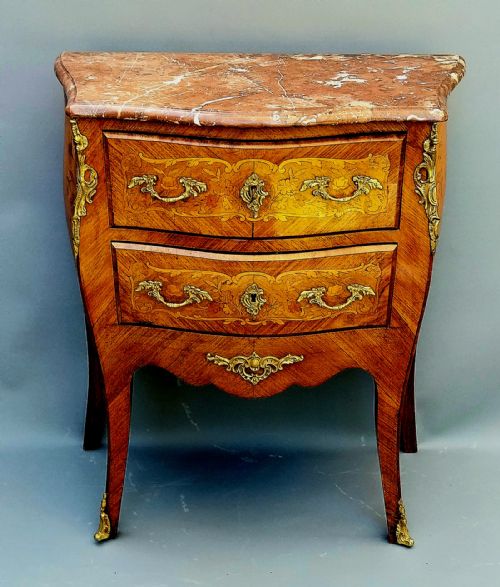


French Bombe Bedside Cabinets
French bombe bedside cabinets bring swelling serpentine lines and rich veneers into the bedroom, offering opulent storage rooted in eighteenth-century continental design.
French Bombe Bedside Cabinets
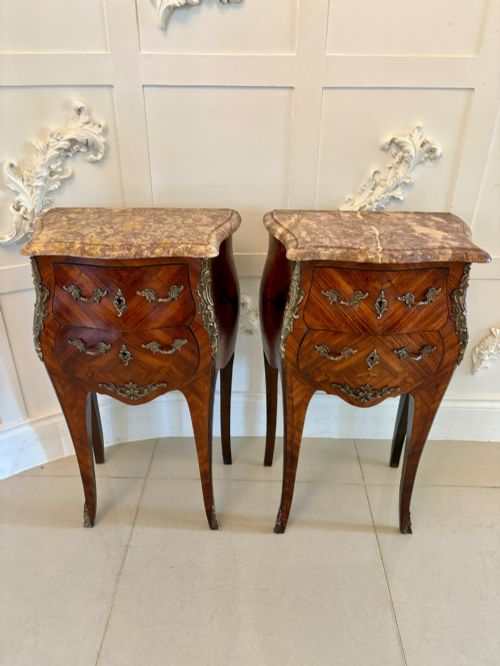
These pieces are distinctively curved bedside tables and small commodes shaped with swelling fronts and sides, designed to provide practical bedside storage with dramatic continental presence. When searching for french bombe bedside cabinets, a buyer encounters nineteenth-century examples and revival pieces that emulate classic rococo forms.
The selection ranges from matched pairs of compact cabinets to larger petite commodes and bedroom suites incorporating rich marquetry and parquetry. Most examples hail from the nineteenth century or later revival periods, displaying the characteristic bulging profile and shaped marble tops.
Makers and craftsmen of the era utilised luxurious woods like kingwood, walnut, and tulipwood to accentuate the swelling contours. These cabinets serve as functional bedside surfaces while acting as sculptural focal points in traditional and eclectic interiors alike.
How they were made
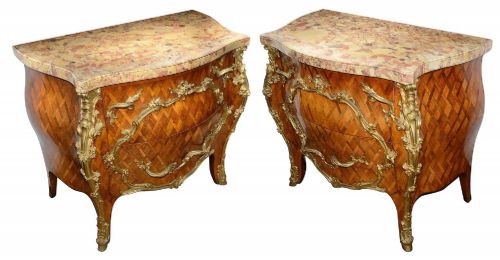
Cabinetmakers constructed these pieces using complex wood veneers such as kingwood, walnut, and tulipwood applied over a sturdy carcass to achieve the pronounced swelling curves. Marquetry and parquetry patterns were meticulously hand-cut and laid in geometric or floral arrangements across the drawer fronts and sides.
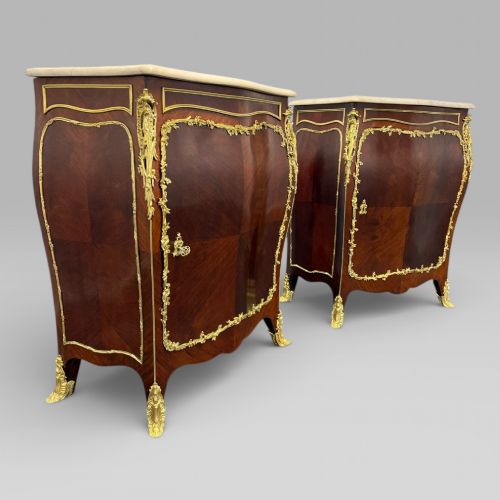
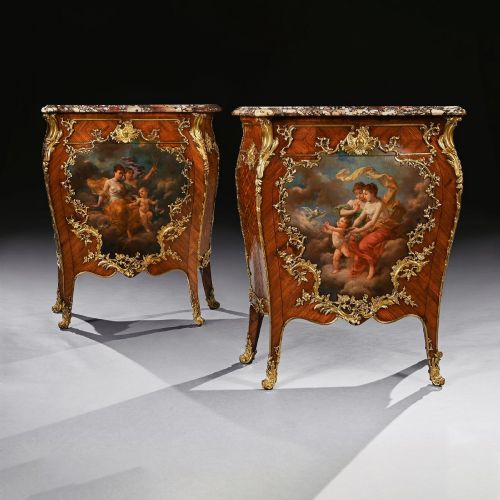
Gilt bronze and ormolu mounts were cast and chased to highlight the corners, aprons, and handles, providing both structural protection and ornamental contrast. Fitted marble tops were shaped to follow the exact contours of the bombe carcass, requiring precise masonry skills.
Some nineteenth-century makers hid secret compartments within the swelling curves of their commodes for private letters.
What varies in quality
The calibre of a cabinet rests upon the sophistication of its veneer work and the crispness of the cast ormolu mounts. Finer examples display seamless matching of wood grains across complex curves and heavier, more deeply chased bronze hardware.
Structural integrity depends on the joinery used to maintain the swelling shape over decades of atmospheric changes. Superior pieces feature heavier marble tops with exact edge profiling and thicker primary timbers that prevent warping.
E. Kahn
The French Bombe Bedside Cabinets Glossary
- Bombe
- A convex, bulging shape characteristic of continental furniture from the eighteenth century onwards. This swelling profile requires advanced veneering techniques.
- Ormolu
- Gilded bronze mounts and decorative hardware applied to furniture. High-quality ormolu exhibits sharp detail and deep hand-chasing after casting.
- Parquetry
- Geometric patterns formed by small pieces of veneered wood fitted together. It creates intricate tiled surfaces across drawer fronts and tops.
- Vernis Martin
- A type of European lacquer developed to imitate Japanese lacquer finishes. It provides a glossy, decorative surface often seen on finer cabinet doors.
- Serpentine
- A line or surface that curves outward and then inward, creating an undulating edge. This contour frequently frames the tops and fronts of bedside chests.
French Bombe Bedside Cabinets: Frequently Asked Questions
Are these cabinets purely decorative?
While visually striking, french bombe bedside cabinets offer functional storage through drawers and cupboards designed for bedside use.
Their robust construction and fitted marble surfaces make them practical everyday furniture for holding lamps and personal items.
How do I care for the marble top?
Marble tops require gentle cleaning with mild soap and water, avoiding acidic cleaners that can etch the polished surface.
Using coasters and mats helps protect the stone from moisture and staining over years of daily use.
How do I identify the period?
Dating relies on examining secondary woods, construction methods, and the style of the cast bronze mounts. Nineteenth-century revival pieces often display heavier carcass construction compared to later twentieth-century iterations.
Maker signatures or stamps, when present, provide definitive clues to the workshop of origin.
Will they fit modern beds?
Most antique bedside cabinets are compact, but buyers should check the height against modern mattress levels before purchasing.
The swelling bombe shape means the footprint at the widest point is greater than the top surface dimensions.