


French Art Deco Buffet
A French art deco buffet delivers bold architectural presence and rich figured timber to a dining room.
What a french art deco buffet is
A french art deco buffet is a substantial storage piece built during the early twentieth century, taking the form of sideboards and servers. These pieces combine geometric massing with sophisticated storage compartments designed for dining rooms.
The evidence shows examples dating specifically to nineteen thirty and nineteen forty, representing the height of the modernist movement. Sideboards dominate the available forms, often paired in dining room suites with matching tables.
How they were made
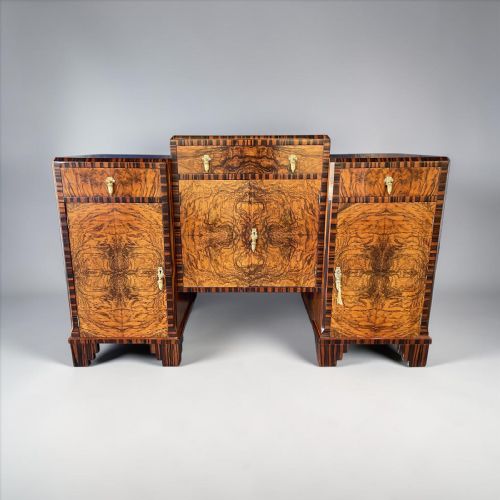
Construction relies upon choice hardwoods such as walnut, burr walnut, oak, and exotic macassar ebony applied as veneers over sturdy carcases. Artisans arranged these grain patterns symmetrically to create striking visual movement across wide cabinet doors.
Metal mounts in brass provide sharp linear accents, while certain variants incorporate inset marble tops and mirrored silver tray sections known as plateaux de buffet.
The archive records nineteen thirty and nineteen forty as key periods for these geometric sideboards.
What varies in quality
Quality rests upon the selection of timber veneers and the precision of the parquetry arrangements across the front doors. Pieces signed by master cabinetmakers command higher distinction through meticulous joinery and integrated hardware.
The presence of luxury surfaces like heavy marble slabs and specialist metalwork elevates certain cabinets above standard production models of the period.
Gaston Poisson·Jules Leleu
The French Art Deco Buffet Glossary
- Macassar Ebony
- A dense exotic timber displaying dramatic dark brown and warm golden striping. It remains highly prized for luxury cabinet facades.
- Parquetry
- Geometric wood inlay patterns assembled from contrasting veneer cuts. This technique creates patterned surfaces on cabinet doors.
- Plateau de buffet
- A mirrored serving tray designed to sit upon or complement a sideboard. It reflects light and glassware during formal dining.
- Burr walnut
- Wood grain marked by clustered swirling knots that create rich organic textures. Cabinetmakers use it to draw the eye across central panels.
Frequently Asked Questions
How do I style a french art deco buffet?
Allow the strong geometric lines and figured veneers to anchor the room without overcrowding the top surface. Keep objects minimal and sculptural to respect the modernist aesthetic.
Pair the cabinet with understated seating or let it stand alone against a neutral wall to highlight the grain of the wood.
What is the difference between a buffet and a sideboard?
In this period, the terms often describe low storage cabinets designed for dining spaces, though buffets traditionally emphasise food service and sideboards storage.
Both forms utilise wide cabinet doors and internal shelving to conceal tableware and linens efficiently.
Are these buffets suitable for modern interiors?
Their clean architectural silhouettes and rich timber tones integrate smoothly into contemporary living spaces. The substantial storage capacity provides practical utility alongside striking visual weight.
Position the cabinet in a dining area or large hallway where the polished wood and brass details can catch natural light.
How do I care for macassar ebony and walnut?
Protect the polished wood surfaces from direct sunlight and excessive moisture by using coasters and mats. Dust gently with a dry, soft cloth to maintain the natural sheen of the veneer.
Avoid chemical polishes that can build up a film over the delicate grain patterns and brass mounts.