

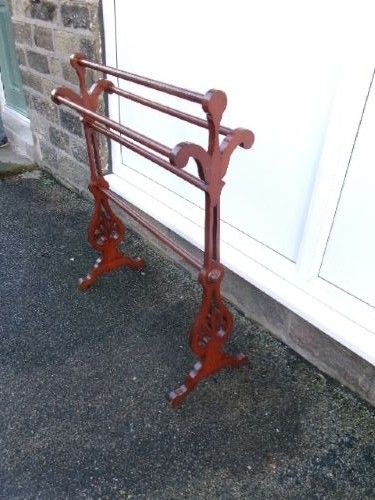


Freestanding Drying Rack
A freestanding drying rack is a practical utility piece built from timber and brass, offering reliable hanging space for domestic textiles.
Freestanding Drying Rack
A freestanding drying rack is primarily represented on this page by towel rails originating from the nineteenth and early twentieth centuries. These pieces serve as functional stands designed to hold and air linens, towels, or garments in domestic settings.
The dominant forms include folding cheval towel rails, three-fold units, and large country house stands. Most examples follow traditional silhouettes established during the Regency, Victorian, and Edwardian eras, prioritising stability and floor clearance.
Mahogany is the prevailing timber found across these listings, accompanied by occasional examples in oak and decorated pine. Such pieces demonstrate how utilitarian household items were constructed from sturdy hardwoods during successive British design periods.
How these pieces were constructed
Makers utilised solid hardwoods such as mahogany and oak, shaping uprights and cross rails to bear the weight of damp textiles. Timber components were joined using traditional woodworking methods suited to folding or static frames.
Brass fittings appear as hinges or structural accents on folding models, allowing sections to articulate smoothly without compromising the overall rigidity of the stand.
Freestanding Drying Rack Retail Price Guide 2026
Typical asking prices for freestanding drying rack among the pieces listed under this phrase on Sellingantiques today, from the lower quarter to the upper quarter. They describe what is for sale here now, not the wider market.
What distinguishes the construction
Quality in a freestanding drying rack rests on the selection of timber and the execution of joints rather than surface ornamentation. Heavier mahogany frames and well-fitted folding hinges distinguish sturdier examples from simpler pine alternatives.
The structural integrity of the pivoting joints on multi-fold rails dictates how reliably the piece stands under daily use. Finer versions exhibit precise carpentry that allows seamless folding while maintaining balance across all sections.
The Freestanding Drying Rack Glossary
- Cheval
- A freestanding frame that supports a pivoting or folding section. This term describes rails designed to tilt or swing on vertical supports.
- Arts and Crafts
- A design movement focusing on honest construction and simple materials. Pieces from this style highlight the natural grain of oak without excessive embellishment.
- Regency
- A design period spanning the early nineteenth century defined by classical restraint. Furniture from this era often incorporates clean lines and dark mahogany timbers.
- Edwardian
- A period covering the early twentieth century up to the First World War. Items from this time frequently retain Victorian utility while adopting lighter proportions.
Freestanding Drying Rack: Frequently Asked Questions
What is a freestanding drying rack used for?
These items function primarily as towel rails and airing stands for domestic textiles. They provide moveable hanging space without requiring wall fixings.
Historically placed in bedrooms or dressing areas, they allow garments and linens to dry or air efficiently across multiple rails.
How do I date a freestanding drying rack?
Dating relies on identifying the timber species, construction joints, and stylistic markers associated with periods like the Victorian or Edwardian eras. Mahogany and oak dominate earlier centuries, while pine often indicates country house utility.
Examining the metal hinges and the wear patterns on the feet also helps establish the approximate age of the piece.
Where should I place a drying rack at home?
These stands fit well in bathrooms, utility spaces, or bedrooms where additional hanging capacity is required. Their freestanding nature means they can be moved easily as needed.
Folding designs allow the rack to be compressed against a wall when not in use, saving floor space in smaller rooms.
What wood types are most common?
Mahogany is the most frequent material seen across these nineteenth-century and Edwardian pieces. It offers both durability and a rich dark grain.
Oak and pine also appear occasionally, particularly in Arts and Crafts or regional country house contexts.