



Framed Highland Portrait
A framed highland portrait brings the rugged romance and traditional dress of northern Scotland straight into a room through oil paint and canvas.
Framed Highland Portrait
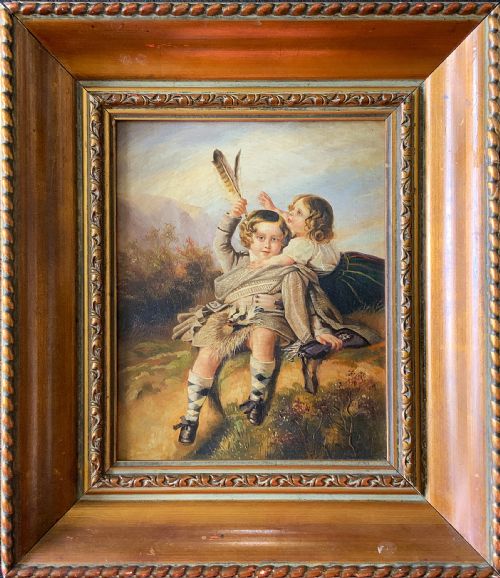
When you search for a framed highland portrait, you are looking at works capturing Scottish figures, children in tartan kilts, and highland scenes across the Victorian and 20th-century periods. These paintings range from depictions of nobility and clan children to figures collecting water and hunting in traditional dress.
You are most likely to meet Victorian and early 20th-century examples on this page, executed in oil on canvas or oil on board. Many of these pieces integrate landscape settings with portraiture, placing figures or sporting subjects against northern backgrounds.
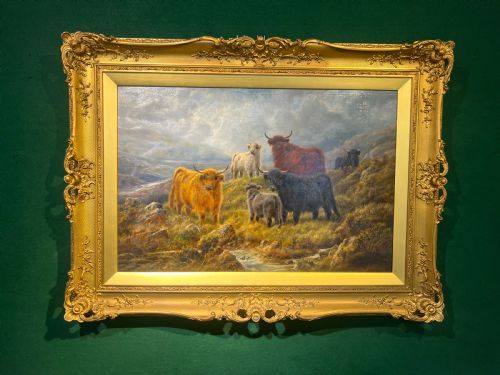
The selection also encompasses regional subjects such as sheep dogs, highland cattle, and royal figures in Scottish dress. These works reflect both Victorian realism and early 20th-century realism styles.
Markers of quality
The distinction between ordinary and superior works lies in the handling of facial expression, tartan textile patterns, and the integration of the figure with the background landscape. Finer pieces demonstrate careful attention to fabric folds and realistic light falling across outdoor scenes.
The quality of the surrounding frame matters greatly, with hand-carved giltwood mouldings and well-preserved gold leaf indicating a higher standard of presentation. Lesser examples often feature simpler wood frames or later replacements that lack period harmony.
Framed Highland Portrait Retail Price Guide 2026
Typical asking prices for framed highland portrait among the pieces listed under this phrase on Sellingantiques today, from the lower quarter to the upper quarter. They describe what is for sale here now, not the wider market.
Several canvases feature west highland terriers and sporting dogs sharing wall space with Scottish nobility and children in full tartan.
Robert Watson·William Henry Mander·Colin Graeme Roe·Charles Jones·John W Morris·GW Horlor·Robert Cleminson·Edward J Cobbett·William Crampton·Samuel Fulton
The Framed Highland Portrait Glossary
- Oil on Canvas
- Pigment mixed with drying oil applied to a woven fabric support. This combination allowed artists to build up thick textures and rich glazes.
- Giltwood
- Wood carved and coated with a thin layer of gold leaf or gold paint. It provided a bright, reflective border for important portraits.
- Victorian Realism
- An artistic approach focusing on everyday subjects and people depicted with factual accuracy. It dominated British painting during the nineteenth century.
- Tartan
- A patterned cloth consisting of criss-crossed horizontal and vertical bands in multiple colours. It remains a key visual identifier in Scottish portraiture.
Framed Highland Portrait: Frequently Asked Questions
What periods do these portraits date from?
The available selection spans from nineteenth-century Victorian works through to the middle decades of the twentieth century. Most pieces cluster in the Victorian period and the early decades of the twentieth century.
Artists during these eras frequently returned to Scottish themes, capturing highland cattle, children in tartan, and rural landscapes with consistent technical skill.
How should I hang an oil painting?
Oil paintings on canvas require stable wall fixtures that can support the combined weight of the artwork and its heavy giltwood frame. Avoid placing them in direct sunlight or above active heat sources.
Maintaining a stable room temperature prevents the canvas and wooden stretcher frames from expanding or contracting excessively over time.
What subjects appear alongside the portraits?
Many works combine portraiture with rural Scottish landscapes, incorporating highland cattle, sheep, hunting dogs, and figures collecting water. These surrounding elements provide context for the human subjects.
Sporting dogs and pastoral scenes frequently share the canvas with figures dressed in traditional Scottish attire.
How do I identify a Victorian frame?
Victorian frames often feature heavy wood construction finished with moulded plaster ornament covered in gold leaf. They are typically deeper and more ornate than twentieth-century equivalents.
Examining the corners and the back of the wood reveals the construction methods and age indicators of the framing.