

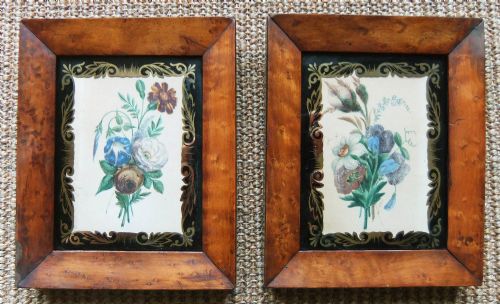
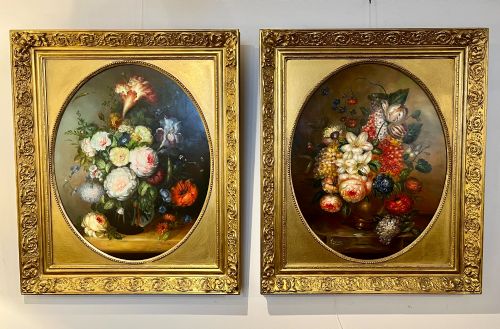
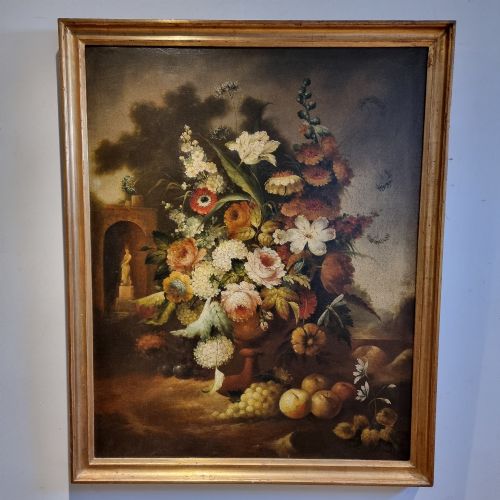
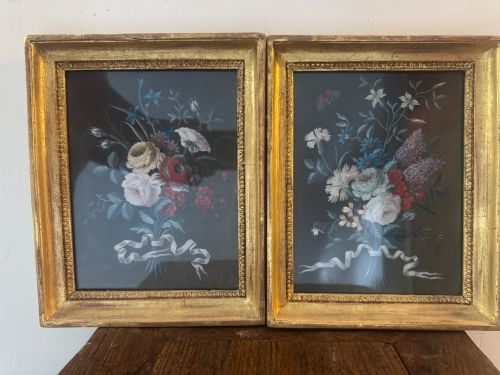
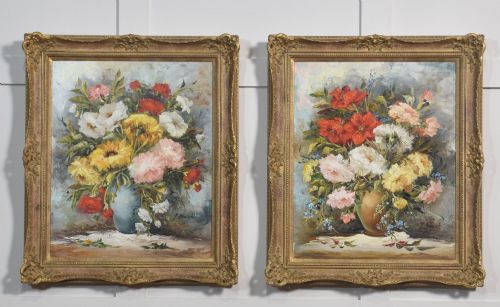


Framed Flower Paintings Pair
Framed flower paintings pair offer balanced decorative wall art, bringing botanical warmth and historical styling into any room.
Framed Flower Paintings Pair
When you search for framed flower paintings pair, you encounter matched sets of botanical wall art created in periods ranging from 1800 through the 1930s. These works span Dutch Golden Age style, 18th century revival, neoclassical, and French post-impressionist aesthetics, offering symmetrical visual impact for interiors.
The most common formats you meet on this page are oil on board, canvas, and works on paper including gouache and watercolour. Subjects focus primarily on floral still lifes, often incorporating vases of flowers alongside occasional fruit arrangements.
Origins represented in these pairings stretch across English country, Italian school, and European still life traditions. Makers such as J.R. Feyerabend, Manuela Bonati, Henry Schouten, M.K. Rhodes, and Oliver Clare appear among the listed works.
How framed flower paintings pair items were made
Artists painted these botanical subjects using oil paint on canvas or board, alongside delicate watercolours and gouache on paper. Application techniques range from tight Dutch Golden Age academic precision to looser French post-impressionist brushwork.
Framing typically involves wood frames finished with gold leaf or gilded wood, protecting the paper, canvas, or board beneath glass where appropriate. These period mounts complement the decorative nature of the twin artworks.
Framed Flower Paintings Pair Retail Price Guide 2026
Typical asking prices for framed flower paintings pair among the pieces listed under this phrase on Sellingantiques today, from the lower quarter to the upper quarter. They describe what is for sale here now, not the wider market.
Current listings feature pieces executed in oil paint, gouache, and watercolour on paper, canvas, and board.
What varies in quality in framed flower paintings pair
Quality rests upon the precision of botanical rendering and the handling of light and shadow across the petals and leaves. Finer examples display meticulous attention to floral anatomy and harmonious colour balance within the twin compositions.
The integrity of the original wood and gilded frames contributes significantly to the overall standing of the pair. Matched frames that preserve their original gold leaf finish elevate the visual coherence of the set.
Manuela Bonati·Henry Schouten·M.K Rhodes·Oliver Clare
The Framed Flower Paintings Pair Glossary
- Oil on board
- Pigment mixed with drying oil applied to a rigid wooden or composite panel rather than stretched canvas. This surface provides a stable foundation often seen in nineteenth and twentieth-century still life works.
- Gouache
- An opaque water-based medium featuring pigment bound in water-soluble gum with added white filler. It allows for matte, highly saturated botanical details on paper.
- Gilded wood
- Timber coated with a thin layer of gold leaf or metallic powder to create a reflective, decorative surface. This finish defines the traditional framing of period artwork.
- Dutch Golden Age style
- An artistic tradition emphasising dark backgrounds and hyper-realistic botanical arrangements. Painters adopted these dramatic lighting conventions well into the twentieth century.
- Still life
- An artwork depicting inanimate subject matter, typically featuring cut flowers and fruit. These compositions allow artists to focus purely on colour, texture, and form.
Framed Flower Paintings Pair: Frequently Asked Questions
How do I hang a pair?
Hang the two paintings at eye level with a consistent gap between them to create visual symmetry on the wall. Matching frames help anchor the pair as a unified installation.
Ensure the wall space accommodates the width of both pieces plus the central spacing without crowding adjacent furniture.
Are these original works?
The listings comprise original oil paintings, watercolours, and gouache pieces created by named artists and regional schools. Each pair reflects the specific painting techniques of its period.
Check individual listings for details on signatures, artist attributions, and medium types.
How should I clean the frames?
Dust the wood and gilded surfaces gently with a dry, soft cloth to prevent accumulation. Avoid chemical cleaners or moisture, which can damage aged gold leaf.
Glass fronts on works on paper can be wiped carefully with a glass cleaner applied to a cloth rather than sprayed directly.
What periods are represented?
The selections span from around 1800 through the 19th century up to the 1920s and 1930s. These dates encompass revival movements and early twentieth-century interpretations of classical styles.
Stylistic influences reach back further into Dutch Golden Age and neoclassical traditions.