


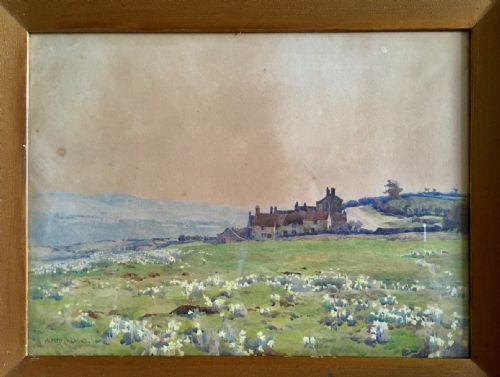

Framed Cottage Floral Watercolour
These framed cottage floral watercolour works capture rural gardens and traditional homes through delicate pigment on paper.
Framed Cottage Floral Watercolour
A framed cottage floral watercolour brings traditional English garden scenes and rural dwellings directly onto the wall. These works typically depict thatched cottages, walled gardens, and country houses surrounded by blooms.
The selections available here span from the late Victorian period through the Edwardian era and into the early twentieth century. English School artists captured these pastoral subjects using watercolour paint on paper, preserved behind glass.
Buyers encounter subjects like cottage gardens, summer flowers, and country seats rendered by named British painters. Each piece represents a window into a quiet, rural past preserved in original framing.
Materials and methods
Artists utilised watercolour pigment applied to paper sheets to build up delicate botanical details and soft landscape washes. This medium allows for luminous skies and vibrant floral displays.
The finished watercolours are protected behind glass and housed within wooden or gilt wood frames. These frames secure the paper works and complement the pastoral subjects within.
One quiet moment preserves a figure knitting outside a cottage door under the Edwardian sun.
Assessing quality
Quality rests in the precision of the botanical rendering and the atmospheric depth of the garden setting. Skilled hands manage pigment and paper to create convincing light and texture.
The presence of a recognised hand from the Edwardian or Victorian periods elevates a piece significantly. Artist reputation and strong compositional balance define the finer examples on offer.
Theresa Stannard·Lilian Stannard·David Woodlock·Jane Utley·George Frederick Nicholls·Arthur H Buckland·Alfred Parsons·Minnie Smythe
The Framed Cottage Floral Watercolour Glossary
- English School
- A loose term denoting artists trained or working within the British artistic tradition. It frequently groups together painters focusing on landscapes and rural scenes during the nineteenth and early twentieth centuries.
- Edwardian
- Pertaining to the reign of King Edward VII, spanning the early years of the twentieth century. This period fostered a taste for sunlit gardens and gentle pastoral imagery.
- Gilt wood
- Wood treated with a thin layer of gold leaf or metallic gold paint. It adds warmth and reflects light around framed artworks.
- Watercolour pigment
- The finely ground colour particles suspended in a water-soluble binder. It forms the primary medium for these delicate works on paper.
Framed Cottage Floral Watercolour: Frequently Asked Questions
What periods do these watercolours date from?
The available watercolours date from the late Victorian period, the Edwardian era, and the early twentieth century. This spans roughly from eighteen eighty to nineteen thirty.
These dates reflect the active years of the artists whose garden scenes and cottage paintings populate the current selection.
How should I hang a framed watercolour?
Watercolour paintings on paper require careful placement away from direct sunlight to prevent the pigments from fading over time. Indirect natural light in a balanced room works best.
Ensure the hanging wall remains dry and stable to protect both the paper artwork and the wooden or gilt frame from environmental damage.
What subjects appear most frequently?
The primary subjects involve thatched cottages, walled gardens, summer flowerbeds, and country houses. Artists focused heavily on traditional English rural life and cultivated grounds.
Figures occasionally appear engaged in quiet daily tasks, such as knitting outside the cottage, framed by abundant floral displays.
Are these works original paintings?
Every listed piece is an original watercolour painting executed by hand on paper rather than a mechanical reproduction. Artists applied watercolour pigment directly to create each unique scene.
Original works bear the subtle brushwork and individual character of the painter who created them over a century ago.