


Foliage Wall Tapestry
These foliage wall tapestry pieces bring historic woodland scenes into a room, offering rich botanical detail woven in wool and silk.
Foliage Wall Tapestry
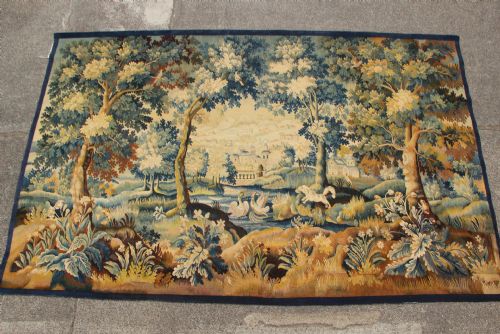
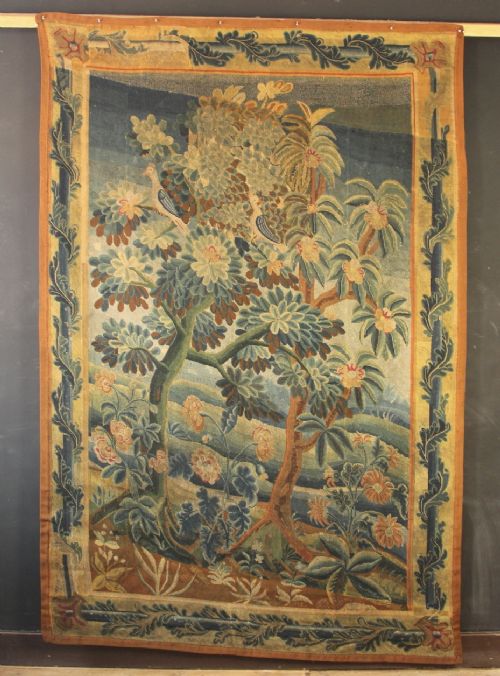
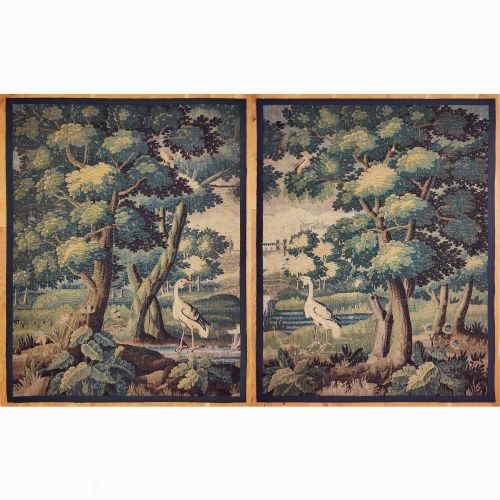
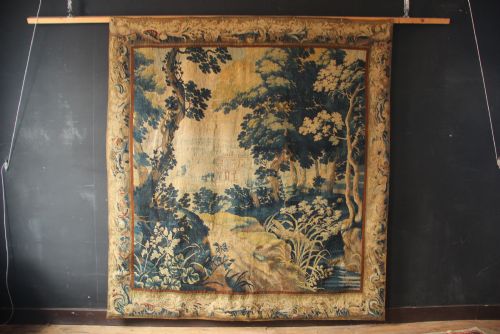
A foliage wall tapestry depicts dense woodland foliage, leaves, and trees, frequently featuring hidden birds or distant architectural elements. When searching for a foliage wall tapestry, buyers encounter historic panels originating primarily from Flemish and French workshops. The examples found here span from the seventeenth century through to the nineteenth century, alongside later twentieth century hanging pieces.
The dominant forms are verdure panels depicting heavy plant life, designed to insulate stone walls and soften domestic interiors. Many pieces date from the seventeenth and eighteenth centuries, attributed to centres such as Aubusson and Flemish looms. These textiles employ naturalistic greenery to create depth and texture across large vertical surfaces.
Materials and construction
These textiles rely on combinations of wool, silk, linen, and cotton yarns woven to build complex pictorial scenes. Weavers built the heavy pictorial surfaces using warp and weft threads, combining wool for structural weight with silk to catch the light in foliage and highlights.
Needlework techniques also appear alongside traditional weaving, particularly in eighteenth century European panels created on a fabric ground. The choice of materials dictates the heavy drape and textural relief characteristic of these historical wall hangings.
Hidden among the woven leaves of these ancient woodlands, small birds and unseen creatures peer out from the foliage.
Variations in quality
The sophistication of the verdure design separates the finer panels from simpler workshop output. Superior pieces integrate subtle shifts in botanical coloration and intricate leaf detailing that give the woodland canopy a sense of three-dimensional depth.
The choice of fibre influences the visual richness of the surface. Panels incorporating generous amounts of silk retain luminous highlights in the foliage, whereas purely woollen examples rely entirely on tone and texture for their impact.
The Foliage Wall Tapestry Glossary
- Verdure tapestry
- A wall hanging dominated by plant motifs, trees, leaves, and foliage rather than human figures or historical narratives. These scenes often focus on natural landscapes.
- Aubusson
- A town in France known for producing tapestry and carpet textiles. Pieces from this origin often display distinct French baroque design qualities.
- Flemish baroque
- A decorative style originating in Flanders during the seventeenth century. It is characterised by dramatic movement and robust botanical elements.
- Needlework tapestry
- A textile created by stitching yarn onto an existing foundation fabric rather than on a loom. This method provides alternative texture and detail.
- Warp and weft
- The foundational vertical threads and the intersecting horizontal threads that form a woven textile. These yarns hold the dyed wool and silk in place.
Foliage Wall Tapestry: Frequently Asked Questions
How do I hang a heavy foliage wall tapestry?
Large textile panels require even distribution of weight to prevent stretching the fabric over time. A professional conservator or framer can attach a stabilizing canvas backing and a concealed wooden batten.
For most walls, hanging from a sturdy iron or brass rod using a sewn-on fabric sleeve distributes the load securely across the top edge.
What is a verdure tapestry?
A verdure tapestry is a specific type of wall hanging that focuses entirely on landscape, trees, and plant life rather than narrative scenes with people. The word derives from the French term for green.
These panels were created to bring the feel of the outdoors inside grand stone interiors.
How do I clean an antique tapestry?
Historic textiles woven from wool and silk require delicate handling and professional textile conservation rather than domestic washing. Gentle surface dust can be removed very carefully using low suction through a mesh screen.
Water or chemical cleaning agents risk causing dye transfer or fibre shrinkage in older pieces.
Where were these tapestries originally made?
The historical pieces originate primarily from European weaving centres in Flanders and France. Towns such as Aubusson and Audenarde established long traditions of workshop production.
Later interpretations and wall hangings continued these decorative traditions into the twentieth century.