

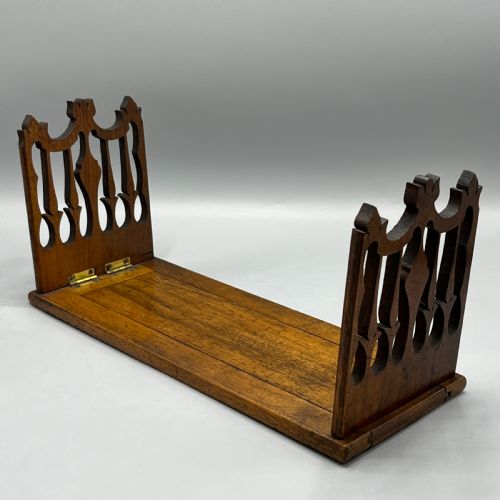


Folding Desk Book Stand
These folding desk book stand pieces are practical reading supports crafted to hold volumes upright on a surface.
Folding Desk Book Stand
A folding desk book stand serves as a functional accessory for libraries and studies, designed to keep volumes accessible and secure. The examples seen on this page span the Victorian period through to the interwar nineteen-twenties, incorporating various formats.
Book slides and expanding racks dominate the available forms, often featuring pivoting mechanisms or extending sides to accommodate varying numbers of volumes. Materials range from native British timbers like oak and walnut to exotic woods including olive wood, coromandel, and teak.
How they were made
Cabinet makers utilised dense hardwoods such as walnut, oak, and rosewood, frequently incorporating robust brass mounts to reinforce the sliding mechanisms and hinges. Some pieces display intricate wood mosaic work or carved detailing, reflecting regional craftsmanship.
Patented expanding designs, such as those by Betjemanns, required precise engineering to allow the wooden book slides to extend smoothly while maintaining structural stability. Bone and brass inlays were also applied to enhance the decorative surface of the stands.
Folding Desk Book Stand Retail Price Guide 2026
Typical asking prices for folding desk book stand among the pieces listed under this phrase on Sellingantiques today, from the lower quarter to the upper quarter. They describe what is for sale here now, not the wider market.
Listings feature items from the Victorian era, nineteenth century, and nineteen-twenties, showcasing styles such as Gothic Revival and Anglo-Indian.
What varies in quality
The sophistication of the mechanism largely determines the calibre of a piece, with patented sliding actions representing higher manufacturing standards. Simple wooden bookstands contrast with elaborately carved teak or coromandel examples fitted with substantial brass mounts.
The choice of decorative finish dictates the distinction between standard utilitarian items and superior decorative accessories. Elaborate wood mosaic work, specialised Oriental carving, and the inclusion of bone details separate standard production from finer examples.
Betjemanns
The Folding Desk Book Stand Glossary
- Book slide
- A device designed to hold a row of books upright on a desk or table, often featuring extending sides. These accessories were common in nineteenth-century libraries.
- Coromandel
- A dense, heavy timber with dark brown and black grain patterns used for fine nineteenth-century furnishings. It provides a durable and decorative surface.
- Brass mounted
- The application of brass hinges, brackets, or decorative plates to wooden objects. This technique adds structural reinforcement and visual contrast.
- Wood mosaic
- Small pieces of various coloured woods assembled to form geometric or pictorial patterns on a surface. This technique showcases the precision of the artisan.
- Extending book slide
- A reading accessory that adjusts in length to accommodate a growing or shrinking selection of volumes. The sliding mechanism allows the frame to expand.
Folding Desk Book Stand: Frequently Asked Questions
What is a folding desk book stand?
A folding desk book stand is a reading accessory designed to support books on a table surface. Many versions feature collapsible or extending elements for easy storage and adjustment.
These pieces were essential additions to home libraries and studies during the nineteenth and early twentieth centuries. They kept reference volumes close at hand while maintaining an orderly desk.
How do you use a book slide?
Book slides are placed on a desktop or shelf to keep a row of upright volumes tidy. The extending sides can be adjusted inward to clamp the books gently or outward to hold more.
Folding variants allow the user to collapse the stand flat when not in use. This practical design made them versatile accessories for Victorian writing desks.
What materials were used?
These items were constructed from a wide variety of timbers, including walnut, oak, teak, rosewood, and olive wood. Exotic materials and decorative finishes reflect global influences during the Victorian era.
Metal components, particularly brass mounts and hinges, were frequently added to strengthen the moving parts. Bone inlays and wood mosaic details also appear on decorative examples.
How do you identify Victorian pieces?
Victorian examples often feature characteristic nineteenth-century timber choices such as coromandel, walnut, and rosewood. Stylistic indicators include Gothic Revival motifs, Anglo-Oriental carving, and patented mechanical actions.
Makers' names or patent stamps, such as those associated with Betjemanns, help confirm the period of manufacture. Construction methods and brass hardware also offer clues to the age of the item.