




Folding Corner Table
A folding corner table uses clever timber geometry to turn unused wall junctions into useful display and playing surfaces.
Folding Corner Table
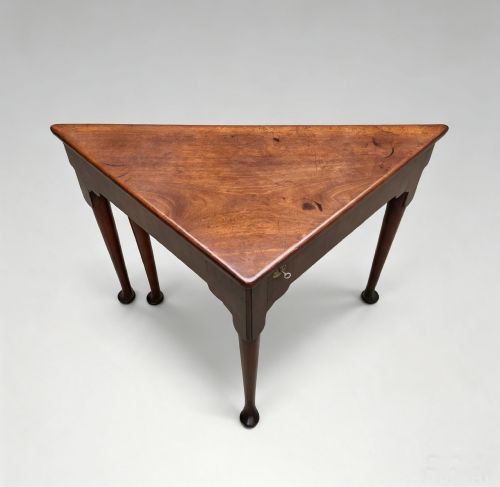
A folding corner table is an ingenious space-saving piece designed specifically to fit into the ninety-degree angle of a room. These clever items expand when needed for cards, tea or supper, then fold away compactly against the wall.
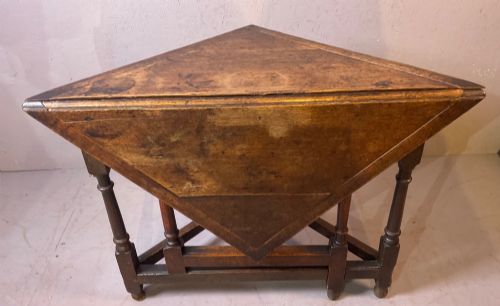
The versions met most frequently on this page span the Georgian and Edwardian eras, executed in rich timbers like mahogany, walnut and rosewood. Makers utilised hinged flaps, swing legs and drop leaves to transform a small triangular footprint into a functional square or rectangular top.
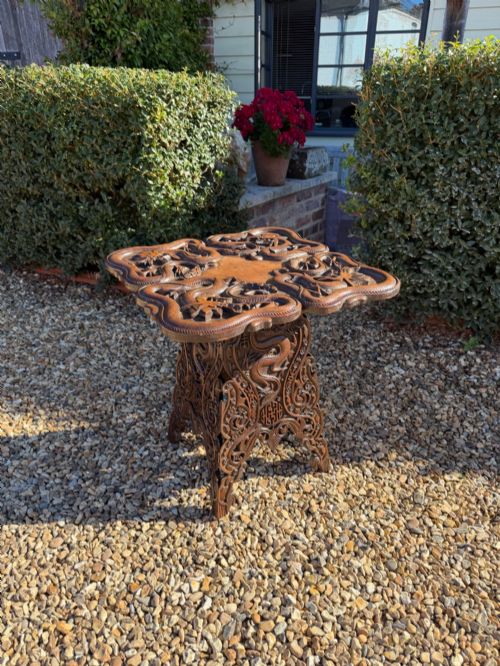
Beyond dedicated corner tables, the selection includes related folding forms such as card tables, envelope tables and sutherland tables with canted corners. Each piece demonstrates how historical cabinetmakers solved the challenge of furnishing smaller rooms without sacrificing surface area.
How they were made
Cabinetmakers constructed these pieces primarily from solid and veneered timbers, relying on dense hardwoods like mahogany, walnut and rosewood for structural integrity. Finer examples incorporate contrasting decorative elements such as satinwood, boxwood and brass inlay.
Construction techniques focus heavily on stable pivoting mechanisms, including swing legs, gate legs and folding leaves that must align precisely when opened. The joinery accommodates the seasonal movement of timber, ensuring the folding leaves operate smoothly over centuries.
What varies in quality
Quality reveals itself in the selection of timber grain and the precision of the inlay work, where skilled hands achieved seamless contrasts between dark rosewood and pale satinwood. The crispness of carved details, from edge mouldings to leg supports, distinguishes ambitious cabinet work from standard production.
Mechanical soundness defines the upper tier of these pieces, ensuring that folding flaps and swing legs operate without binding or sagging when extended. Well-executed hinges and tight joinery allow the top to sit completely flat in both open and closed positions.
The Folding Corner Table Glossary
- Corner table
- A piece specifically shaped to fit flush against the walls in the corner of a room. They often feature triangular tops that unfold or drop to expand their surface area.
- Card table
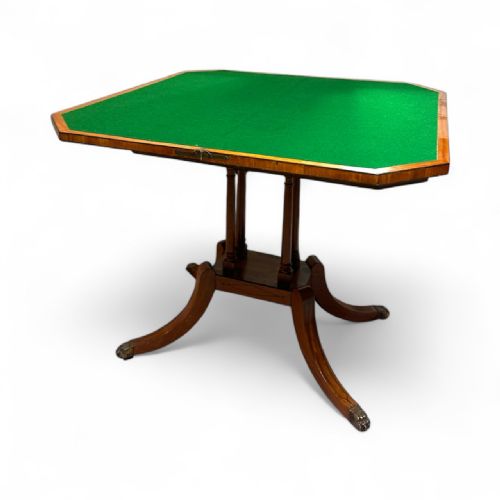
- A folding table designed for evening games, typically lined with baize or felt and fitted with counter wells. These pieces often feature a fold-over top supported by a swing leg.
- Drop leaf table
- A table with a fixed central section and hinged flaps on either side that drop down. These leaves are supported by swing legs or brackets when raised.
- Sutherland table
- A narrow table with exceptionally wide drop leaves designed to fold almost entirely flat. Edwardian versions frequently showcase canted corners and decorative crossbanding.
- Crossbanding
- A decorative border of veneer laid with the grain running perpendicular to the main surface. This technique frames the top of a table to create a refined visual contrast.
Folding Corner Table: Frequently Asked Questions
How do folding corner tables work?
These tables utilise clever hinges and swing legs to support an unfolding top section. When closed, they sit flat against the wall as a compact triangular shelf.
Opening the table usually involves swinging a rear leg outward to support the secondary flap, revealing a larger square or rectangular surface for serving tea or playing cards.
Where should I place a corner table?
A folding corner table belongs in awkward or empty room angles that standard furniture cannot easily fill. They make excellent use of neglected space without blocking pathways.
In a living room or hallway, they provide a stable surface for lamps and displays while keeping the central floor area open and uncluttered.
What is the difference between a card table and a corner table?
A corner table is specifically shaped to fit into the angle of two walls, whereas standard card tables are designed to stand anywhere in a room. However, some pieces combine both functions through clever triangular folding designs.
Card tables generally feature baize-lined surfaces and corner wells for gaming counters, a detail rarely found on standard corner furniture.
How do I date an antique folding table?
Dating relies on examining the timber species, construction methods and decorative styles present on the piece. Georgian pieces often feature solid mahogany and restrained carving, while Edwardian examples frequently showcase satinwood crossbanding and inlaid rosewood.
Hardware types, such as the design of hinges and the presence of handmade screws, also provide reliable clues to the manufacturing period.