


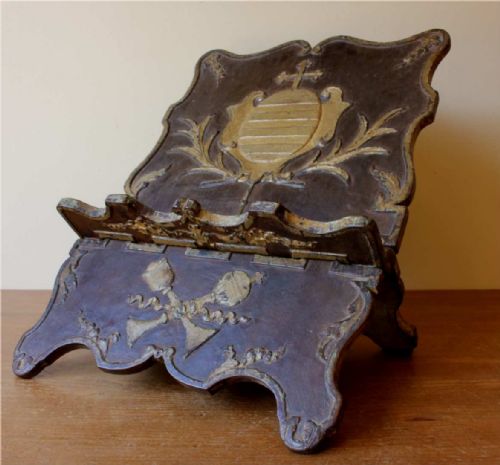


Folding Book Stand
A folding book stand holds your volumes at the proper angle for study and display, offering a practical solution for the library or desk.
Folding Book Stand
A folding book stand serves as a portable support for reading texts, folios and religious volumes. When you search for a folding book stand, you encounter pieces designed to adjust, extend or fold flat when not in use.
The selections span the eighteenth, nineteenth and early twentieth centuries, encompassing Victorian, Edwardian and Interwar periods. Forms range from extending book slides and Missal stands to metamorphic magazine racks and reading tables.
Origin and regional craftsmanship vary widely across these items, with English, French, Burmese and Anglo-Indian examples appearing. Each version reflects the specific domestic, scholarly or devotional requirements of its era.
How they were made
Makers utilised a variety of dense timbers including oak, walnut, teak, coromandel, olive wood and ebonised wood. These woods provided the structural rigidity necessary to support heavy volumes without warping.
Metalwork played a crucial functional role, incorporating brass mounts, extending mechanisms and hinges. Decorative details occasionally involved gesso, gold leaf, mother of pearl inlay and intricate hand carving.
Folding Book Stand Retail Price Guide 2026
Typical asking prices for folding book stand among the pieces listed under this phrase on Sellingantiques today, from the lower quarter to the upper quarter. They describe what is for sale here now, not the wider market.
Several Victorian designs incorporate clever novel rests to keep your place while you ponder.
What varies in quality
The distinction between standard pieces and finer examples lies in the execution of the mechanical action and the selection of timber. Smooth extension and robust hinges demonstrate superior workshop practice.
Betjemanns
The Folding Book Stand Glossary
- Book slide
- An extending desk accessory designed to hold a row of books upright between two vertical ends. They often feature folding or stationary brackets.
- Missal stand
- A devotional reading rest specifically proportioned to hold large liturgical books or Bibles during services or private prayer.
- Metamorphic
- Describing furniture or accessories that transform from one function to another, such as a rack converting into a reading table.
- Folio stand
- A low rack or stand built to store and display large, unbound sheets, newspapers or oversized art books.
- Ebonised wood
- Timber treated with a dark stain or finish to imitate ebony, popular during the Victorian period for dramatic contrast.
Folding Book Stand: Frequently Asked Questions
What is a folding book stand used for?
These stands support heavy volumes, missals and folios at a readable angle for study or display. They adjust or fold down to save space when not in use.
Historically, they served scholars, clergy and readers who needed a stable rest for large reference books on desks or tables.
How do I date a folding book stand?
Dating relies on identifying the prevailing timber choices, construction methods and stylistic markers associated with specific periods like the Victorian or Edwardian eras. Patination and mechanical patents also offer clues to age.
Makers frequently incorporated specific brass mechanisms or regional carving styles that help narrow down the decade of manufacture.
Where were these stands made?
Production occurred across domestic English workshops as well as international centres, resulting in Burmese teak and Anglo-Indian carved pieces. European religious stands followed distinct regional church traditions.
Global trade and colonial connections brought exotic timbers and foreign carving techniques into British and continental markets during the nineteenth century.
Can I use an antique stand for modern books?
Most stands accommodate modern hardbacks and reference texts quite well, provided the weight does not exceed the capacity of the folding arms or extending slides. Extending book slides adjust easily to fit varying lengths of bookshelves.
Care should be taken with delicate hinges and older wooden ratchets to prevent undue strain during adjustment.