

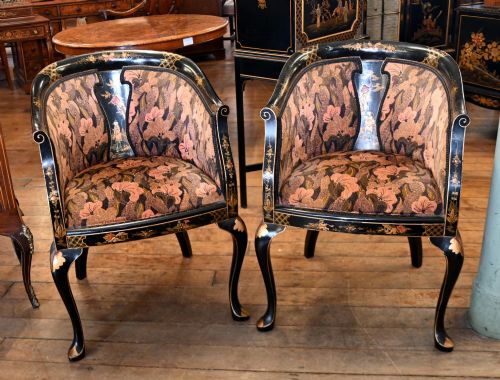
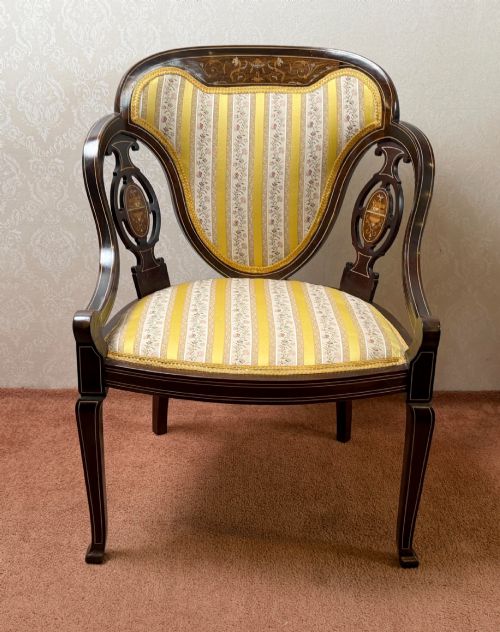
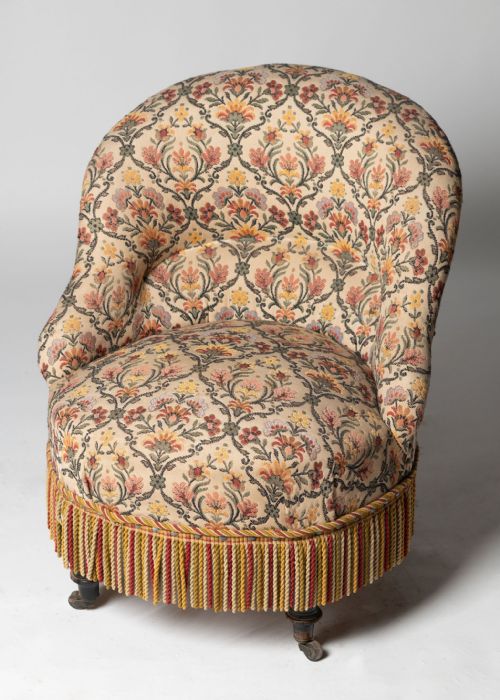
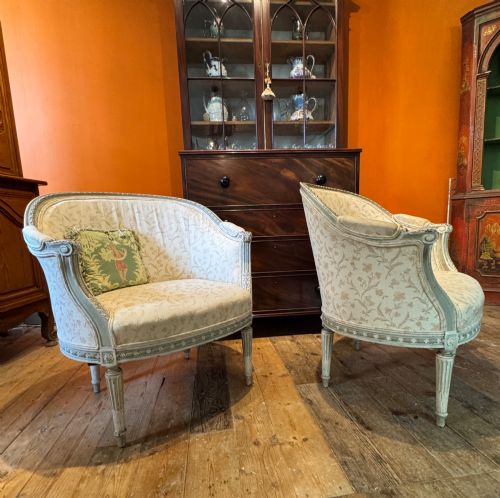


Floral Tub Armchair
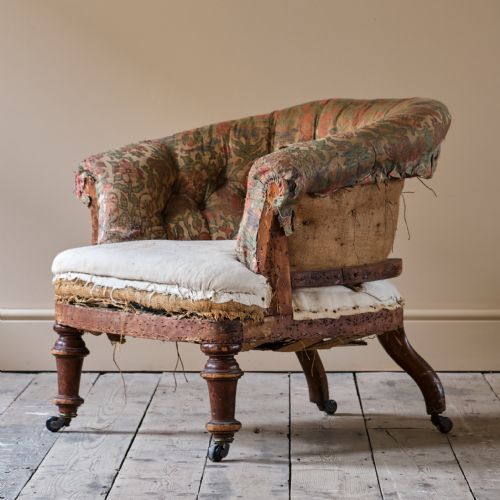
These floral tub armchair examples bring curved comfort and period character to a room, offering a rounded back that wraps the sitter.
Floral Tub Armchair
A floral tub armchair brings a curved, enclosing seat back into a sitting room or bedroom, combining upholstered comfort with distinct period woodwork. When you search for a floral tub armchair, you are looking at seating that draws on Victorian and Edwardian designs, alongside French Louis XVI style influences and Sheraton Revival pieces.
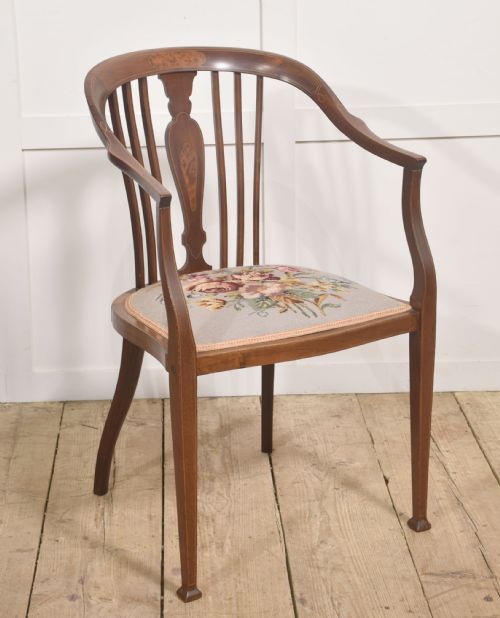
The pieces on this page appear in forms ranging from compact occasional chairs and salon armchairs to larger boudoir suites and paired bergeres. Mahogany forms the backbone of the woodwork, often enriched with satinwood, boxwood, and bone inlay, while beech and ebonised timber also appear across the selection.
Victorian and Edwardian makers shaped these chairs to serve as intimate seating in private rooms, employing showwood frames and upholstered tub shells. You will frequently encounter examples that retain original paint or traditional fabric coverings, as well as pieces offered for re-upholstery.
How they were made
Cabinetmakers constructed the frames primarily from mahogany, beech, and satinwood, shaping the curved tub backs to wrap around the seated person. Joinery relies on traditional techniques to support the continuous sweep of the upholstered shell.
Surface decoration involves delicate marquetry and inlay work using boxwood and bone to create fine geometric or floral patterns on the woodwork. Some pieces feature ebonised finishes or retain their original painted surfaces applied during the nineteenth or early twentieth centuries.
Floral Tub Armchair Retail Price Guide 2026
Typical asking prices for floral tub armchair among the pieces listed under this phrase on Sellingantiques today, from the lower quarter to the upper quarter. They describe what is for sale here now, not the wider market.
Listings feature mahogany, satinwood, and beech frames combined with fabric, velvet, and brass elements across Victorian and Edwardian periods.
What varies in quality
The refinement of the timber framing and the precision of the boxwood and bone inlay distinguish the finer examples from simpler workshop output. Subtle carving on the showwood frame and the balance of the curved proportions reveal the hand of a more skilled cabinetmaker.
The survival of original decorative elements, such as early paint finishes or intact marquetry, elevates the character of a piece. Conversely, frames designated for re-upholstery place greater emphasis on the underlying structural joinery and timber quality.
The Floral Tub Armchair Glossary
- Tub armchair
- A chair with a rounded, enclosing back that forms a continuous curved tub shape, designed to wrap around the sitter.
- Marquetry
- Decorative veneer work arranged in intricate patterns or pictures on the wooden frame, often using contrasting woods like satinwood and boxwood.
- Inlay
- A technique where pieces of contrasting material such as bone or boxwood are set into recesses flush with the surrounding mahogany surface.
- Bergere
- A French-style upholstered armchair with enclosed sides, usually featuring exposed wood and a padded seat.
- Showwood
- Timber frame parts left visible around the upholstered portions of a chair to display the grain and craftsmanship.
Floral Tub Armchair: Frequently Asked Questions
How do I date these chairs?
Dating relies on observing the timber choices, inlay techniques, and stylistic markers recorded across the Victorian and Edwardian periods. Pieces from the nineteenth century often feature heavier mahogany frames and bone inlay, while Edwardian examples tend toward lighter marquetry.
Stamps, maker marks, and structural clues within the woodwork further help narrow down the decade of manufacture, distinguishing 1880s pieces from later 1910 work.
Where were tub armchairs used?
These chairs served primarily in private spaces such as bedrooms, boudoirs, and intimate sitting rooms where comfortable, smaller-scale seating was required. Their enclosed shape made them suitable for placing near firesides or in corners for reading.
Salon armchairs and occasional chairs were also placed in formal drawing rooms to supplement larger settee and chair suites.
What is Sheraton Revival style?
Sheraton Revival refers to late nineteenth and early twentieth century furniture that reinterprets the lighter, neoclassical designs of eighteenth-century designer Thomas Sheraton. These pieces typically incorporate mahogany, satinwood inlay, and tapered legs.
Chairs from this style group often display refined geometric stringing and delicate proportions suited to Edwardian drawing rooms.