

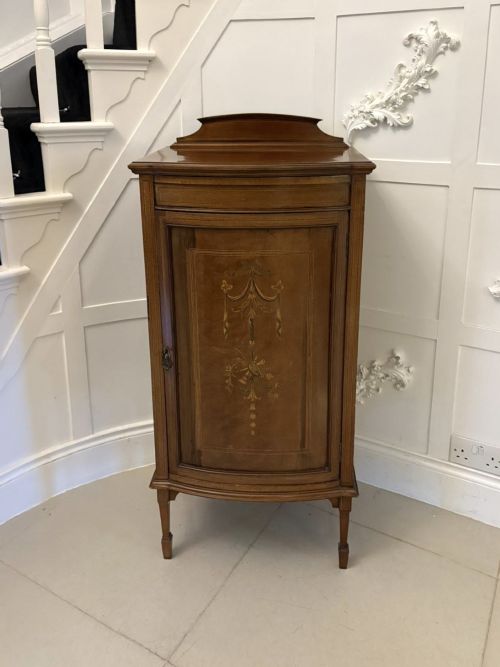
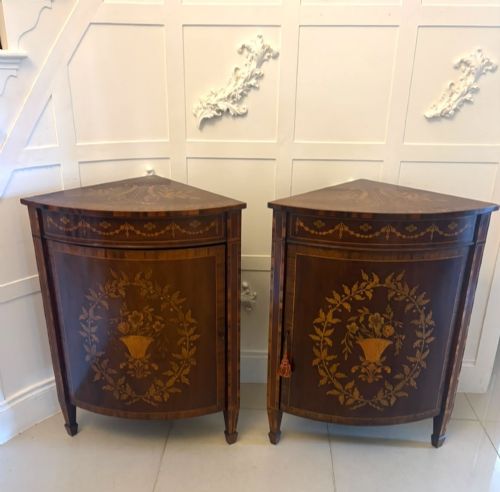
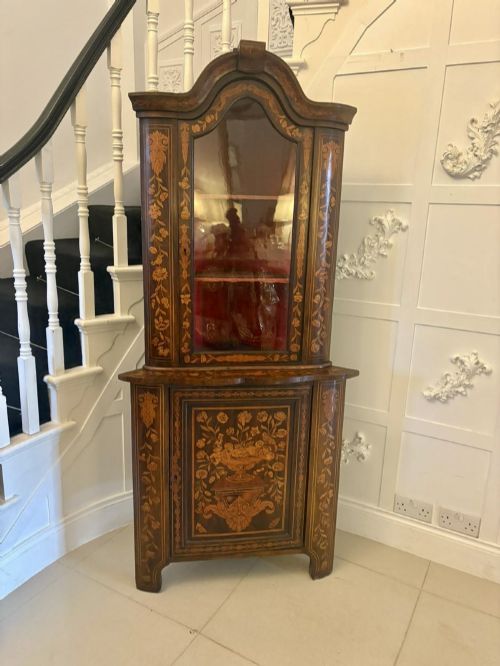
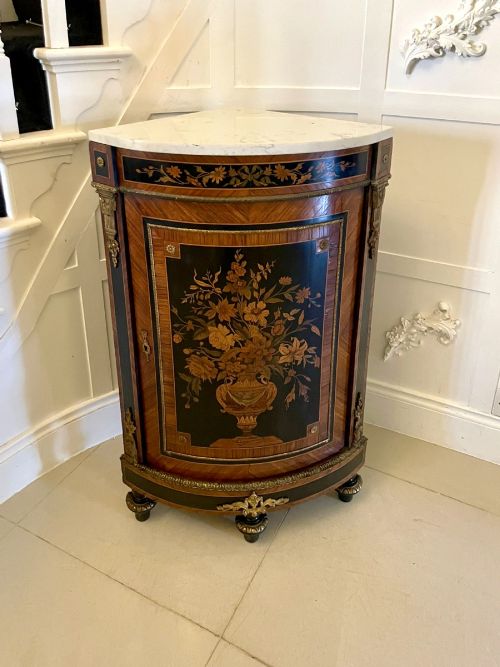
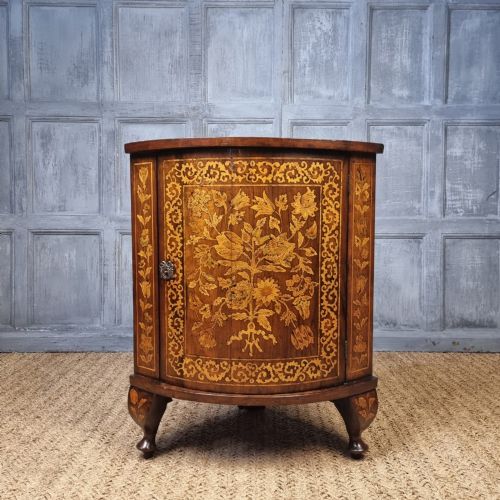


Floral Marquetry Corner Cabinets
These floral marquetry corner cabinets bring rich inlaid timber and practical corner storage together in one distinguished room-anchoring piece.
Floral Marquetry Corner Cabinets
Floral marquetry corner cabinets transform unused room angles into focal points of intricate woodworking and display. Buyers seeking floral marquetry corner cabinets encounter pieces shaped by Dutch Baroque, Louis XVI, and Victorian traditions.
The selection ranges from tall floor-standing cupboards to display pieces and double corner cabinets. Walnut, mahogany, and fruitwood form the primary bodies, often carrying detailed floral inlay.
Examples stretch across the eighteenth, nineteenth, and twentieth centuries. Dutch and French stylistic influences appear frequently among the pieces currently listed.
How they were made
Cabinetmakers constructed these frames using solid timbers such as mahogany, walnut, and oak for structural stability. Marquetry panels were created by cutting thin veneers of fruitwood and other woods to form floral motifs.
Selected pieces incorporate marble tops and bronze mounts for added weight and classical detail. Glass panels appear in cabinets designed for display, fitted securely into wooden doors.
Floral Marquetry Corner Cabinets Retail Price Guide 2026
Typical asking prices for floral marquetry corner cabinets among the pieces listed under this phrase on Sellingantiques today, from the lower quarter to the upper quarter. They describe what is for sale here now, not the wider market.
Listings span four centuries of cabinetmaking, featuring walnut, mahogany, fruitwood, oak, marble, and bronze elements across French and Dutch design traditions.
What varies in quality
The precision and complexity of the floral inlay dictate much of the visual standard. Crisp execution of the fruitwood veneer work separates finer examples from simpler provincial items.
The choice of primary timber and secondary materials, such as genuine marble slabs or cast bronze fittings, influences the overall substance of the cabinet. Structural integrity in the corner joints and door alignment completes the assessment.
The Floral Marquetry Corner Cabinets Glossary
- Marquetry
- Decorative veneer work arranged in pictorial patterns on a wooden surface. Craftsmen cut various coloured woods to depict floral and foliage designs.
- Fruitwood inlay
- The use of dense domestic fruit timbers within veneer panels. This material takes a fine edge and provides contrasting natural tones.
- Double corner cabinet
- A two-part storage unit designed to fit a room angle, often combining upper display shelves with a lower cupboard.
- Parquetry
- Geometric wood inlay forming repeating patterns such as cubes or chequers. It differs from marquetry through its strict geometric arrangement.
- Serpentine
- A gently undulating curved shape seen on the front facade of certain cabinets. This contour requires advanced carpentry to achieve smoothly.
Floral Marquetry Corner Cabinets: Frequently Asked Questions
Where should I place a corner cabinet?
These units fit directly into the unused right-angle corners of a dining room, hallway, or drawing room. They maximise floor space while drawing the eye upward.
Ensure the adjacent walls accommodate the specific depth and door swing of the chosen cabinet without obstructing walkways.
How do I clean marquetry surfaces?
Dust the inlaid wood gently with a soft, dry cloth to prevent particles from settling into the veneer joints. Avoid using harsh chemical sprays or excess moisture.
Apply a traditional beeswax polish occasionally to nourish the timber and maintain the subtle sheen of the fruitwood inlay.
Can I display heavy items inside?
Display cabinets and cupboards suit lighter ceramics, glassware, and decorative objects. Check the internal shelving support before placing heavier items on upper tiers.
Floor-standing models generally offer greater weight capacity in their lower timber compartments than wall-mounted or elevated display versions.
How do I date a marquetry cabinet?
Examine the secondary woods inside the carcass and the style of the floral inlay work. Eighteenth-century versions often show different construction methods compared to nineteenth-century revival pieces.
Stylistic cues such as Louis XVI proportions or Dutch Baroque curves provide clear indicators of the era of manufacture.