

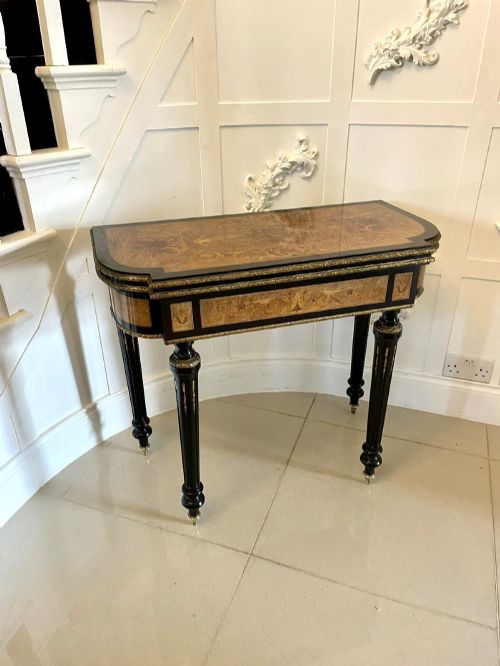
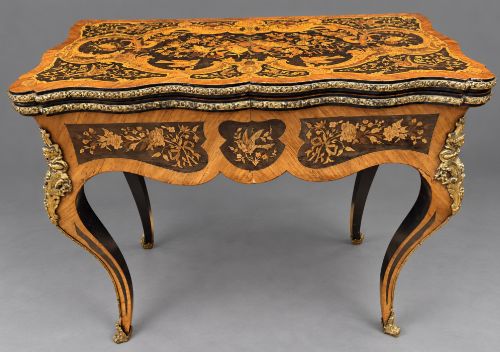
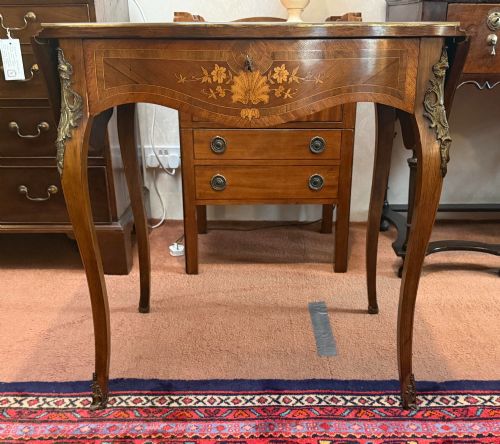
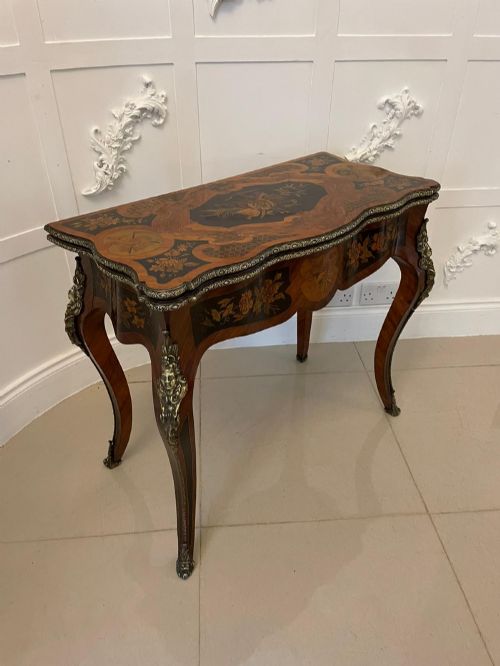
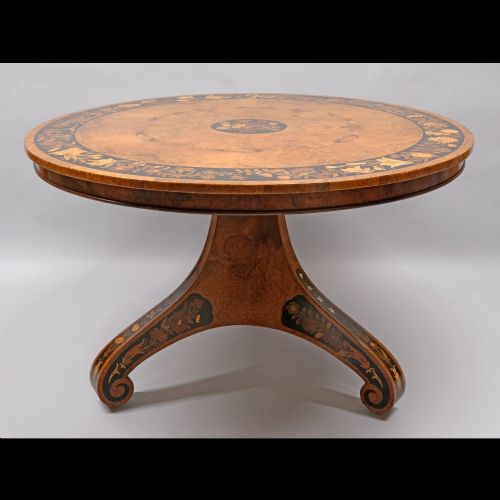


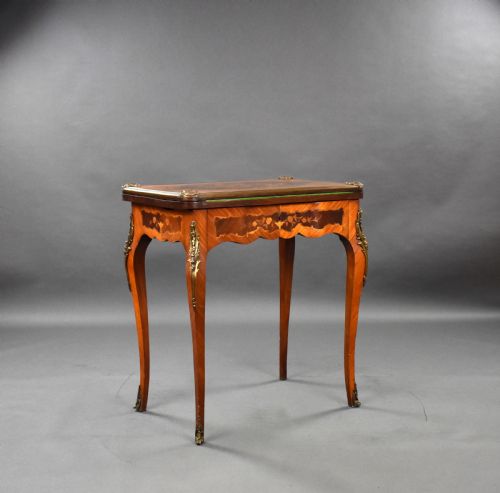


Floral Inlay Card Table
A floral inlay card table brings the rich floral marquetry and folding timber surfaces of the eighteenth and nineteenth centuries straight into a modern room.
Floral Inlay Card Table
A floral inlay card table functions as a folding games surface when entertaining and a decorative console or side table against the wall when closed. These pieces merge practical furniture with elaborate decorative marquetry across various historical periods.
Most examples present as card tables, games tables, or combined card and games tables, occasionally overlapping with centre tables or side tables. Buyers encounter forms ranging from serpentine shapes to dog-eared designs mounted in ormolu and brass.
How they were made
Cabinet makers utilised foundational timbers like walnut, burr walnut, and kingwood, laying down fruitwood and specialised wood inlay to build up intricate floral marquetry patterns. These botanical motifs sweep across the folding tops and aprons.
Many of the nineteenth-century examples incorporate cast ormolu and brass mounts to frame the timber panels and accentuate the curved contours of the legs and edges. Workshops combined precision joinery for the folding hinges with meticulous hand-cut veneering.
Floral Inlay Card Table Retail Price Guide 2026
Typical asking prices for floral inlay card table among the pieces listed under this phrase on Sellingantiques today, from the lower quarter to the upper quarter. They describe what is for sale here now, not the wider market.
Some eighteenth-century Dutch tables sport dog-eared corners, proving even historic furniture had room for a quirky fold.
What varies in quality
The standard of the marquetry cutting and the depth of the timber grain dictate the upper tier of these tables, separating standard workshop output from exhibition grade pieces. Richer selections display tight floral details rendered in contrasting fruitwood and exotic woods.
The integration of metal mounts, such as fine ormolu cast work, alongside the structural crispness of the folding mechanism, marks the distinction between ordinary domestic furniture and higher prestige commissions.
Holmes Baldock·Henry Dasson
The Floral Inlay Card Table Glossary
- Marquetry
- A decorative technique of applying thin slices of wood veneer to a structural background to form pictorial floral or geometric patterns. The craft requires precise hand-cutting to fit the contrasting timbers together seamlessly.
- Ormolu
- Gilt bronze mounts applied to furniture edges, corners, and legs to provide decorative contrast and protect vulnerable timber margins. This ornamentation appears frequently on French nineteenth-century pieces.
- Kingwood
- A dense, heavily figured exotic timber utilised by period cabinet makers for its rich dark tones and contrasting pale streaks. It forms a stable and visually striking base for floral veneer work.
- Burr walnut
- Timber taken from the abnormal growth knots of a walnut tree, yielding a swirling, highly decorative grain pattern. Furniture makers prized this material for prominent table tops.
- Dog-eared
- A descriptor for specific table corners shaped with distinctive angular projections. This detail appears on several Dutch marquetry examples from the eighteenth century.
Floral Inlay Card Table: Frequently Asked Questions
How do I open the table?
The top leaf typically swivels on a pivot hinge or folds outward on a swinging rear leg to reveal the baize-lined playing surface.
Take care to support the pivoting weight evenly to avoid straining the original hinges and timber frame.
Where should I place it?
These pieces sit comfortably against a hallway or living room wall as a side table when folded shut.
Pull the table out into the room and unfold the top whenever you need a display surface or an impromptu card table.
How do I date these tables?
Examine the timber species, the mounting hardware, and the style of the floral marquetry to determine the period of origin. Eighteenth-century Dutch pieces often feature different grain structures and leg forms compared to Victorian French revival models.
Look closely at the construction methods underneath and inside the frame for further clues regarding age.
What is Dutch marquetry?
Dutch marquetry involves elaborate floral and botanical inlay work produced in the Netherlands across the eighteenth and nineteenth centuries. The designs frequently cover the entire outer surfaces of the table with light and dark wood veneers.
These pieces often display characteristic serpentine profiles and distinctively shaped corners.