






Floral Glass Bowl
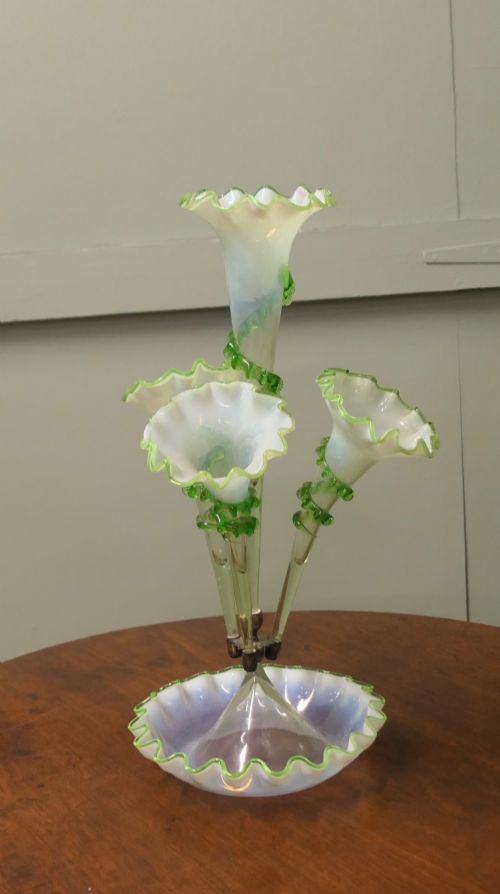
A floral glass bowl brings botanical form and colour into a room, capturing the organic curves of flora within glass.
Floral Glass Bowl
A floral glass bowl takes many decorative forms, appearing as pedestal bowls, shallow coupes, and decorative vessels spanning the Victorian era through the Art Nouveau and Art Deco periods. These pieces utilise plant-inspired motifs, with bowls shaped like flowers or decorated with enamelled and engraved botanical scenes.
The selections on this page draw from French, English, and Bohemian workshops, ranging from 19th-century moulded crystal to opalescent creations of the early 20th century. Buyers frequently encounter pieces associated with Art Nouveau styling, French cameo glass, and traditional Victorian cut crystal.
Beyond standard decorative table bowls, the category encompasses related functional objects such as dressing table jars, ceiling light shades, and tazzas integrated with pewter or metal mounts. Each piece demonstrates how makers translated natural petal and stem structures into utilitarian glassware.
Materials and construction
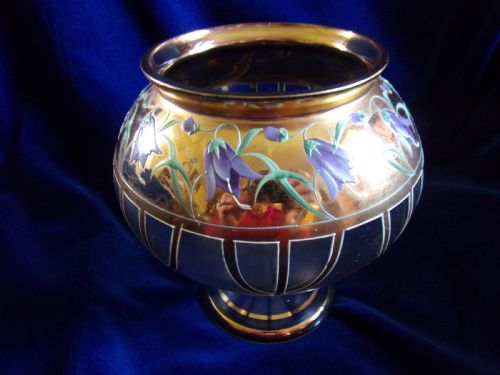
Makers utilised various glass types including clear crystal, opalescent glass, ruby glass, and cameo glass, often shaping them through moulding, cutting, or blowing. Surface decoration frequently involved applied gold leaf, paste gilding, and intricate enamel painting to accentuate the floral motifs.
Advanced techniques such as cameo glass carving involved acid-etching layered coloured glass to reveal contrasting botanical designs in relief. Metal elements, including sterling silver, pewter mounts, and brass components, were incorporated to support or frame the glass vessels.
Floral Glass Bowl Retail Price Guide 2026
Typical asking prices for floral glass bowl among the pieces listed under this phrase on Sellingantiques today, from the lower quarter to the upper quarter. They describe what is for sale here now, not the wider market.
Several bowls are named after specific flowers like Campanules, Dahlias, and Volubilis, letting a tabletop bloom permanently.
Distinguishing quality across periods
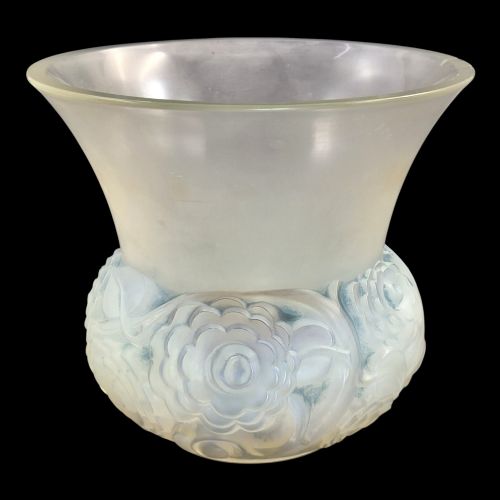
Quality in a floral glass bowl rests on the crispness of the moulding and the finesse of the hand-finishing, whether in the delicate engraving of Victorian crystal or the precise relief of French opalescent pieces. Superior examples display intentional depth and translucency, allowing light to interact naturally with the glass body.
The integration of secondary materials also dictates standard, as seen in fine gilt highlights, hand-painted enamel details, and high-grade metal mounts that complement rather than overpower the central glass form. Maker attribution and the complexity of cameo layering further elevate the standing of individual pieces.
Rene Lalique·Paul Nicolas·Stuart for Liberty·Orivit
The Floral Glass Bowl Glossary
- Opalescent Glass
- Glass that diffuses light with a milky, translucent quality, frequently used in 20th-century French bowls to highlight moulded floral relief. The milky edges shift in tone depending on the light angle.
- Cameo Glass
- Glass vessels created by fusing layers of different coloured glass and carving away the exterior layer to leave a raised design. This technique requires considerable skill to achieve consistent depth.
- Paste Gilding
- A method of applying gold decoration using a metallic powder mixed with a binder before firing or fixing to the glass surface. It adds a tactile, slightly raised golden accent to floral patterns.
- Plafonnier
- A ceiling-mounted bowl light shade, often decorated with painted or moulded glass designs. These fixtures sit close to the ceiling to diffuse illumination across a room.
Floral Glass Bowl: Frequently Asked Questions
How do I identify an Art Nouveau floral glass bowl?
Art Nouveau pieces typically feature asymmetric plant motifs, flowing stems, and organic curves influenced by natural forms. You will often notice stylised flowers such as lilies, orchids, or poppies integrated directly into the silhouette of the glass.
These items frequently date from the late 19th to the early 20th century and may incorporate cameo carving, iridescent surfaces, or pewter mounts styled to resemble roots and foliage.
What is opalescent glass?
Opalescent glass contains chemical agents that cause the glass to appear milky or semi-translucent, particularly along the raised edges of moulded designs. When light passes through the piece, it creates a subtle blue or amber glow.
This technique became especially popular among French glassmakers during the early decades of the 20th century for accentuating floral patterns.
Are all floral glass bowls French?
While French makers produced many notable opalescent and cameo glass pieces during the Art Nouveau and Art Deco periods, floral glass bowls originated across Europe. English makers, Bohemian workshops, and American factories all contributed distinct regional styles.
Victorian English glass often focused on cut, etched, and enamelled crystal, while Bohemian output frequently utilised ruby glass and heavy gilding.