

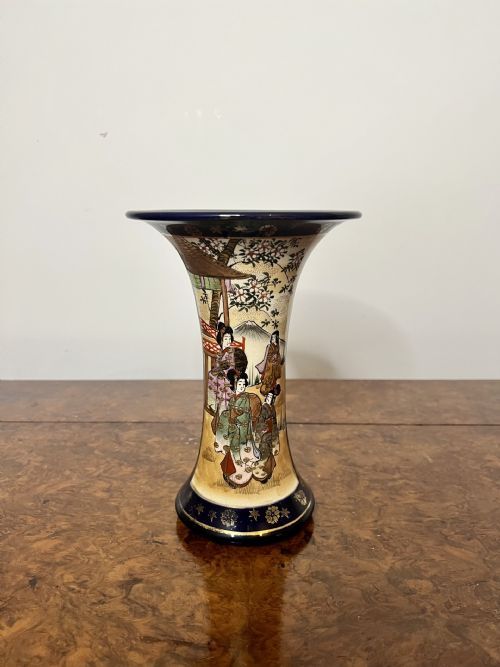


Flared Blue Vase
These flared blue vases bring striking colour and confident form into a room.
Flared Blue Vase
A flared blue vase delivers an outward-turning rim above a body coloured in cobalt, porcelain blue, or rich lapis tones. When you search for a flared blue vase, you encounter pieces spanning the nineteenth century through the nineteen-thirties, taking shapes from Japanese Imari forms to French Faience and British art pottery.
The examples most commonly met on this page combine traditional Asian ceramics with European glass and earthenware. You will find nineteenth-century Japanese pieces alongside Victorian cut glass and later studio pottery.
How they were made
Makers shaped these vessels from porcelain, earthenware, lead crystal, and glass, applying deep cobalt glazes or enamel finishes directly to the body. Some items incorporate hand-painted detailing alongside gold leaf accents, while others rely on the chemistry of crystalline glazes fired at high temperatures.
Techniques range from the wheel-thrown body of British art pottery to the heavy wheel-cutting of Victorian lead crystal, where clear glass is removed to reveal the dark blue layer beneath.
Flared Blue Vase Retail Price Guide 2026
Typical asking prices for flared blue vase among the pieces listed under this phrase on Sellingantiques today, from the lower quarter to the upper quarter. They describe what is for sale here now, not the wider market.
Some nineteenth-century makers achieved rich blue tones using powdered cobalt mined from distant mountains.
What varies in quality
Quality rests in the precision of the form and the depth of the blue colouration. A superior piece shows a balanced, confident flare at the neck and a glaze that pools evenly without muddiness.
In cut glass, the crispness of the facet work dictates the standard, whereas in ceramics the success of the high-temperature glaze determines the artistic merit.
Rene Lalique·Ruskin Pottery·Moorcroft
The Flared Blue Vase Glossary
- Cobalt glaze
- A metallic oxide colourant applied to ceramics to produce a deep, stable blue under high-temperature firing. It has been used for centuries across diverse pottery traditions.
- Imari
- A style of Japanese porcelain and ceramics featuring rich cobalt blue and iron red, often highlighted with gold. The palette remains instantly recognisable.
- Lead crystal
- Glass containing metal oxide that increases weight, brilliance, and refractive index. It allows for deep, sharp cutting.
- Crystalline glaze
- A ceramic finish where zinc or other minerals form visible crystals during the cooling stage of the kiln firing. Each fired pattern is entirely distinct.
Flared Blue Vase: Frequently Asked Questions
How do I date a flared blue vase?
Dating relies on material composition, maker marks, and stylistic markers such as Victorian cut glass methods or nineteen-thirties crystalline pottery finishes.
Examining the base and manufacturing technique often reveals the specific period of production.
Where were these blue vases made?
The pieces originate from diverse workshops in Britain, France, Japan, and China. Each region brought distinct ceramic traditions and glass-cutting methods to the form.
Asian export wares sit alongside European studio pottery and Victorian glass.
How should I display a flared vase?
Place them where natural light can strike the blue glass or glossy glaze, highlighting the shape of the flared rim. Single statement pieces work well on side tables or mantels.
Ensure stable placement to protect the wider upper rims from accidental knocks.
What is cut to clear glass?
This technique involves a layer of coloured glass cased over a clear glass body. Artisans cut away sections of the outer blue layer to reveal the clear crystal beneath.
The resulting contrast creates sharp, geometric patterns across the surface.