

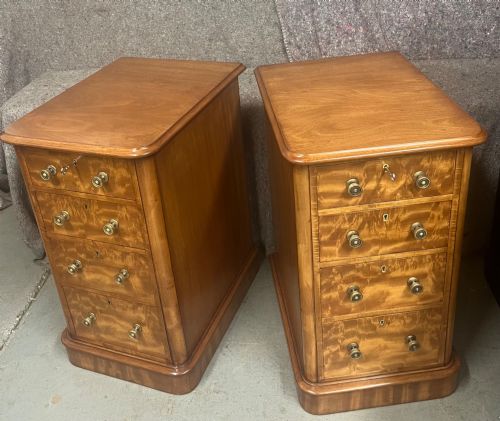
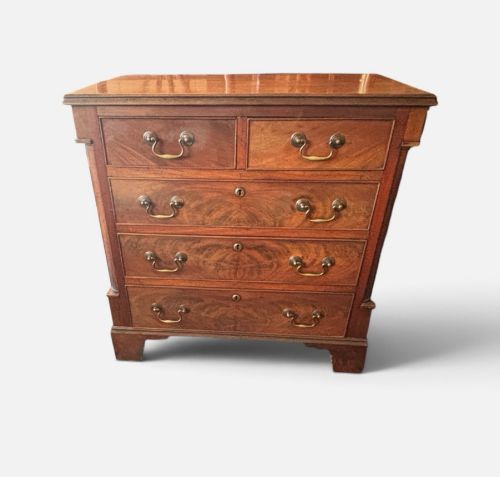
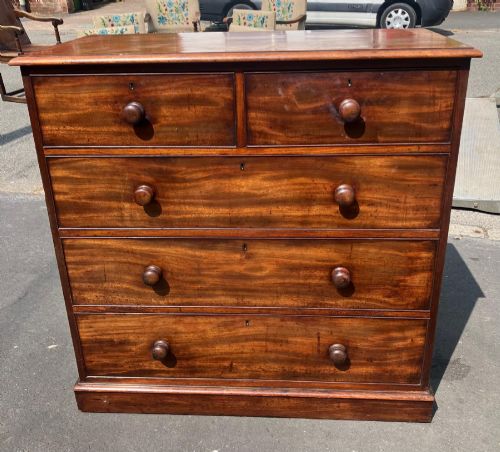
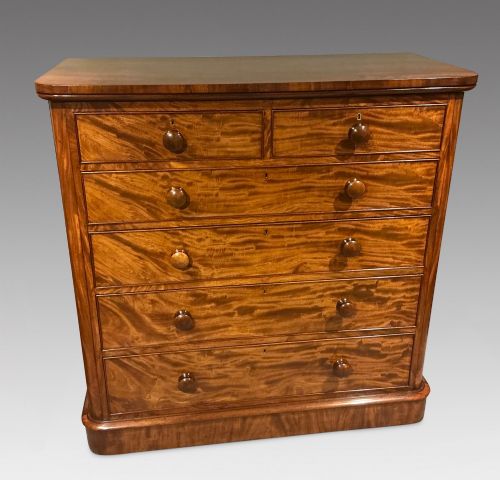
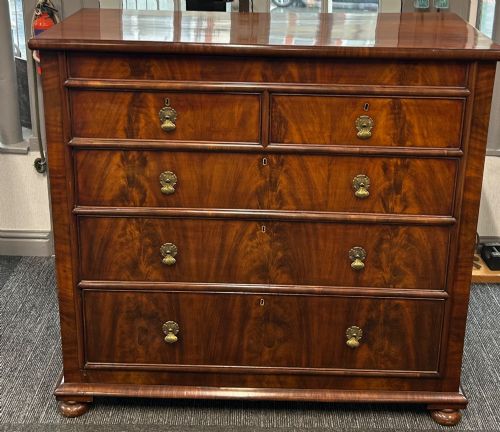


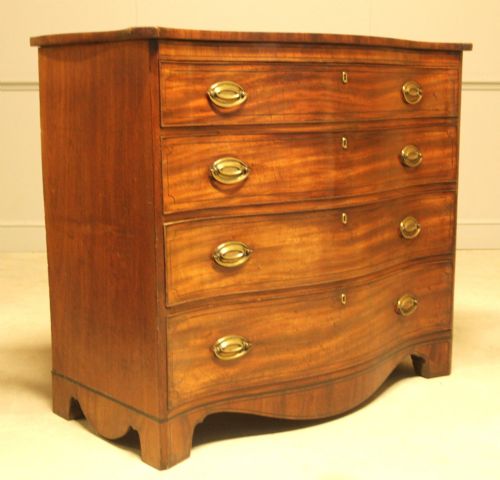
Flame Mahogany Drawer Unit
A flame mahogany drawer unit brings deep timber figuring and functional storage into a room, offering both character and utility.
Flame Mahogany Drawer Unit
A flame mahogany drawer unit comprises storage chests and cabinets surfaced with striking timber veneers, appearing across Georgian, Regency, and Victorian periods. Buyers search for these pieces to anchor a room with rich wood grain and traditional craftsmanship.
The versions most commonly met on this page are chests of drawers, spanning compact three-drawer cabinets up to large Victorian specimen chests and two-part Georgian designs. Solid wood construction often supports the decorative veneers across these forms.
Origins trace through the nineteenth century and earlier, taking in George III, Regency, and Edwardian stylistic influences. Makers utilised satinwood line inlay and brass details to complement the dominant mahogany timber.
How they were made
Cabinet makers applied flame mahogany veneer over secondary timbers such as pine and solid wood carcasses, creating distinctive swirling grain patterns across the drawer fronts. Satinwood line inlay provided sharp contrast and definition to the main timber surfaces.
Brass hardware, including handles and escutcheons, was fitted to functional drawers, while two-part designs allowed larger chests to be transported more easily. Secondary woods like pine were commonly employed for internal framing and drawer linings.
Flame Mahogany Drawer Unit Retail Price Guide 2026
Typical asking prices for flame mahogany drawer unit among the pieces listed under this phrase on Sellingantiques today, from the lower quarter to the upper quarter. They describe what is for sale here now, not the wider market.
Mother of pearl makes a subtle appearance among the materials, adding unexpected shimmer to the timber.
What varies in quality
The visual impact of the flame mahogany veneer sets superior examples apart, depending on the symmetry and depth of the timber figuring. Subtle decorative additions, such as satinwood line inlay, indicate a higher level of workshop execution.
Form and proportion influence distinction, ranging from standard chests to serpentine fronts and multi-drawer specimen cabinets. The integration of solid wood structures alongside well-figured veneers demonstrates greater care in construction.
The Flame Mahogany Drawer Unit Glossary
- Flame mahogany veneer
- A thin slice of mahogany timber cut from the fork of the tree where branches meet, producing a distinctive flame-like grain pattern. This decorative surface defines the appearance of the primary drawer fronts.
- Line inlay
- A narrow strip of contrasting wood, such as satinwood, inserted flush into the primary timber surface to create decorative borders. It was frequently utilised on Victorian and Georgian furniture.
- Serpentine front
- A furniture facade shaped with a convex centre flanked by concave curves. This contour requires precise woodworking skills.
- Specimen cabinet
- A specialised storage unit containing numerous small drawers designed for organising natural history or mineral collections. These pieces often feature fine proportions and robust construction.
Flame Mahogany Drawer Unit: Frequently Asked Questions
What periods do these drawer units span?
The pieces available on this page span the Georgian, Regency, and Victorian eras, extending into early twentieth-century examples from nineteen twenty. Earlier items often exhibit George III stylistic influences alongside traditional construction methods.
Craftsmanship evolved over these periods, moving from solid timber and two-part designs toward varied cabinet forms like specimen chests and serpentine drawer units.
How do two-part chests function?
Two-part chests are constructed in separate upper and lower sections that stack together to form a single tall storage unit. This method originated to make large furniture easier to transport during the Georgian and Regency periods.
The division is typically concealed where the sections meet, allowing the unit to maintain stability and structural integrity while retaining the capacity of a large chest.
What woods are used besides mahogany?
Secondary woods such as pine appear extensively in the internal framing, drawer linings, and structural carcasses of these pieces. These functional timbers provided stability behind the decorative exterior surfaces.
Satinwood was also utilised for decorative line inlay, providing a pale contrast against the darker tones of the primary flame mahogany veneer.
How should I care for flame mahogany?
Protect the veneer by keeping the timber away from direct sunlight and sudden temperature shifts that can cause the wood to dry out or crack. Regular dusting with a soft, dry cloth helps maintain the polished surface.
Avoid placing damp items directly onto the wood, and use suitable furniture wax sparingly to preserve the depth and lustre of the grain.