
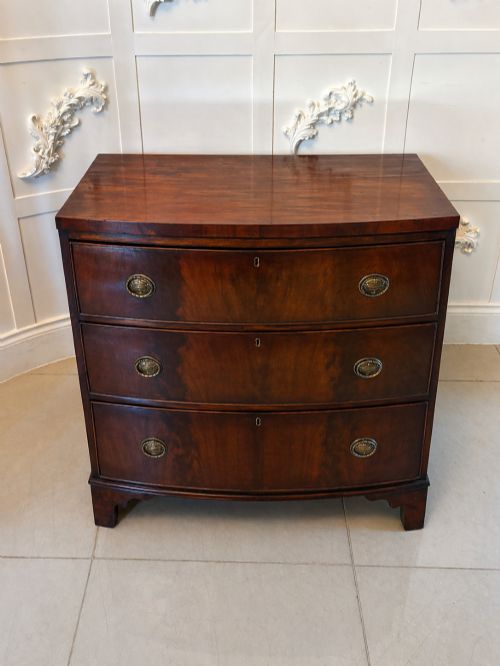
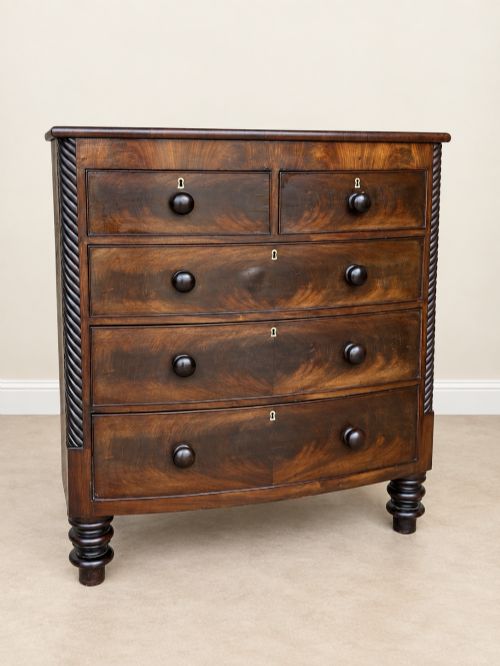

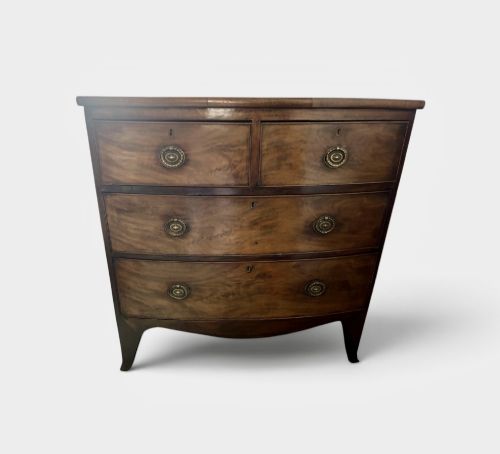
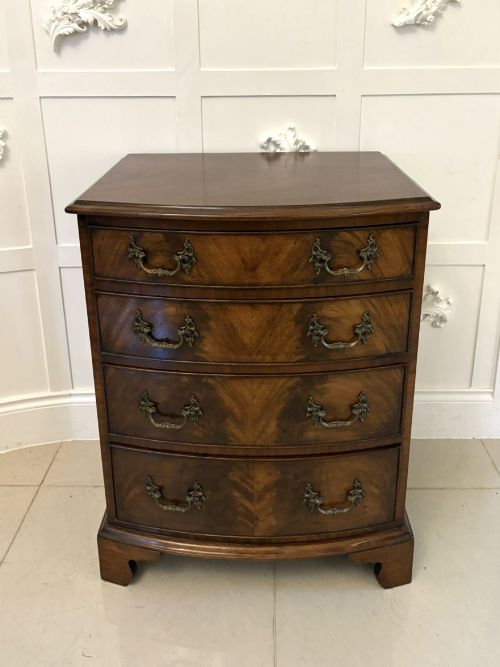
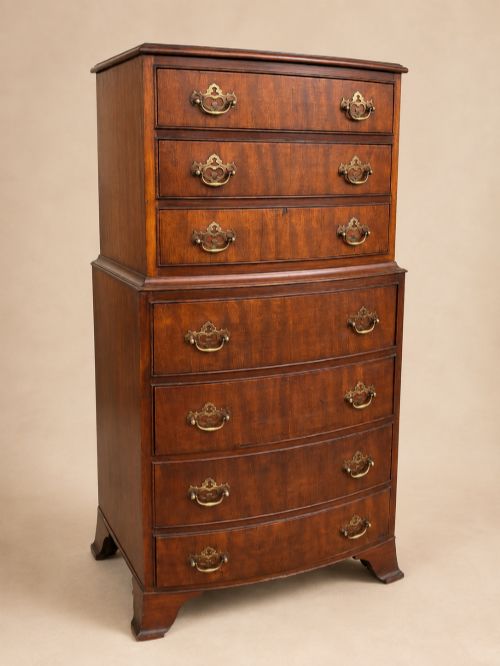
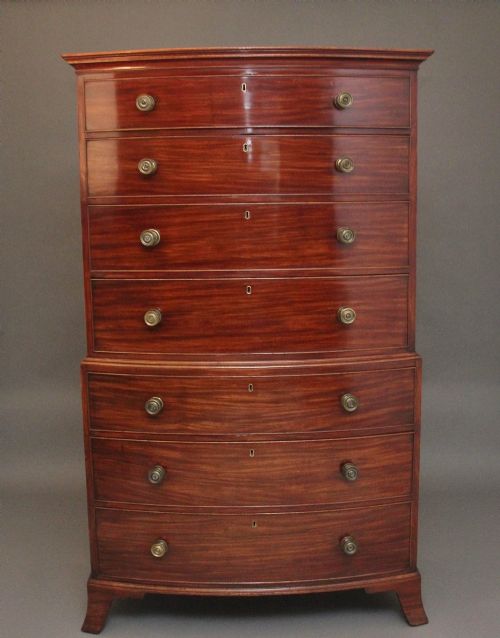
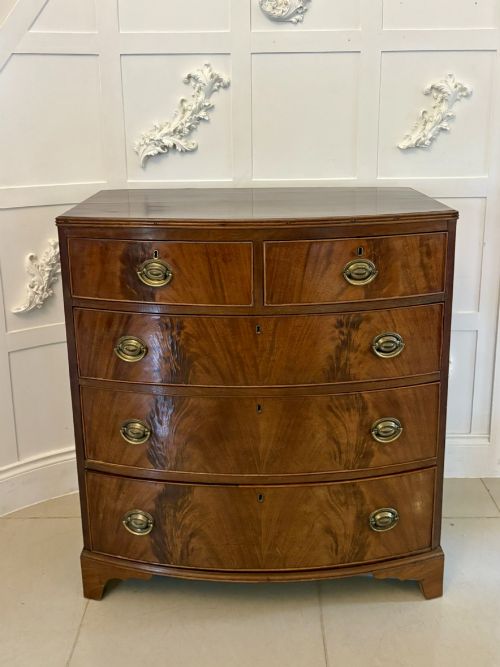
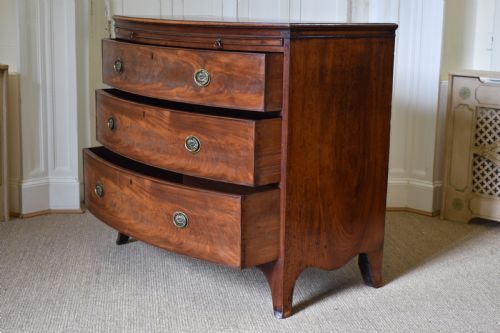
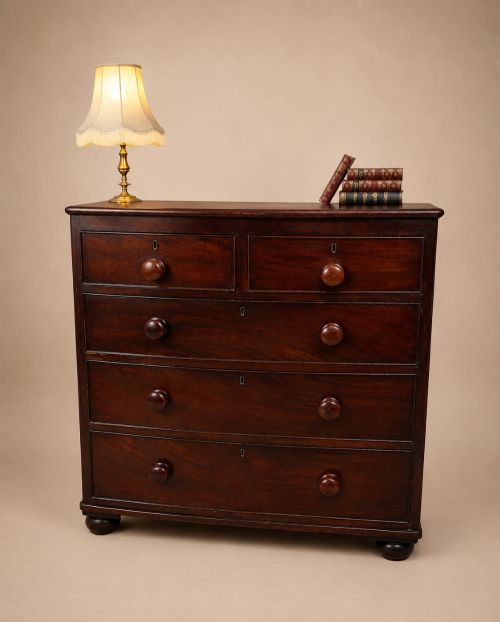
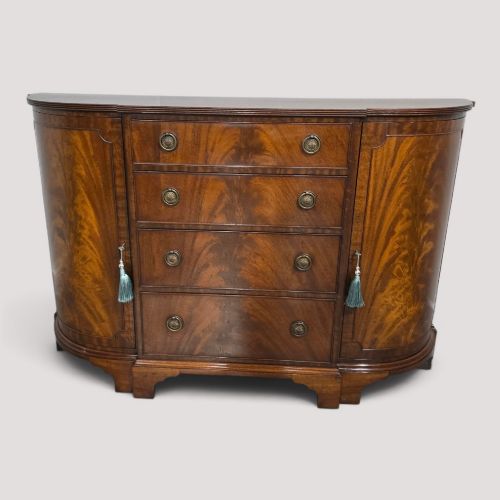
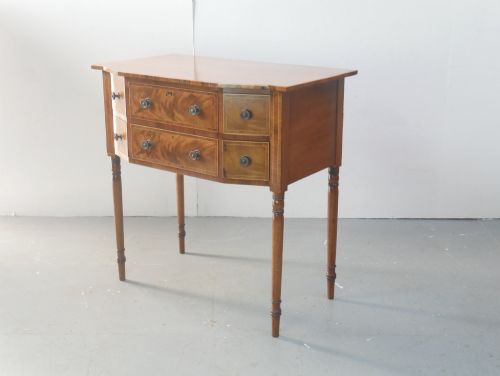
Flame Mahogany Bowfront Chest
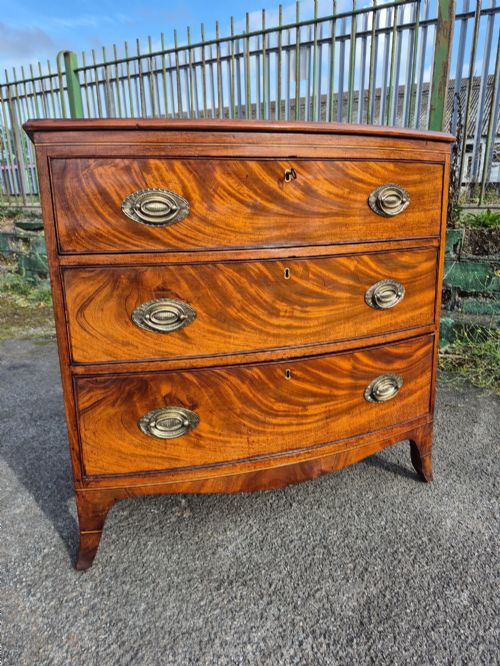
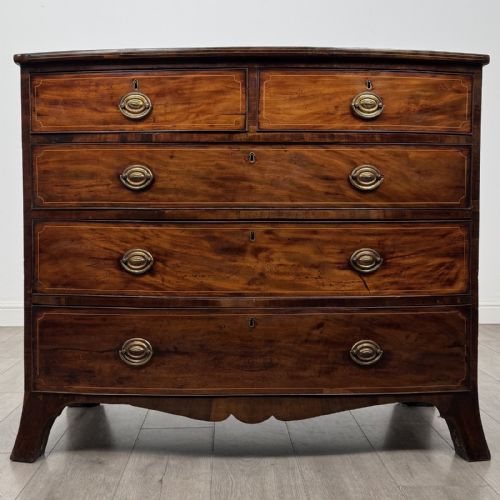
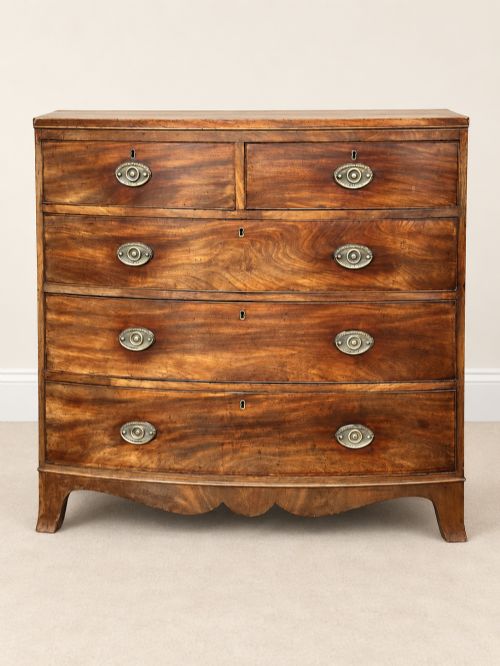
A flame mahogany bowfront chest brings curving warmth and pronounced grain into a room, offering practical storage through sweeping eighteenth and nineteenth-century forms.
Flame Mahogany Bowfront Chest
A flame mahogany bowfront chest presents a convex curved front that catches light across dramatic timber figuring. The pieces meeting this search phrase span Georgian, Regency, and Victorian periods, with many emerging from the early nineteenth century.
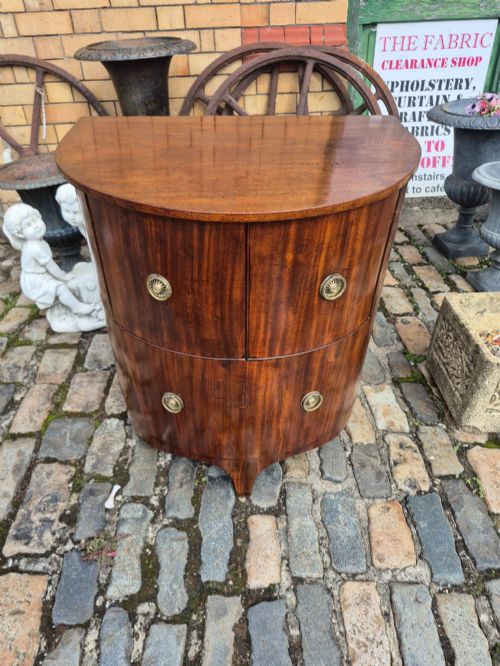
Most examples function primarily as chests of drawers, though variations include tallboys, linen presses, and smaller bedside or miniature formats. Cabinetmakers shaped these forms using solid secondary timbers lined with carefully selected decorative veneers.
Origin points encompass English and Scottish workshops, showing regional preferences in drawer arrangements and proportion. Buyers encounter everything from compact three-drawer pieces to imposing five-drawer formats with secret compartments.
Materials and construction techniques
Cabinetmakers constructed carcases using sturdy foundational woods like oak, applying thin flame mahogany veneer to the sweeping curved fronts. This veneer process demanded immense skill to align undulating grain patterns symmetrically across multiple drawer faces.
Secondary details frequently incorporate boxwood inlay, satinwood stringing, and brass handles fixed to graduated drawers. Drawer linings typically consist of softwoods or oak, assembled with hand-cut dovetail joints that ensure structural longevity.
Some chests hide secret drawers behind seemingly solid mouldings, built for owners who distrusted domestic locks.
Distinctions in craftsmanship and proportion
Quality rests in the intensity and book-matching of the flame veneer across the curved drawer fronts, alongside the crispness of boxwood inlay and stringing. Superior examples maintain harmonious proportions where the bow front sweeps gently without appearing bulbous.
Internal joinery defines the standard of the piece, visible in hand-dovetailed drawer construction and the presence of dust boards between tiers. Original brass hardware, smooth drawer action, and intact secret drawers elevate an example above standard utility pieces.
The Flame Mahogany Bowfront Chest Glossary
- Flame mahogany
- A veneer cut from the fork of the mahogany tree, producing a feather-like, undulating grain pattern. It creates the fiery visual movement prized on formal case furniture.
- Bowfront
- A convex curving front facade that projects outward in a smooth arc. This shape softens the room and requires specialised joinery to fit drawers accurately.
- Graduated drawers
- A sequence of drawers diminishing in depth from bottom to top. This arrangement creates visual balance on taller chests and tallboys.
- Linen press
- A tall storage piece combining upper sliding trays for textiles with lower drawers. Georgian and nineteenth-century makers frequently adopted the bowfront shape for these dual-purpose items.
- Stringing
- A thin inlay of contrasting wood, such as boxwood or satinwood, set flush into the mahogany surface. It outlines drawer perimeters and top edges for decorative definition.
Flame Mahogany Bowfront Chest: Frequently Asked Questions
How do I date a bowfront chest?
Dating relies on secondary woods, handle fixings, and overall proportion rather than a single feature. Georgian and Regency pieces typically show hand-cut dovetails and specific bracket or sweep feet.
Later Victorian and Edwardian interpretations often incorporate machine-sawn elements and different internal timber choices while maintaining the signature curved front.
What is a Scottish Regency chest?
Scottish Regency pieces display distinct regional proportions and robust carcase construction. They frequently feature deep top drawers and bold column details flanking the facade.
These chests often showcase exceptional flame mahogany veneer work selected by northern cabinetmakers working in the early nineteenth century.
Are secret drawers common?
Secret concealed compartments appear in selected Georgian and Regency chests, often hidden beneath the top moulding or behind a vanity section. They reflect the period demand for secure storage of personal documents and valuables.
Access usually requires releasing a hidden wooden catch or removing a specific small drawer to reveal the inner space.
How do I care for flame mahogany?
Maintenance requires stable indoor humidity away from direct sunlight to prevent veneer lifting and timber drying. Gentle dusting with a soft dry cloth preserves the polished surface.
Application of traditional wax polish occasionally nourishes the wood and maintains the natural depth of the grain without building heavy residue.