
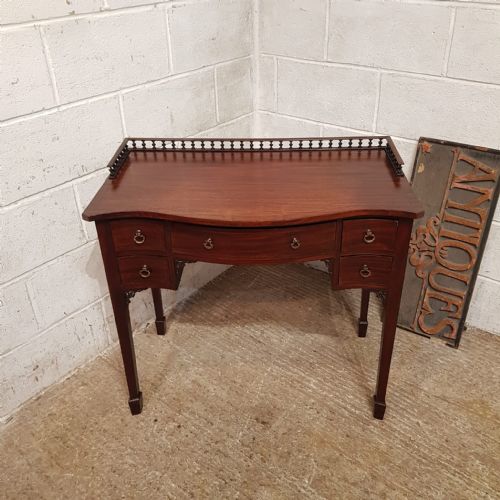


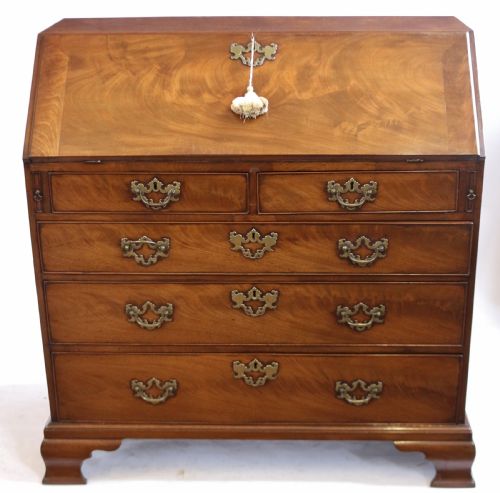
Five Drawer Desk
A five drawer desk offers practical proportions and classic workspace storage, combining generous surface area with deep departmental organisation.
Five Drawer Desk
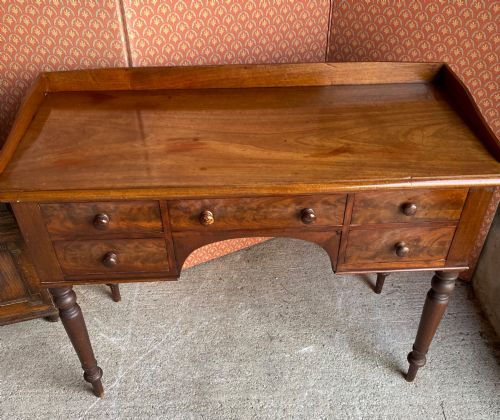
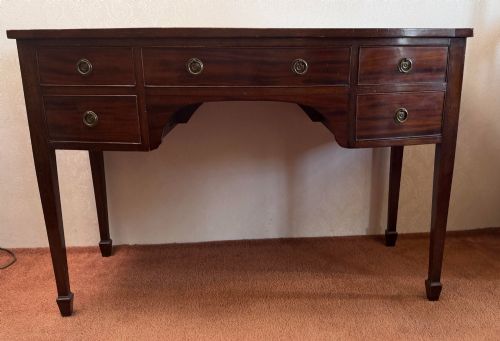
A five drawer desk provides functional writing and storage space, typically seen in Georgian, Regency, Victorian, and Edwardian iterations. These pieces function as writing tables, dressing tables, or compact kneehole desks suited to domestic studies and libraries.
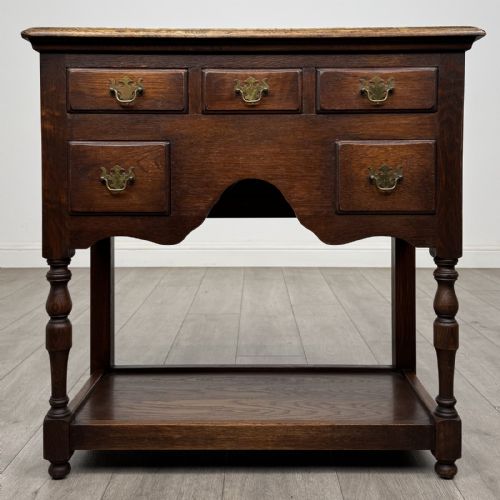
Makers adapted these desks across various stylistic revivals, including Chippendale and Georgian, whilst maintaining the familiar five-drawer configuration. Buyers encounter everything from serpentine fronts to bowfront designs created during the nineteenth and early twentieth centuries.
Materials and Construction
Cabinetmakers predominantly selected mahogany for these desks, often paired with secondary woods like oak for drawer linings. Selected pieces incorporate burr walnut or feature bleached oak finishes.
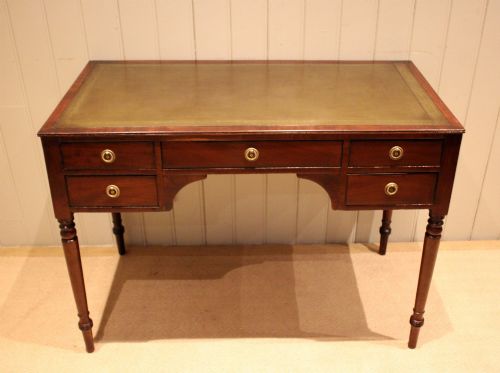
Hardware details such as brass handles and drawer pulls punctuate the timber facades, whilst inset leather writing surfaces appear on multiple variations. Construction methods rely on traditional joinery techniques appropriate to Georgian, Regency, and Victorian workshops.
Several desks manage to sneak in extra utility by doubling as dressing tables complete with five drawers.
Assessing Quality and Execution
Quality rests in the handling of timber figure, timber selection, and the crispness of carved details such as those found on George IV and Chippendale revival pieces. Finer examples display harmonious proportions across serpentine or bowfront configurations.
The integrity of secondary materials, including original brass hardware and fitted leather surfaces, elevates a piece. Superior execution is evident in the smooth operation of five individual drawers and precise dovetail joinery.
The Five Drawer Desk Glossary
- Kneehole
- A recessed space beneath the central drawers of a desk designed to accommodate the user's legs. This arrangement allows for flanking stacks of drawers.
- Bowfront
- A curved front facade that bulges outward in a convex sweep. This shaping appears on several nineteenth-century side tables and desks.
- Serpentine
- A furniture front characterised by a gentle undulating curve, featuring a central convex section flanked by concave sweeps. It requires skilled woodworking to execute.
- Dovetail
- A traditional interlocking woodworking joint used to construct sturdy drawer sides. This method ensures lasting durability for working furniture.
- Regency
- An English design period spanning the early nineteenth century, noted for classical restraint and influenced by Greco-Roman motifs. Pieces from this era often feature clean lines and mahogany construction.
Five Drawer Desk: Frequently Asked Questions
Where should a five drawer desk go?
These desks suit home studies, living rooms, or bedrooms, functioning as writing stations or dressing tables depending on the specific layout.
Their compact proportions allow them to sit comfortably against walls or float within larger rooms.
How do I identify a Georgian desk?
Georgian pieces generally display classical proportions, solid mahogany construction, and understated decorative carving rather than heavy revival motifs.
Look for traditional dovetailing and period-appropriate brass hardware.
Are these desks suitable for daily work?
Many buyers utilise these period pieces as functional workspaces for laptops and writing.
The five-drawer configuration provides sufficient storage to keep modern supplies neatly tucked away.
What is a kneehole desk?
A kneehole desk incorporates a central recess beneath the writing surface, allowing the user to sit directly in front of the piece.
Drawers are positioned to the left and right, or above the central opening.