
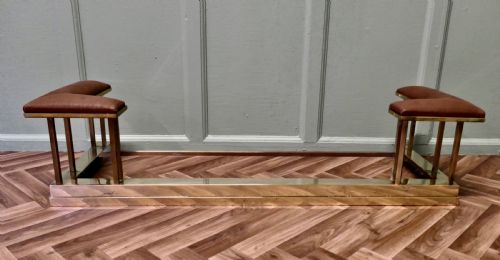
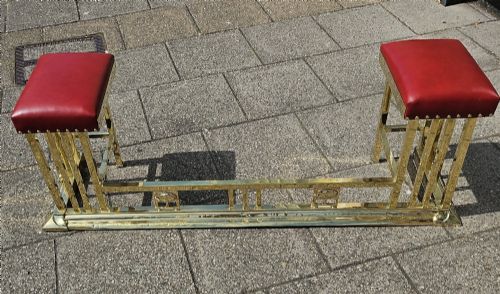
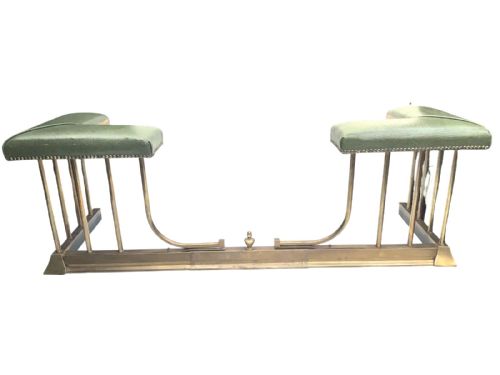


Fireplace Guard Seat
These fireplace guard seat designs, more commonly known as club fenders, offer a practical hearthside perch.
Fireplace Guard Seat
A fireplace guard seat combines a low hearth fender with upholstered corner seats, creating a social vantage point directly beside the fire. Most examples seen here date from the Victorian and Edwardian eras, stretching from the late nineteenth century into the early twentieth century.
The form typically comprises a rigid metal frame fitted with cushioned pads covered in leather or fabric. These pieces originate primarily from traditional English country house interiors, designed to maximise warmth and conversation in large reception rooms.
Materials and construction methods
Makers built the structural frames using heavy cast metals such as brass, steel, and iron, often combining polished brass with blackened or silvered iron components. Timber elements in oak and mahogany appear across various periods to construct the internal framing or low base supports.
Early club fenders let gentlemen sit so close to the coals their shins practically toasted.
Assessing quality and craftsmanship
Quality reveals itself in the substantial gauge of the metal and the precise execution of the corner joints and spindlework. Finer examples display heavier brass castings, sophisticated metal patination, and robust internal framing that supports weight securely.
The upholstery standard further distinguishes the piece, seen in the selection of high-grade leather and the traditional execution of buttoning and tacking. Proportion and scale relative to standard hearth dimensions dictate how harmoniously the piece integrates with an open fireplace.
The Fireplace Guard Seat Glossary
- Club fender
- A low metal frame surrounding a hearth, incorporating upholstered seats on either side. This form gained popularity in country houses during the Victorian period.
- Spindle
- A turned or shaped vertical metal or wooden rod forming part of the openwork gallery. These elements provide structural rigidity while allowing radiant heat to pass through.
- Patina
- The surface texture and coloration developed by metal and leather through age and handling. A rich patina indicates natural weathering rather than artificial distress.
- Extender
- A section designed to adjust the overall width of the fender to fit specific hearth openings. This mechanism allows rigid metal frames to accommodate varying fireplace dimensions.
Fireplace Guard Seat: Frequently Asked Questions
What is a fireplace guard seat?
A fireplace guard seat is a low metal fender equipped with cushioned pads, designed to sit directly around a hearth.
They provide a warm, elevated seating position close to the fire while containing stray embers.
How do I date these pieces?
Dating relies on identifying material choices, metal casting techniques, and upholstery styles typical of specific decades.
Victorian and Edwardian examples often display heavier brass work and traditional buttoned leather, whereas Art Deco pieces show streamlined iron frames.
Are these seats comfortable?
The seats are built low to the ground to keep sitters within the zone of maximum radiant heat.
They function best as a short-term perch during social gatherings around an active hearth.
Can these fenders be adjusted?
Some variants include extender sections built into the metal framework to alter the overall width.
This adjustability helps fit the structure accurately against specific hearth dimensions and chimney breasts.