
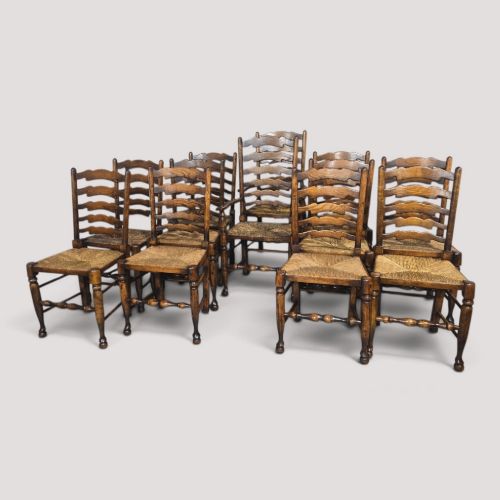


Farmhouse Ladder Back Chairs
Farmhouse ladder back chairs bring enduring rustic character to a dining room through honest timber construction and simple ladder rails.
Farmhouse Ladder Back Chairs
Farmhouse ladder back chairs are traditional seating options designed for everyday domestic use in kitchens and dining rooms. Buyers seeking these pieces will encounter sturdy dining chairs and armchairs defined by horizontal back rails that step up in profile.
The selections available here span from the nineteenth century into the early twentieth century, incorporating English Country, American Country, and Victorian Country styles. Sets ranging from four to ten chairs appear alongside individual armchairs and kitchen seating.
Materials and construction methods
Timbers such as oak, ash, and elm provide the rigid framework necessary for daily use in farmhouse environments. Carpenters selected hardwood for durability, often combining ash frames with elm seats to withstand heavy wear.
Traditional turning techniques shape the upright posts and spindles, while rush seating or solid wood planks form the bases. Joints rely on time-tested mortise and tenon construction to maintain stability across decades of use.
Listings feature pieces spanning the nineteenth century through the 1930s, constructed predominantly from oak, ash, elm, and rush.
Factors of quality and distinction
Quality rests in the uniformity of large sets and the integrity of the original timber framing. Sets that have remained together over generations command attention for their matching grain and consistent turning details.
The refinement of the ladder rails and the balance of the proportions separate standard utility seating from finer country examples. Substantial corner posts and well-preserved rush work indicate superior workshop standards.
The Farmhouse Ladder Back Chairs Glossary
- Ladder back
- A chair featuring a backrest composed of horizontal wooden slats or rails stacked vertically between two upright posts. This design dates back centuries and remains a staple of country furniture.
- Rush seat
- A seating surface woven from dried marsh grasses twisted into cords. It offers a resilient and pliable base that yields slightly to the sitter.
- Spindle back
- A variation of regional chair design incorporating vertical turned wooden rods rather than horizontal slats. These elements support the upper back while lightening the visual weight of the frame.
- Armchair
- A seating unit incorporating structural armrests integrated into the front posts. These pieces often served as carver chairs at the head of a dining table.
- Turned wood
- Timber shaped on a lathe to create cylindrical, tapered, or bulbous profiles along legs and stretchers. This process provides both structural reinforcement and decorative contouring.
Farmhouse Ladder Back Chairs: Frequently Asked Questions
How do I care for rush seats?
Keep rush seating away from excessive moisture and direct heat sources to prevent the natural fibres from becoming brittle. Regular gentle dusting preserves the material without damaging the twisted strands.
Apply occasional light humidity if the room air is exceptionally dry, though standard indoor conditions suit these materials well. Avoid heavy liquid cleaners entirely.
Are these chairs comfortable for daily dining?
Traditional country seating accommodates long meals quite naturally through contoured wooden seats or yielding rush foundations. The upright rake of the ladder rails supports the spine during extended sitting.
Adding loose seat pads offers extra cushioning if desired while keeping the original structure completely visible.
How do I distinguish oak from ash and elm?
Oak displays prominent medullary rays and an open grain pattern with distinct growth rings. Ash presents a paler tone with a straight, open grain that feels somewhat coarser to the touch.
Elm reveals a tightly interlocking grain structure with characteristic swirling patterns that resist splitting. Each timber contributes a distinct hue and texture to the finished piece.
Can I mix side chairs and armchairs?
Historic dining arrangements frequently paired a uniform run of side chairs with matching armchairs placed at the table ends. This approach provides functional hierarchy while maintaining a cohesive visual theme.
Matching the timber species and rail profile ensures the group appears unified even when the exact turning details vary slightly.