
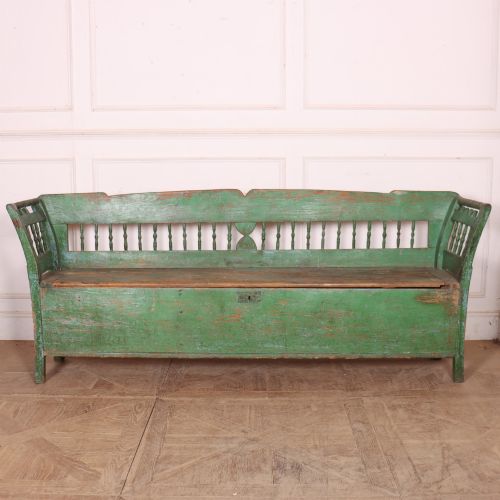
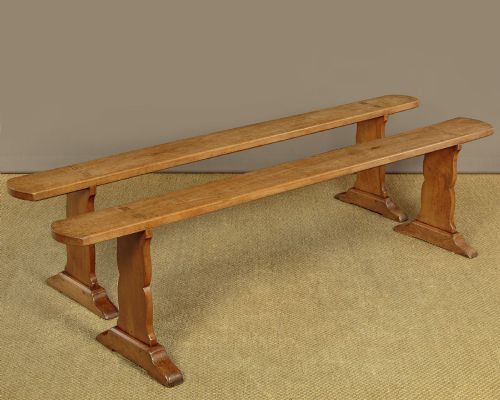
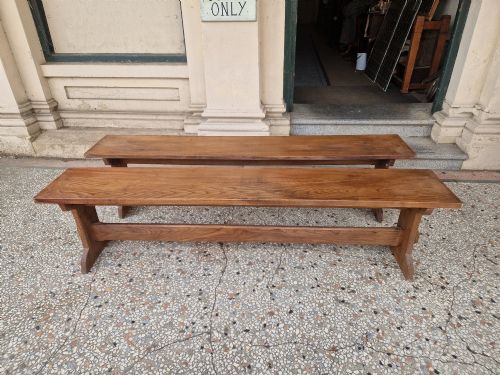


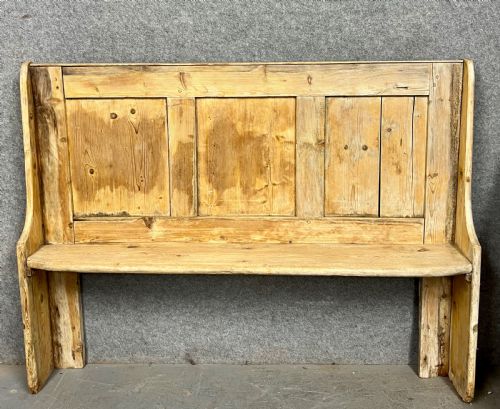


Farmhouse Hall Bench
A farmhouse hall bench brings honest utility and enduring character to an entryway, crafted from robust timbers designed for daily rural life.
Farmhouse Hall Bench
A farmhouse hall bench serves as practical seating in an entranceway or passage, taking the form of long benches, settle benches, or high-backed settles. These pieces originate from various regional traditions, spanning English, French, and Austrian country workshops.
The selections available here range from nineteenth-century pine and oak examples to pairs of elm or cherrywood benches. Buyers will also find high-backed settles and console forms that fit narrow hallways and country interiors.
Originating as utilitarian furniture for farmhouses and country houses, these benches prioritise robust construction and functional design over delicate ornamentation. Their presence anchors a hallway with authentic historical weight and simple utility.
How they were made
Makers constructed these pieces from solid domestic timbers such as pine, oak, elm, cherrywood, and sycamore, selecting woods based on local availability and structural strength. Boards were jointed and secured to withstand heavy daily use in busy rural households.
Surface treatments vary from scrubbed and bleached wood finishes to original paint, reflecting the historical upkeep and decorative choices of different European regions. Joinery techniques rely on sturdy pegged joints, trestle supports, and solid plank construction.
Some antique settles still carry the faint ghost of woodsmoke and centuries of muddy boots tucked safely beneath the seat.
What varies in quality
The distinction between ordinary and superior pieces lies in the choice of timber, the integrity of the original construction, and the preservation of surface patination. Timber selection ranges from common deal and pine to dense hardwoods like oak and cherry, which offer greater longevity and depth of grain.
Proportion and scale also dictate quality, particularly with matched pairs or exceptionally long benches intended for grand country halls. Original surface treatments, such as untouched scrubbed finishes or genuine period paint, elevate the character of a piece compared to later stripped or altered surfaces.
The Farmhouse Hall Bench Glossary
- Settle
- A wooden bench with a high back, solid arms, and often a box base, designed to keep out drafts in old farmhouses. These pieces provide enclosed seating for a hallway or fireside.
- Trestle
- A structural support consisting of a horizontal beam fixed to two splayed legs, commonly found beneath long benches and tables. This design allows maximum legroom along the length of the seat.
- Patina
- The surface sheen and textural depth developed on wood through decades of handling, polishing, and natural wear. A desirable patinated surface reveals the true age and history of the timber.
- Bleached
- A wood finishing treatment that lightens the natural tone of oak, chestnut, or sycamore, often achieved through historic scrubbing and exposure. This process creates a clean, pale surface popular in country interiors.
Farmhouse Hall Bench: Frequently Asked Questions
How do I choose the right size bench?
Measure the available length of your hallway carefully, leaving adequate clearance at either end for passage and doors. Consider the depth of the seat to ensure it does not obstruct narrow thoroughfares.
Longer benches and matched pairs suit expansive hallways, whilst shorter single benches or settles fit compact cottage entrances without overwhelming the space.
Are these benches suitable for daily hallway use?
These pieces were originally built for heavy domestic service in farmhouses, making them inherently robust for modern entryways. Solid timber construction handles the weight of daily seating and the placement of bags or footwear.
Protect the wood from excessive moisture by using pads under wet items, allowing the historic timber to endure routine household traffic.
How do I care for antique pine and oak?
Maintain the timber by dusting regularly with a dry cloth and occasionally applying natural beeswax to nourish dry boards. Avoid placing wooden benches directly against hot radiators to prevent warping or splitting.
Preserve scrubbed or painted surfaces by blotting spills immediately rather than using harsh chemical cleaners that strip the historic finish.
What is the difference between a bench and a settle?
A standard bench provides simple open seating on a flat or planked top supported by legs or trestles. It offers an unobstructed profile suited to narrow spaces.
A settle incorporates a solid high back and enclosed sides, historically designed to block cold drafts in entrance halls and farm kitchens while offering sheltered seating.